ChatGPT Prompts for Differentiation and IEP (15 Templates, 2026)
ChatGPT prompts for differentiation can turn a single lesson into three tiered versions, adapt a reading passage to multiple grade levels, or draft IEP-aligned accommodation language in minutes. The hard part of differentiation has never been the concept — it’s the time it takes to produce the extra materials. These 15 prompts cut that work down to something a teacher can actually do before 8am.
Why Differentiation Is Time-Consuming Without the Right Tools
Differentiating instruction well means producing multiple versions of the same lesson or task — tiered assignments, leveled reading texts, scaffolded instructions, and modified assessments — while keeping every version aligned to the same learning standard. CAST’s Universal Design for Learning (UDL) framework recommends building multiple means of representation, expression, and engagement into every lesson from the start. In practice, that means more materials, more planning time, and more cognitive load for the teacher — which is exactly where ChatGPT helps.
The prompts below are organized by task type. Use them after you’ve planned the lesson and know what the standard requires — ChatGPT adapts content, not goals. Pair the differentiated materials with targeted ChatGPT prompts for quizzes to build assessments that match each tier.
15 ChatGPT Prompts for Differentiation and IEP Accommodations
Tiered Text and Reading Level Adaptation
Prompt 1 — Three-level reading adaptation:
“Rewrite the following text at three reading levels for [GRADE LEVEL] students: (1) 2–3 grade levels below, with simplified vocabulary and shorter sentences; (2) on grade level; (3) 2 grade levels above, with domain vocabulary and complex sentence structure. Keep the same key information in all three versions. [PASTE ORIGINAL TEXT]”
Prompt 2 — Vocabulary scaffolding for a text:
“I’m assigning the following text to [GRADE LEVEL] students with varying reading levels. Create a tiered vocabulary support guide: (1) a glossary of the 8 most important content words with simple definitions and an example sentence; (2) a list of 5 academic vocabulary words with definitions; (3) no support needed for advanced readers, but suggest 3 extension vocabulary words they could learn from context. [PASTE TEXT]”
Prompt 3 — Leveled comprehension questions:
“Write three sets of comprehension questions for the following text, one set per level: (1) Tier 1 — 5 literal recall questions (who, what, when, where); (2) Tier 2 — 4 inferential questions requiring text evidence; (3) Tier 3 — 3 analysis questions that connect the text to a broader concept. Subject: [SUBJECT]. Grade level: [GRADE]. [PASTE TEXT]”
Modified Assignments and Scaffolding
Prompt 4 — Three-tier assignment version:
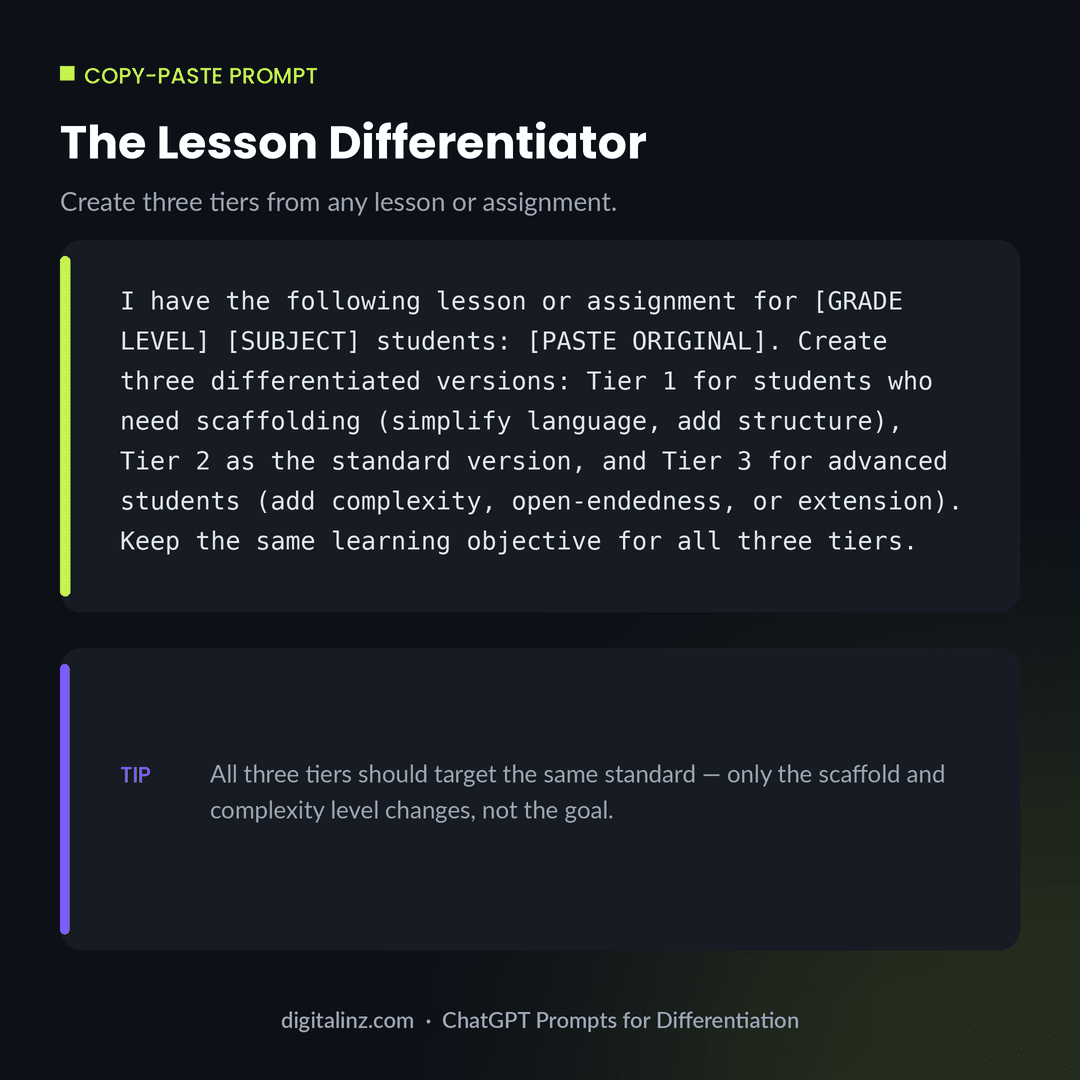
“I have the following assignment for [GRADE LEVEL] [SUBJECT] students: [PASTE ORIGINAL]. Create three differentiated versions: Tier 1 for students who need scaffolding (simplify language, add structure, reduce quantity), Tier 2 as the standard version, and Tier 3 for advanced students (add complexity or open-endedness). Keep the same learning objective for all three tiers.”
Prompt 5 — Graphic organizer scaffold:
“Create a graphic organizer to help [GRADE LEVEL] students who struggle with organization complete the following writing or project task: [DESCRIBE TASK]. The organizer should: break the task into 4–6 clearly labeled sections, include sentence starters for each section, and leave space for students to write. Subject: [SUBJECT].”
Prompt 6 — Step-by-step task breakdown:
“Break down the following task into explicit steps for students with executive function challenges or learning disabilities: [PASTE TASK DESCRIPTION]. Each step should be one action (not two), written in plain language, and numbered. Where helpful, include a checkpoint question students can ask themselves to confirm they completed the step correctly. Grade level: [GRADE].”
IEP and 504 Accommodation Language
Prompt 7 — Accommodation suggestion for a disability type:
“A student in my [GRADE LEVEL] [SUBJECT] class has [DISABILITY or CHALLENGE, e.g., dyslexia / ADHD / processing speed delays]. Suggest 8 specific classroom accommodations for this student based on best practice — focus on accommodations I can implement without additional resources. Include 3 that apply to instruction, 3 for assessments, and 2 for the physical or digital classroom environment.”
Prompt 8 — IEP goal draft for academic skills:
“Draft 3 annual IEP goal options for a [GRADE LEVEL] student who is currently performing at [BASELINE PERFORMANCE LEVEL] in [SKILL AREA, e.g., reading fluency / written expression / math computation]. Each goal should follow the SMART format (specific, measurable, achievable, relevant, time-bound) and include: the baseline, the target, the measurement method, and the timeline. Review period: [TIME FRAME].”
Prompt 9 — 504 accommodation plan draft:
“A student in [GRADE LEVEL] has been diagnosed with [CONDITION, e.g., ADHD / anxiety / vision impairment] and qualifies for a 504 plan. Draft a 504 accommodation plan that includes: a brief description of how the condition affects learning, 6–8 specific accommodations by category (instruction, assessment, environment, materials), and a monitoring schedule. Use formal plan language.”
Sensory and Attention Supports
Prompt 10 — Chunked instruction script:
“I’m teaching the following lesson to [GRADE LEVEL] students, some of whom have attention difficulties: [DESCRIBE LESSON TOPIC AND OBJECTIVES]. Chunk the lesson into segments no longer than 10 minutes each. For each segment, write: what I’ll teach, how I’ll check for understanding, and a brief movement or refocus break activity between segments. Total lesson time: [MINUTES].”
Prompt 11 — Sensory-friendly classroom instructions:
“Rewrite the following classroom instructions for a student who is easily overwhelmed by multi-step verbal directions: [PASTE INSTRUCTIONS]. Rewrite as: (1) no more than 3 steps per instruction set; (2) one instruction per line; (3) key action words bolded; (4) visual cue suggestions in brackets where helpful. Grade level: [GRADE].”
Prompt 12 — Flexible task menu:
“Create a choice menu for [GRADE LEVEL] [SUBJECT] students to demonstrate understanding of [TOPIC]. Include 9 options in a 3×3 tic-tac-toe format: one row for kinesthetic learners (create/build/perform), one for visual learners (draw/map/design), one for verbal learners (write/present/explain). All 9 options must target the same standard: [STANDARD].”
Advanced Learners and Enrichment
Prompt 13 — Extension task for early finishers:
“My [GRADE LEVEL] [SUBJECT] students who finish early need a challenging extension task related to [CURRENT UNIT TOPIC]. Create 3 extension options at an elevated complexity level: one that goes deeper into the content (analysis or evaluation level), one that applies the concept to a real-world scenario, and one creative or inquiry-based option. All three should be self-directed — students should be able to work without teacher assistance.”
Prompt 14 — Socratic seminar questions for gifted learners:
“Create a set of Socratic seminar discussion questions for advanced [GRADE LEVEL] [SUBJECT] students studying [TOPIC]. Include: 2 opening questions to start discussion, 4 core questions that require evidence and synthesis, and 2 closing questions that push students to evaluate implications or make connections across units. Avoid yes/no questions.”
Prompt 15 — Independent inquiry project brief:
“Design an independent inquiry project for a [GRADE LEVEL] advanced learner in [SUBJECT] who has already demonstrated mastery of [CURRENT UNIT]. The project should: (1) have an authentic driving question, (2) require original research or creation, (3) end with a shareable product or presentation, and (4) align to at least one standard beyond the current unit. Include a suggested timeline and assessment criteria.”
Copy-Paste: The Lesson Differentiator
This is the foundation prompt — use it as the starting point for any lesson or assignment that needs to reach multiple learner levels at once.
Before and After: One-Size vs. Differentiated Task
Same World War I unit, same standard — three completely different entry points for students at different levels.
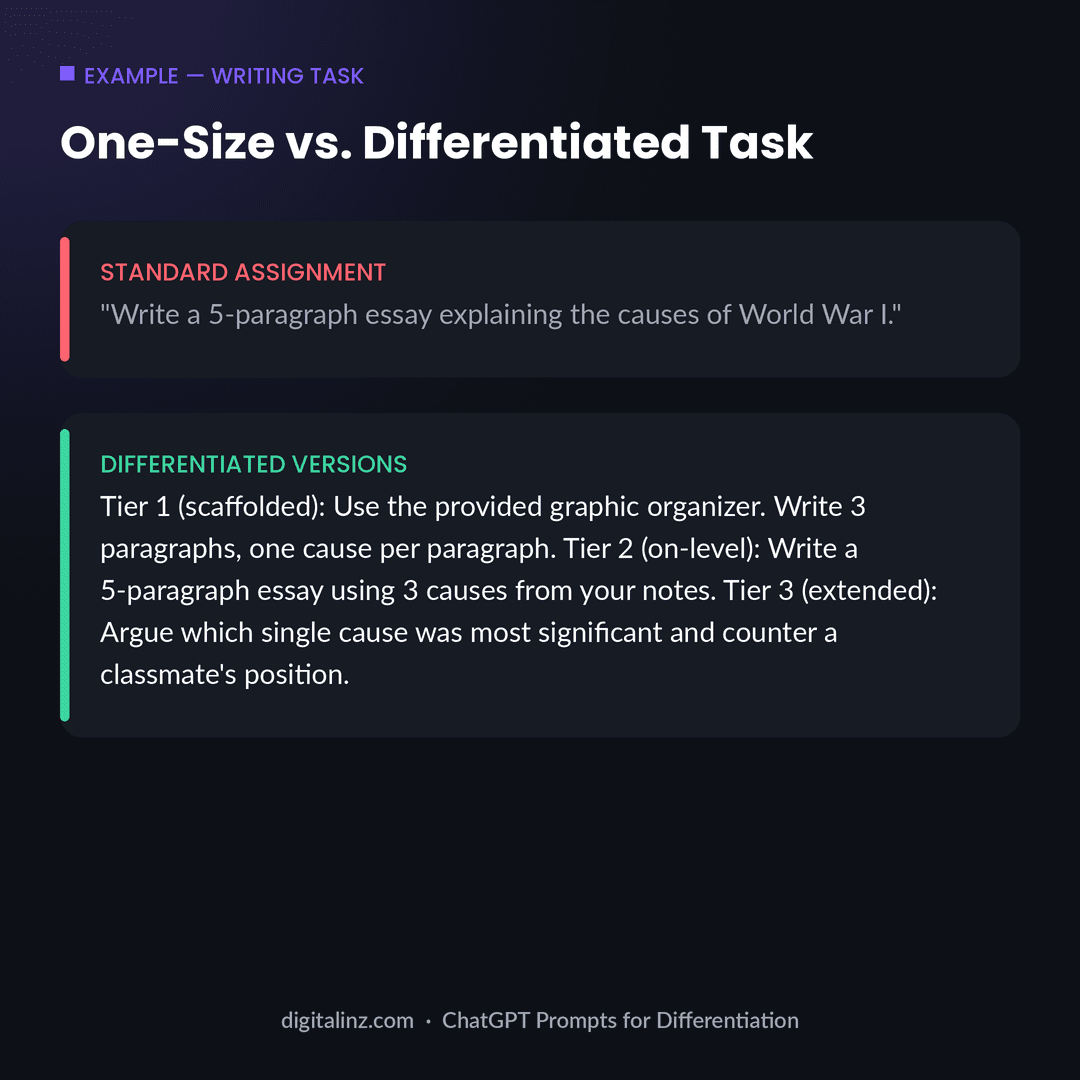
Every tier targets the same outcome — understanding the causes of WWI — but the scaffolding, the complexity, and the cognitive demand adjust for where the student actually is. Using ChatGPT prompts for differentiation this way doesn’t lower expectations for struggling students: it removes the access barriers so all students can reach the same goal.
FAQ: ChatGPT Prompts for Differentiation and IEP
Can ChatGPT write IEP goals?
ChatGPT can draft IEP goal options in SMART format based on the information you provide — baseline performance, skill area, grade level, and timeline. These are starting drafts for the IEP team to refine, not final documents. Always review with a special education specialist before including in an official IEP.
How do I use ChatGPT to differentiate a lesson without extra planning time?
Start from the lesson you’ve already planned. Paste the assignment, text, or activity into ChatGPT with the Lesson Differentiator prompt above and ask for three tiers. The goal stays the same; ChatGPT adjusts the scaffold and complexity. Most teachers spend 5–10 minutes reviewing and editing the output.
Can ChatGPT adapt reading materials for different reading levels?
Yes — Prompt 1 above handles this directly. Specify the original grade level and the target levels (e.g., 2 grades below, on level, 2 grades above) and ChatGPT will rewrite the same passage at each level. Check the adapted versions against a readability tool to confirm the levels before distributing.
Is it appropriate to use ChatGPT for 504 accommodation plans?
ChatGPT can draft accommodation language and structure a 504 plan, but 504 decisions are legal documents governed by Section 504 of the Rehabilitation Act. Use ChatGPT output as a starting draft only — a 504 team including parents, teachers, and a school administrator must review and approve any final plan.
Accommodations are only half the picture — the annual goals they support have their own structure. We break that down in can ChatGPT write IEP goals, including the four components every measurable goal needs. If you need the goals themselves, the IEP Goal Bank has 54 ready to adapt.
The Shortcut
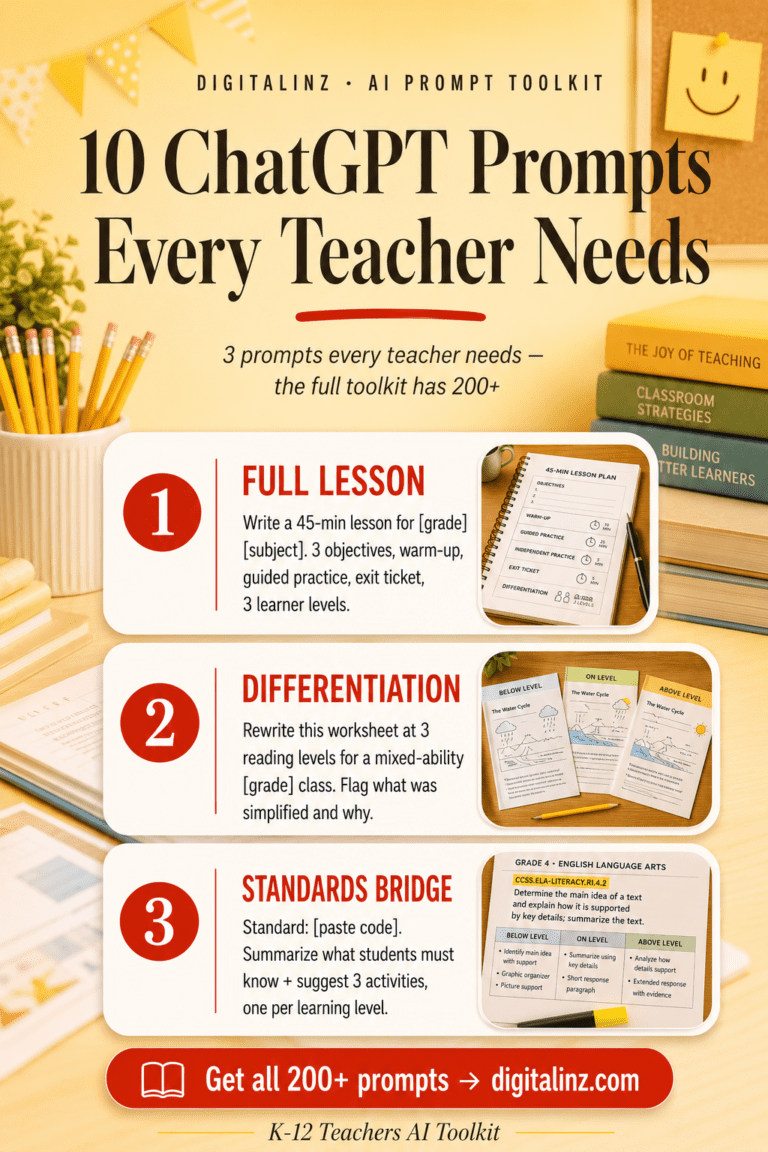
Creating tiered materials for every unit across every subject is ongoing work — not a one-time task. Our Teacher AI Toolkit includes 200+ ready-to-use prompts for differentiation, IEP planning, lesson planning, parent communication, and assessment — organized by task so you can build what you need in minutes, not hours.
Also available on Gumroad.