ChatGPT Prompts for Interview Questions (15 Templates, 2026)
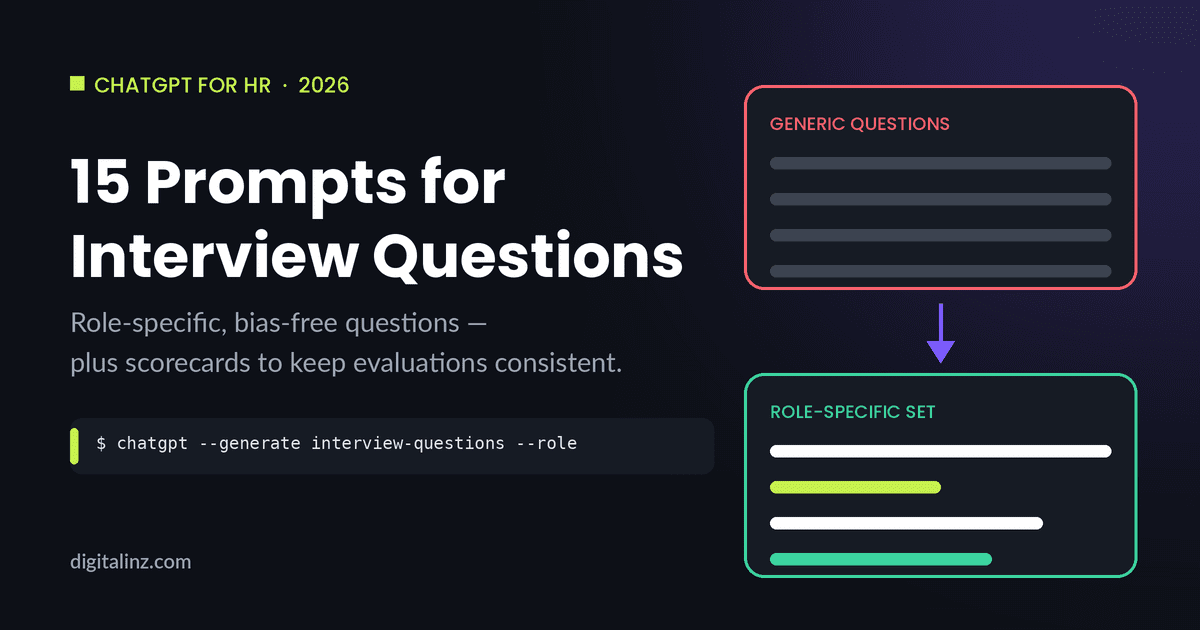
“Tell me about yourself” and “what’s your biggest weakness” get rehearsed answers from every candidate — they don’t tell you much about whether someone can actually do the job. ChatGPT prompts for interview questions work best when they’re built from the role itself: tied to specific competencies, grounded in real scenarios, and checked for bias before anyone sits down across the table. Here are 15 prompts that cover the full process, from question writing to post-interview debriefs.
Why “Tell Me About Yourself” Isn’t Enough
Generic questions produce generic signal. Every candidate has a polished answer for the classics, which means those questions mostly measure interview prep, not job fit. The fix is to build questions from the same source you used to write the role in the first place — if you used ChatGPT prompts for job descriptions to define the must-haves, those same requirements map directly onto interview questions that actually test for them.
The other half of the equation is making sure those questions are fair and legally sound. Some “harmless” small-talk questions — about family plans, age, where someone grew up, or gaps in a resume — can create real risk even when they’re well-intentioned. The EEOC’s overview of prohibited employment practices is a useful reference for what to avoid, and several of the prompts below are built around catching exactly this kind of issue before it reaches a candidate.
15 ChatGPT Prompts for Interview Questions
These are grouped into five categories: role-specific questions, behavioral and competency questions, bias-free and legal checks, structuring the interview process, and what happens after. As with any prompt list, use what’s relevant — you don’t need all 15 for a single role.
Role-Specific Questions
1. The Job-Description-to-Questions Prompt
“Based on this job description, generate 5 interview questions that directly test the top requirements: [PASTE JOB DESCRIPTION]. For each question, note which requirement it’s assessing.”
If you don’t have a job description yet, start with ChatGPT prompts for job descriptions — once you have a clear list of must-haves, this prompt turns them into interview questions directly.
2. The Technical Scenario Prompt
“Write a realistic technical scenario question for a [JOB TITLE] candidate at [SENIORITY] level, based on a problem someone in this role would actually face: [BRIEF CONTEXT — e.g., ‘a campaign that’s underperforming’ or ‘a production bug reported by a customer’]. Include what a strong answer would cover.”
3. The “What Would You Do” Situational Prompt
“Write 2 situational interview questions for a [JOB TITLE] role that present a realistic workplace scenario — not a hypothetical trolley problem — and ask how the candidate would handle it. Base the scenarios on: [COMMON CHALLENGES IN THIS ROLE].”
Behavioral & Competency
4. The STAR Behavioral Question Prompt
“Write 3 behavioral interview questions in STAR format (Situation, Task, Action, Result) for a [JOB TITLE] role, focused on these competencies: [COMPETENCY 1, COMPETENCY 2, COMPETENCY 3].”
5. The Strengths-and-Growth-Areas Prompt
“Write 2 interview questions that help surface a candidate’s self-awareness about their strengths and areas for growth, without asking the cliché ‘what’s your biggest weakness’ — tailor them to a [JOB TITLE] role.”
6. The Red-Flag Follow-Up Prompt
“A candidate for a [JOB TITLE] role just gave this answer: [PASTE THEIR ANSWER OR A SUMMARY]. Suggest 2 follow-up questions that would help clarify whether [SPECIFIC CONCERN — e.g., ‘they actually led the project or just participated’], without being confrontational.”
Bias-Free & Legally Sound
7. The Bias Audit for Interview Questions Prompt
“Review this list of interview questions for anything that could be biased, leading, or could disadvantage certain candidates — for example, questions that assume availability for late nights, or that ask about employment gaps in a way that penalizes caregivers: [PASTE QUESTION LIST]. Suggest neutral rewrites.”
8. The Protected-Characteristic Checker Prompt
“Check this list of interview questions for anything that touches on age, marital or family status, religion, national origin, disability, or other protected characteristics — even indirectly (for example, ‘do you have reliable childcare?’ or ‘where did you grow up?’). Flag and rewrite anything risky: [PASTE QUESTION LIST].”
9. The Consistent-Panel Question Set Prompt
“Create a shared set of 6 interview questions for a [JOB TITLE] role that every panel member will ask, so all candidates are evaluated on the same basis. Assign 2 questions per interviewer based on their role: [INTERVIEWER 1 ROLE, INTERVIEWER 2 ROLE, INTERVIEWER 3 ROLE].”
Structuring & Evaluating
10. The Interview Stage Question Bank Prompt
“Build a question bank for a [JOB TITLE] hiring process with 3 stages: phone screen (3 questions), hiring manager interview (4 questions), and panel or technical interview (5 questions). Avoid repeating questions across stages.”
11. The Scoring Rubric Prompt
“For these interview questions: [PASTE QUESTIONS], create a simple scoring rubric on a 1-4 scale describing what a 1, 2, 3, and 4 response looks like for each, so interviewers can score consistently.”
12. The Candidate Question Prep Prompt
“Write a short, friendly email to send candidates before their interview, listing the general topics we’ll cover — without giving away exact questions — so they can prepare: [LIST OF TOPICS/COMPETENCIES].”
After the Interview
13. The Reference Check Question Prompt
“Write 5 reference check questions for a [JOB TITLE] candidate that go beyond ‘would you rehire them’ — focused on [SPECIFIC THINGS TO VERIFY — e.g., ‘how they handle deadline pressure’ or ‘their communication style’].”
14. The Debrief Summary Prompt
“Summarize this set of interviewer notes into a structured debrief: overall recommendation, key strengths, key concerns, and any discrepancies between interviewers that should be discussed: [PASTE NOTES FROM ALL INTERVIEWERS].”
15. The Candidate Feedback Email Prompt
“Write a brief, kind rejection email for a candidate who interviewed for [JOB TITLE] but wasn’t selected. Keep it warm but generic — don’t reference specific interview answers. Tone: respectful, leaves the door open for future roles.”
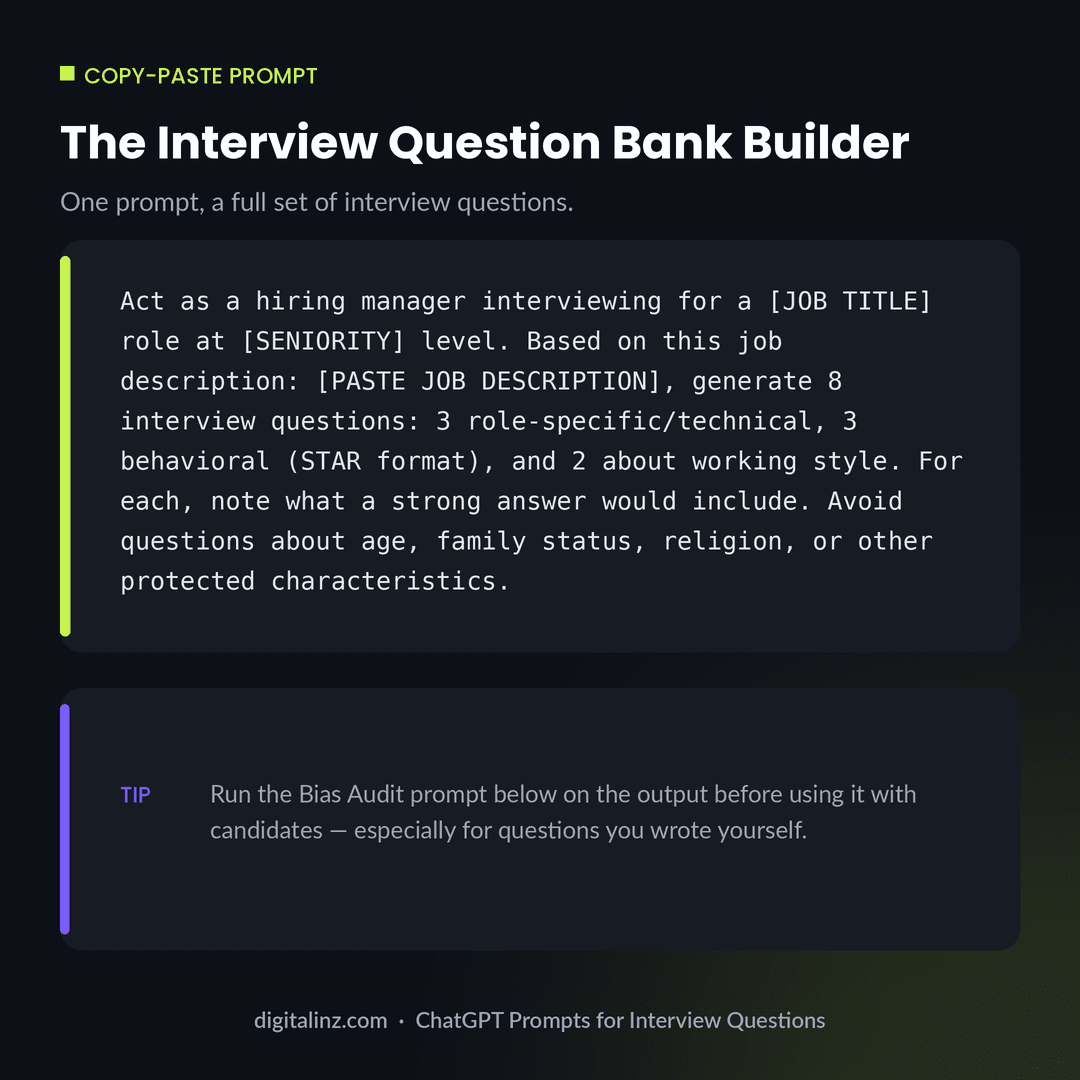
Copy-Paste: The Interview Question Bank Builder
This is the one prompt to start with for any new role — it turns a job description into a balanced first set of interview questions in one pass.
Before and After: Generic vs. Role-Specific Question
Here’s the same competency — handling pushback or pressure — asked two different ways.
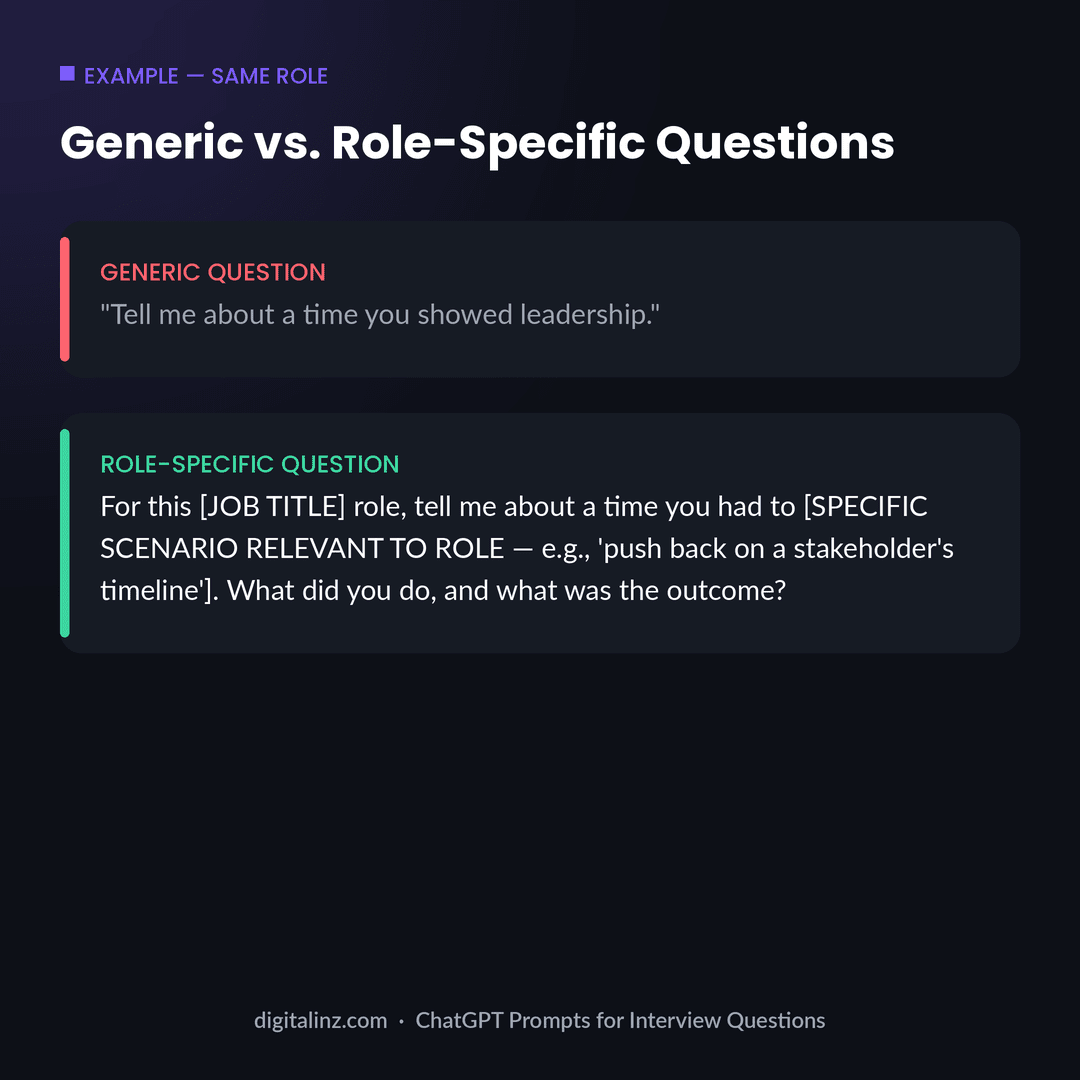
Both questions are technically “behavioral,” but only one of them is anchored to something the candidate will actually encounter in the role. That’s the difference ChatGPT prompts for interview questions are designed to make — not more questions, but questions that produce a real signal.
FAQ: ChatGPT Prompts for Interview Questions
What’s the best ChatGPT prompt for writing interview questions?
Start from the job description rather than a blank page. A prompt that asks ChatGPT to generate questions tied to the role’s specific requirements — and to label which requirement each question tests — produces more useful questions than a generic “give me 10 interview questions” request.
Can ChatGPT help make sure interview questions aren’t biased or illegal?
Yes. ChatGPT can review a list of questions and flag anything that touches on protected characteristics like age, family status, religion, or national origin — even indirectly — and suggest neutral rewrites. It’s a useful second check, though it doesn’t replace legal advice for your specific situation.
How do I get consistent interview questions across multiple interviewers?
Ask ChatGPT to build one shared question set for the role and assign specific questions to each panel member based on their perspective (manager, peer, technical reviewer). This keeps every candidate evaluated on the same basis and makes debriefs easier to compare.
Can ChatGPT help with the post-interview parts, like debriefs and rejection emails?
Yes — ChatGPT can summarize interviewer notes into a structured debrief, build a scoring rubric so feedback is comparable across interviewers, and draft warm, generic rejection emails for candidates who aren’t moving forward.
The Shortcut
Writing a full question bank, rubric, and debrief template for every open role takes time most hiring managers don’t have. Our HR AI Toolkit includes 200+ ready-to-use prompts for interview questions, scorecards, job descriptions, and candidate communications — already checked for bias and ready to adapt to any role.
Also available on Gumroad.