ChatGPT Prompts for Employee Onboarding (15 Free Templates, 2026)
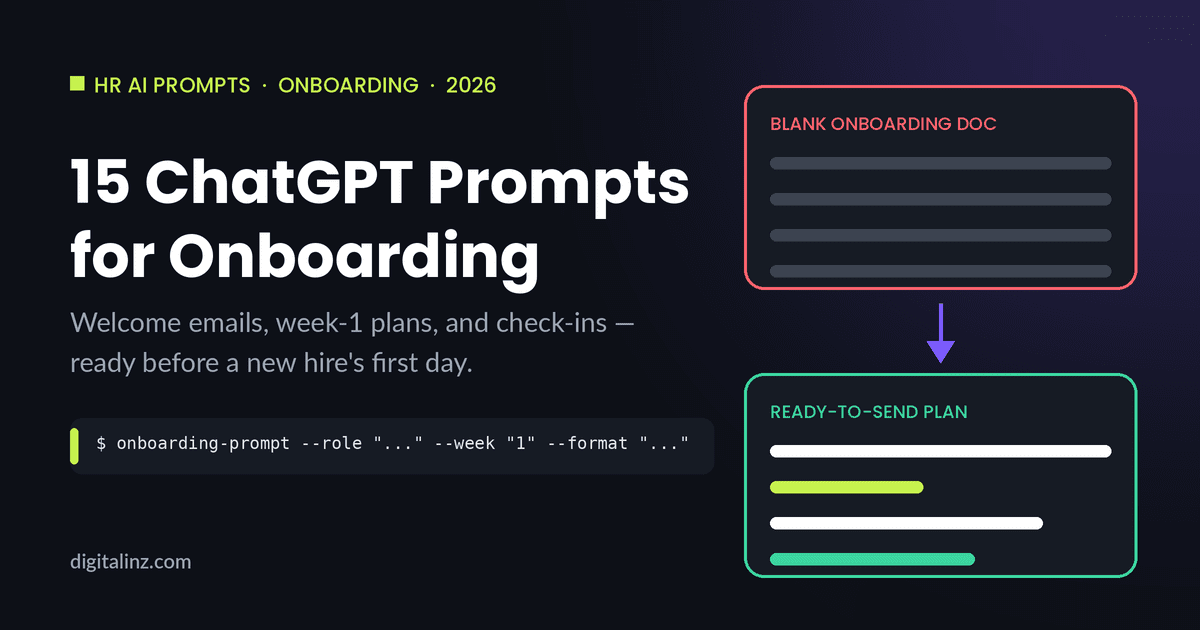
A new hire’s first week sets the tone for everything that follows — and most of it comes down to documents someone has to write from scratch: welcome emails, schedules, checklists, training plans, check-in agendas. ChatGPT prompts for employee onboarding can turn a blank doc into a ready-to-send week-1 plan, training checklist, or welcome message in minutes, without losing the personal, human tone that makes a new hire feel welcomed rather than processed.
Why Onboarding Is Worth Automating with ChatGPT
Onboarding is one of the highest-leverage, most time-consuming parts of HR — and it’s also one of the most repetitive. Every new hire needs a welcome email, an IT checklist, a first-week schedule, and a 30-day check-in, and those documents rarely change much from role to role. SHRM’s onboarding toolkit points to structured, well-paced onboarding as one of the biggest factors in new-hire retention and time-to-productivity — which makes it exactly the kind of work where a few good prompts pay off fast.
The 15 prompts below cover the full first 30 days: pre-boarding and day one, week-1 and 30-60-90 day plans, role-specific training, culture and mentorship, and check-ins. Copy any of them into ChatGPT, fill in the brackets, and adjust the tone to match your company.
15 ChatGPT Prompts for Employee Onboarding
Pre-Boarding & Day One
1. The Welcome Email Prompt
“Act as an HR coordinator. Write a warm welcome email for [new hire name], who is joining [company] as a [role] on [start date]. Include: what to expect on day one, where to go or log in, who to bring questions to, and one friendly personal touch. Keep it under 150 words, warm but professional.”
2. The IT & Equipment Checklist Prompt
“Act as an IT onboarding specialist. Create a checklist of accounts, hardware, and software a new [role] will need set up before their first day, for a [company size]-person [industry] company using [tools, e.g. Google Workspace, Slack, Salesforce]. Group items into ‘Before Day 1’ and ‘Day 1.'”
3. The First-Day Schedule Prompt
“Act as an onboarding coordinator. Build an hour-by-hour first-day schedule for a new [role] starting at [company], including: a welcome meeting, workspace and account setup, an introduction to their manager and team, a lunch plan, and one easy first task. Format as a simple time-based table.”
Week-1 & 30-60-90 Day Plans
4. The 30-60-90 Day Plan Prompt
“Act as a hiring manager. Create a 30-60-90 day plan for a new [role] on the [team] team. For each phase, list 2-3 goals, key activities, and how success will be measured. Tone: motivating and realistic, focused on ramping up rather than immediate output.”
5. The Team Introduction Schedule Prompt
“Act as an onboarding coordinator. Build a week-1 schedule of short 1:1 ‘meet the team’ calls for a new [role], pairing them with [list of roles or teams they’ll work with]. For each meeting, suggest one question the new hire could ask to learn about that person’s role.”
6. The Job Shadowing Plan Prompt
“Act as a team lead. Create a 3-day job shadowing plan for a new [role], pairing them with [existing team member or role] to observe [key tasks or processes]. For each day, list what they’ll observe, one thing they’ll try themselves, and a short reflection question.”
Role-Specific Training & SOPs
7. The Role-Specific Training Checklist Prompt
“Act as a training manager. Create a training checklist for a new [role] covering the tools, processes, and skills they need in their first 30 days at a [industry] company. Group items by ‘Must-know week 1,’ ‘Should-know by week 2,’ and ‘Nice-to-know by month 1.'”
8. The SOP Walkthrough Script Prompt
“Act as a process documentation specialist. Turn this SOP into a step-by-step walkthrough script a manager can read aloud while training a new hire: [paste SOP or process notes]. For each step, add a short note on why it matters, not just what to do.”
9. The Skills Gap Assessment Prompt
“Act as a learning and development specialist. Based on this new hire’s background [paste resume summary] and the requirements for a [role] at [company], create a short skills gap checklist highlighting 3-5 areas to prioritize in their first month, with one suggested resource or action per gap.”
Culture, Communication & Mentorship
10. The Manager Introduction Message Prompt
“Act as a new manager. Write a short introduction message to send a new direct report before their first day. Include: your management style in 1-2 sentences, what they can expect from your 1:1s, and one thing you’re excited about them joining for. Tone: warm and human, not corporate.”
11. The Company Culture Overview Prompt
“Act as an HR specialist. Write a one-page ‘how we work here’ overview for new hires at [company], covering: communication norms (e.g. Slack vs. email), meeting culture, how decisions get made, and 1-2 things that make the culture distinct. Keep it conversational, not policy-document tone.”
12. The Buddy/Mentor Assignment Brief Prompt
“Act as an onboarding coordinator. Write a short brief for an employee assigned as an onboarding buddy to a new [role], explaining: their role for the first 30 days, 3-4 suggested check-in topics, and what they don’t need to worry about covering, since that’s the manager’s job.”
Check-Ins & Feedback
13. The 30-Day Check-In Prompt
“Act as a manager preparing for a 30-day check-in with a new [role]. Create a list of 6-8 open-ended questions covering: how onboarding felt, what’s been confusing, early wins, and what support they need going forward. Group the questions by topic.”
14. The New Hire Feedback Survey Prompt
“Act as an HR specialist. Create a short anonymous onboarding feedback survey (8-10 questions, a mix of rating scales and open text) for new hires to complete after their first 30 days, covering: pre-boarding communication, first-week experience, training quality, and manager support.”
15. The Onboarding Completion Summary Prompt
“Act as an HR coordinator. Write a short internal summary of [new hire name]’s completed 30-day onboarding, covering: what was completed, any open action items, and a recommendation for their 60-day focus. Tone: factual and useful for the next manager or HR check-in.”
Copy-Paste: The Week-1 Onboarding Plan Prompt
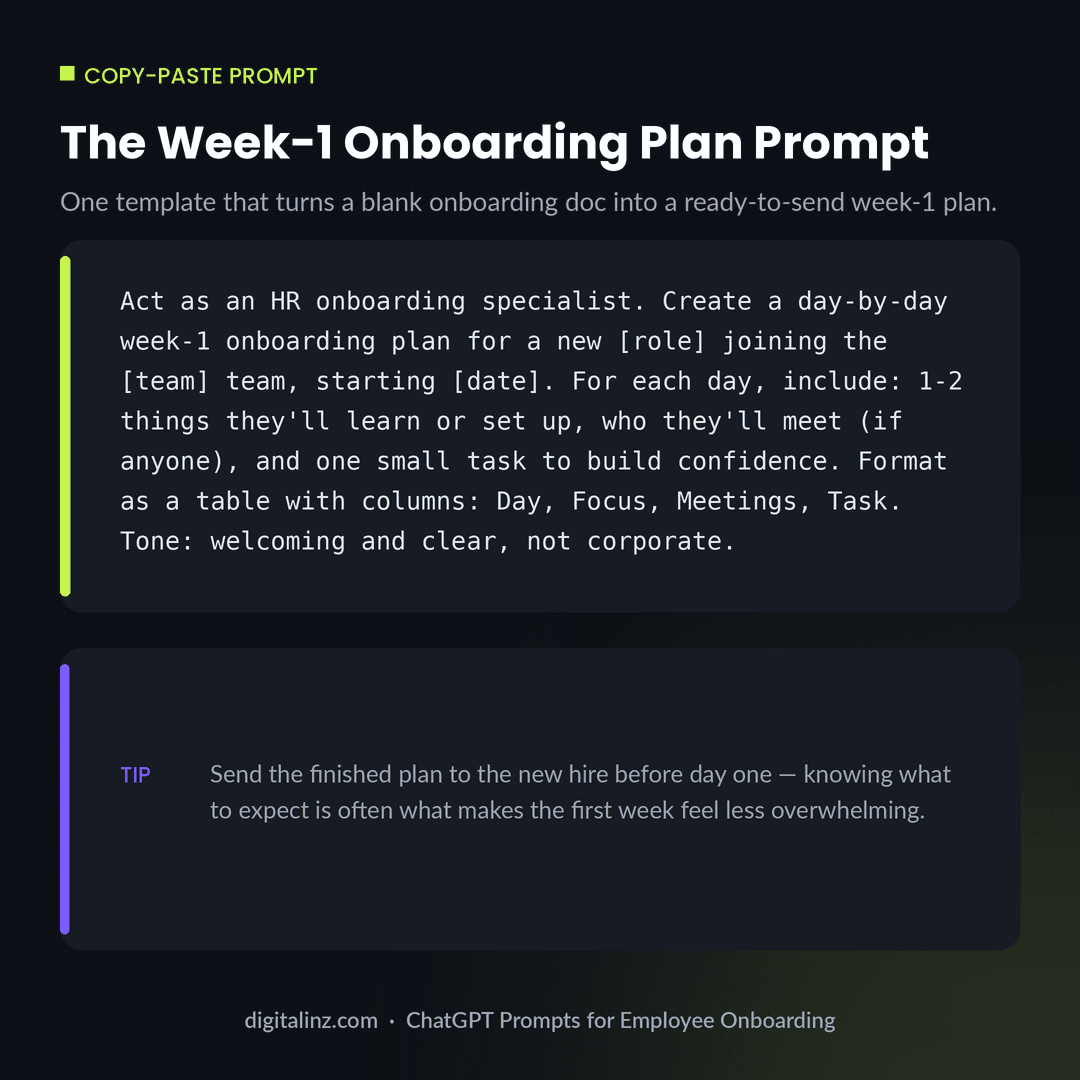
If you only save one prompt from this list, save this one. It’s the closest thing to a master template for new-hire onboarding:
Act as an HR onboarding specialist. Create a day-by-day
week-1 onboarding plan for a new [role] joining the [team]
team, starting [date]. For each day, include: 1-2 things
they'll learn or set up, who they'll meet (if anyone), and
one small task to build confidence. Format as a table with
columns: Day, Focus, Meetings, Task. Tone: welcoming and
clear, not corporate.
Send the finished plan to the new hire before day one. Knowing what to expect is often what makes the first week feel less overwhelming — for them and for whoever’s managing it.
Blank vs. Structured: See the Difference
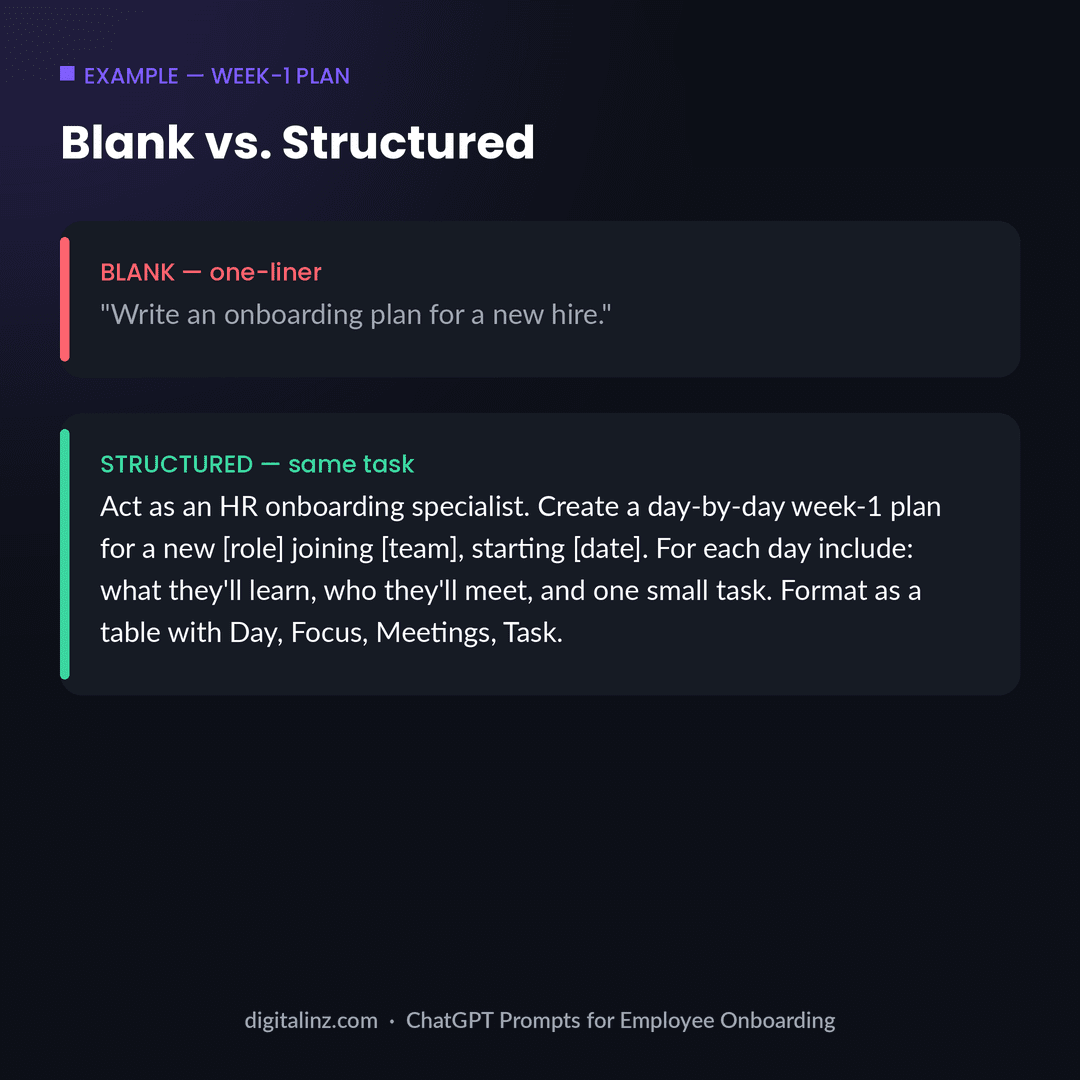
Both prompts above ask ChatGPT for the same thing — a week-1 onboarding plan — but only one gives it enough to work with. For a closer look at the prompt that produces the structured version, our best ChatGPT prompts for HR professionals roundup covers 15 more templates across the full HR workflow, not just onboarding.
FAQ
What are the best ChatGPT prompts for employee onboarding?
The most useful ones cover the documents HR writes repeatedly for every new hire: welcome emails, IT checklists, first-day schedules, 30-60-90 day plans, training checklists, and 30-day check-in questions. The 15 prompts above cover all of these, organized by the stage of onboarding they support.
Can ChatGPT write a full onboarding plan for a new hire?
Yes — with the right prompt. The week-1 onboarding plan prompt above asks for a day-by-day table covering what the new hire will learn, who they’ll meet, and one small task per day, which is enough structure for ChatGPT to produce a plan you can send with light editing.
How do I keep onboarding emails from sounding too generic?
Give ChatGPT specifics: the new hire’s name and role, the actual tools and people involved, and a note on tone (warm, casual, formal). The welcome email and manager introduction prompts above are built to take these details, which is usually the difference between a generic-sounding email and one that feels like it was written by a person.
Is it safe to use ChatGPT for HR onboarding documents?
For general templates like schedules, checklists, and welcome emails, yes — these don’t involve sensitive personal data. Avoid pasting confidential information like salaries, performance history, or personal identifiers into prompts, and review anything generated before it goes to a new hire.
The Shortcut
Writing onboarding prompts one at a time works, but if you’re handling onboarding regularly, our HR AI Toolkit includes 200+ ready-to-use ChatGPT prompts for HR — onboarding, recruiting, performance reviews, and more — already structured so you’re not rebuilding them from scratch. See how it compares to other options in our honest breakdown of the best ChatGPT prompt packs for HR, or read whether paid ChatGPT prompt packs are worth it first if you’re still deciding. Also available on Gumroad.