How to Write Good ChatGPT Prompts: The 4-Part Formula (2026)
Most “write me a [thing]” prompts get you a generic, forgettable first draft — not because ChatGPT can’t do better, but because the prompt is missing information it needs. Learning how to write good ChatGPT prompts comes down to one repeatable structure: role, context, format, and constraints. Build a prompt around these four parts and the output gets specific, usable, and close to a final draft — for almost any task, in any field.
Why Most ChatGPT Prompts Fall Flat
A one-line prompt like “write a product description” gives ChatGPT no information about who it’s writing as, who it’s writing for, what the result should look like, or what to avoid — so it fills in the gaps with the most generic, average version of that task it can produce. That’s the same root cause behind why ChatGPT gives generic answers: not a limitation of the model, but a lack of direction in the prompt.
OpenAI’s own prompt engineering guide makes a similar point — specificity and structure are what separate a useful response from a generic one. The 4-part formula below is a simple way to bring both to every prompt you write.
The 4-Part Prompt Formula: Role, Context, Format, Constraints
Each part answers one question. Skip a part, and ChatGPT has to guess — which is usually where “generic” comes from.
1. Role — Who should ChatGPT “be”?
Telling ChatGPT what role to take on shapes its vocabulary, priorities, and level of expertise. “Act as a senior copywriter,” “act as a high school biology teacher,” and “act as a financial analyst” will all produce noticeably different answers to the same question.
Example: “Act as a customer support manager with 10 years of experience in SaaS.”
2. Context — What’s this for, and who’s it for?
Context fills in the background ChatGPT can’t guess: what the output will be used for, who the audience is, and any relevant details about the situation. This is usually the single biggest difference between a generic answer and a useful one.
Example: “Context: this is a reply to a customer whose order arrived late, for a small online store that values a friendly, no-excuses tone.”
3. Format — What should the output look like?
Format covers length, structure, and tone — a paragraph vs. bullet points, 100 words vs. 500, formal vs. casual. Without it, ChatGPT picks a default format that may not fit where the text is going.
Example: “Format: a short email, 3-4 sentences, friendly and apologetic but not overly formal.”
4. Constraints — What should ChatGPT avoid or include?
Constraints are the guardrails: words or phrases to avoid, things that must be included, or rules specific to your situation. This is where you head off the most common AI-sounding clichés before they appear.
Example: “Constraints: don’t say ‘we apologize for any inconvenience,’ do offer a specific next step, keep it under 80 words.”
Copy-Paste: The 4-Part Prompt Template
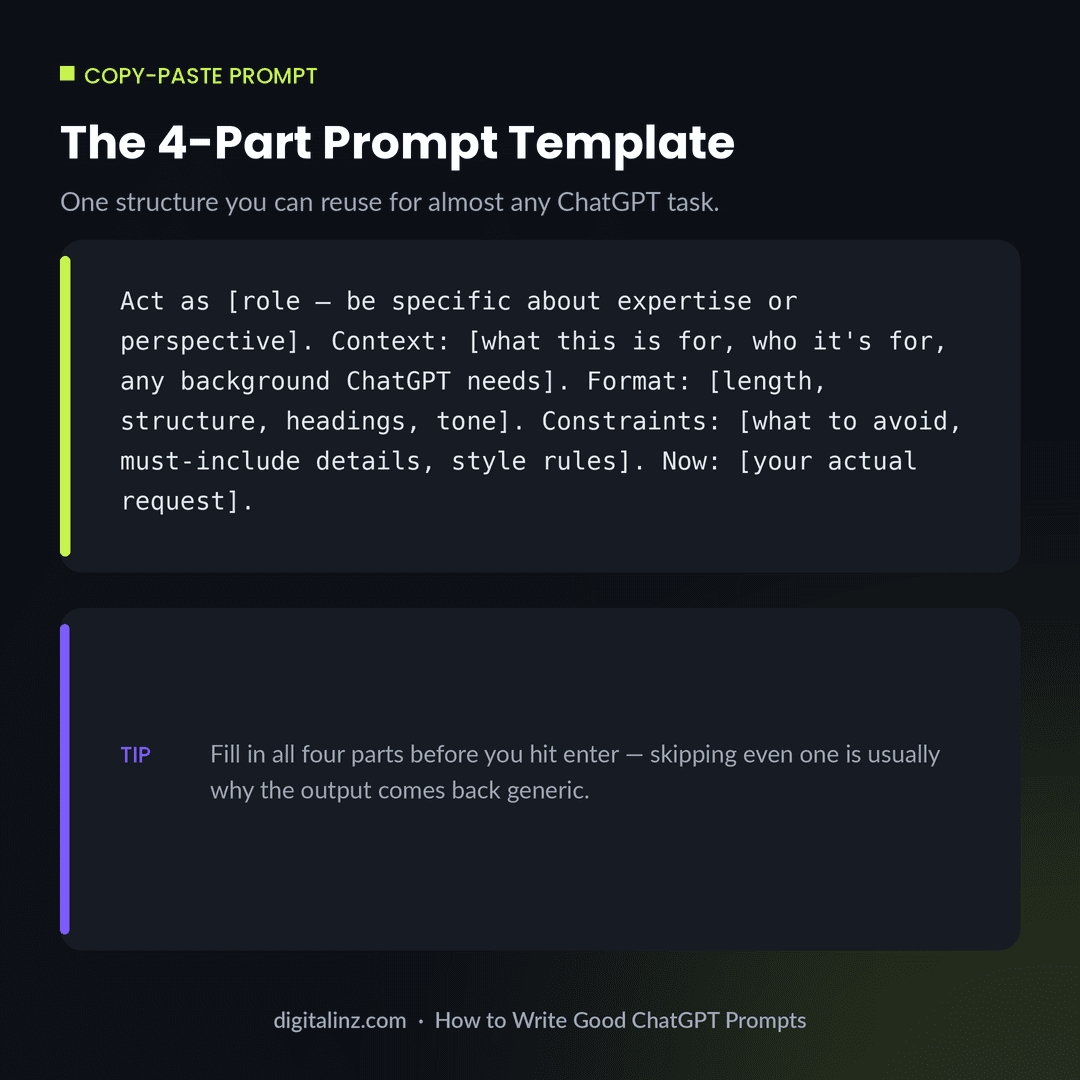
Save this template somewhere handy. For any new task, fill in the four brackets before you hit enter:
Act as [role — be specific about expertise or perspective].
Context: [what this is for, who it's for, any background
ChatGPT needs]. Format: [length, structure, headings, tone].
Constraints: [what to avoid, must-include details, style
rules]. Now: [your actual request].
It feels slower the first few times. Once it’s a habit, it takes about 30 extra seconds and saves several rounds of “no, not like that” follow-ups.
Vague vs. 4-Part: See the Difference
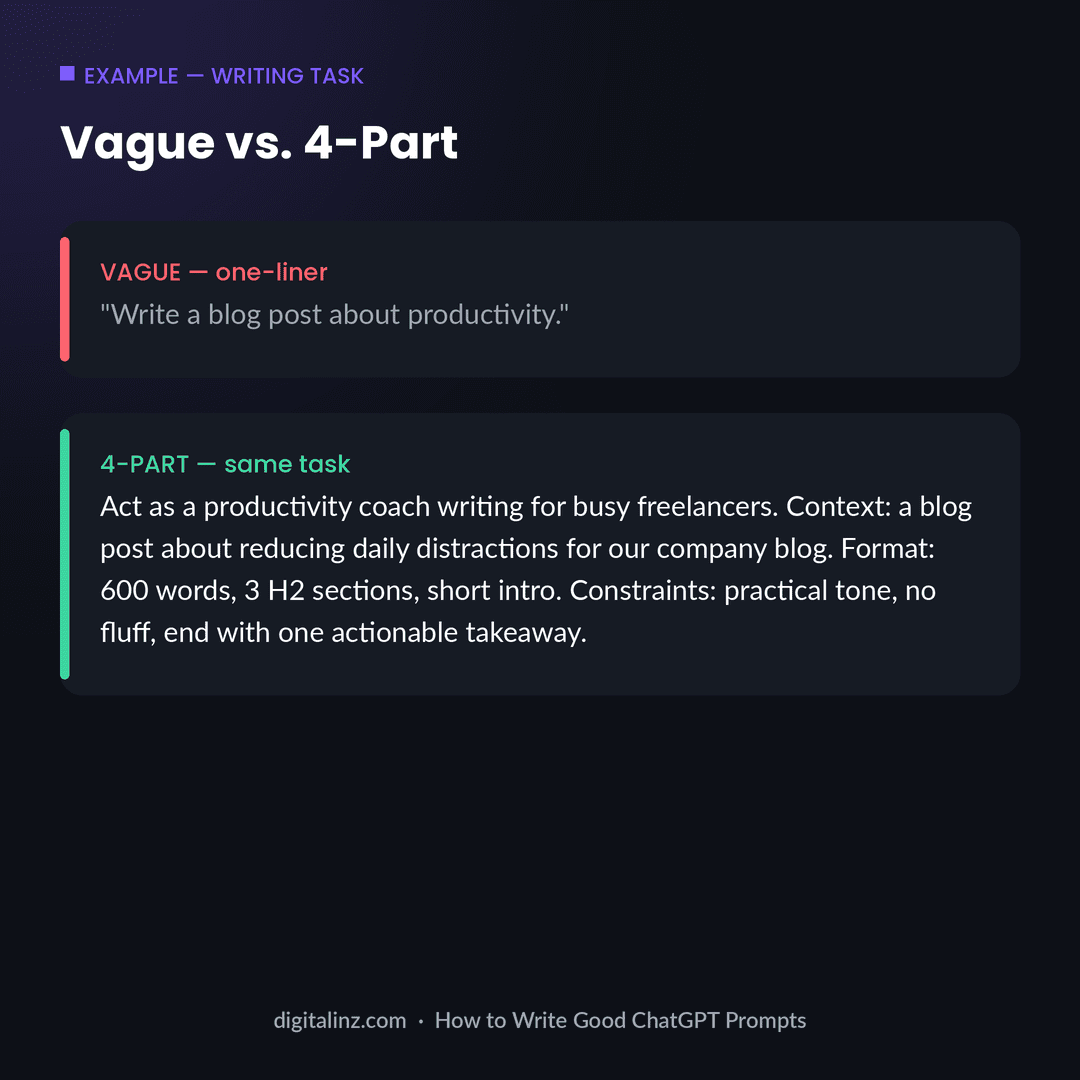
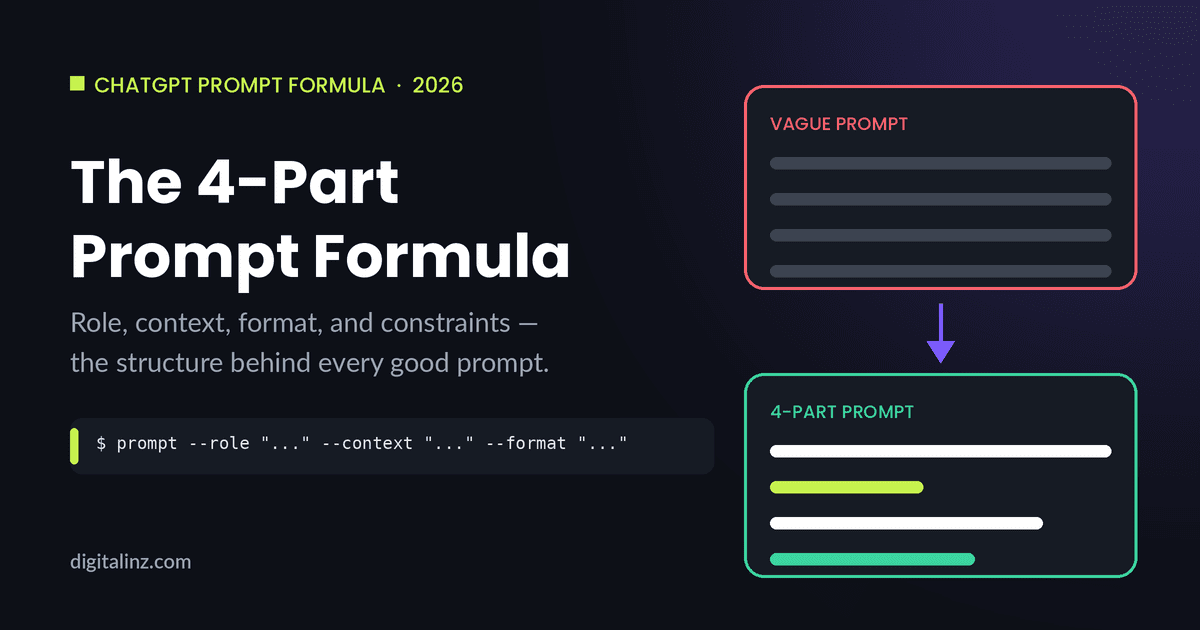
Both prompts above ask for the same thing — a blog post about productivity — but only one gives ChatGPT enough to work with. If you’d rather not write prompts like this from scratch every time, it’s worth reading our honest take on whether paid ChatGPT prompt packs are worth it before deciding which way to go.
FAQ
What is the 4-part ChatGPT prompt formula?
It’s a simple structure for writing prompts: Role (who ChatGPT should act as), Context (what the output is for and who it’s for), Format (length, structure, and tone), and Constraints (what to avoid or must include). Covering all four turns a vague request into a specific one.
Do I need to use all 4 parts every time?
For quick, low-stakes tasks, no — but for anything you’ll actually use (an email, a post, a document), including all four almost always produces a result closer to your final draft, with fewer back-and-forth edits.
How is this different from “prompt engineering”?
Prompt engineering is the broader practice of designing and refining prompts, often for technical or repeated use cases. The 4-part formula is a simple, everyday version of the same idea — structure that anyone can apply without technical knowledge.
Where can I save and reuse my best prompts?
A plain note or document with your best 4-part prompts, organized by task, works fine to start. If you’d rather start from prompts that are already built this way for a specific role, our AI Prompt Toolkits are organized exactly this way.
The Shortcut
Once you’ve built a few 4-part prompts for your own work, the next step is not rebuilding them from scratch every time. Our AI Prompt Toolkits come with the role, context, format, and constraint structure already built into every prompt — pick the one for your role: HR, Teachers, Therapists, or Social Media Managers — or browse the full set on Gumroad.