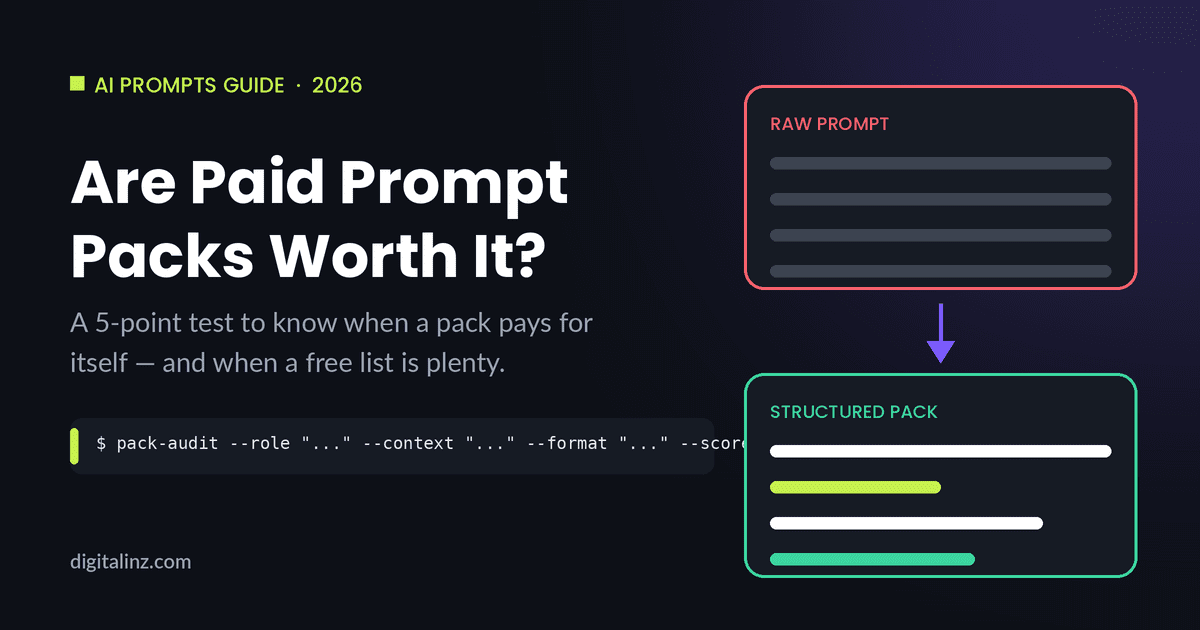
Are Paid ChatGPT Prompt Packs Worth It? An Honest 2026 Breakdown
If you’ve spent any time browsing Etsy, Gumroad, or Pinterest, you’ve seen them everywhere: bundles of “500+ ChatGPT Prompts” or “10,000 AI Prompts” for $9-$50. So are paid ChatGPT prompt packs worth it, or is the same information available for free with a quick search? The honest answer is: it depends entirely on what’s actually inside the pack — and most buyers never check before paying. Here’s a 5-point test that tells you in under two minutes.
What You’re Actually Paying For
A prompt pack is just a text file or PDF of prompts — so what separates a $30 pack from a free list on Reddit? In a well-made pack, you’re paying for the work that happens around the prompt, not the prompt itself:
- Curation — prompts written by someone who’s tested them against real tasks in a specific role, not generated in bulk.
- Context-setup — each prompt already includes the role, audience, and constraints, so you don’t have to write that part yourself every time.
- Formatting — copy-paste ready, often with fill-in-the-blank fields instead of generic templates.
- Support and updates — packs tied to a real seller often get revised as models change; a free list someone abandoned in 2023 doesn’t.
None of this means every paid pack actually delivers on it — which is exactly why the test below exists. For a refresher on what separates a useful prompt from a vague one in the first place, OpenAI’s prompt engineering best practices cover the fundamentals.
The 5-Point Test: Is a Prompt Pack Worth It?
Before buying — or after, if a pack is already sitting in your downloads folder — score it against these five criteria. A pack that scores well on most of these is worth the price; one that fails most of them is a free list with a price tag.
1. Role Specificity — or Just Generic?
Open three or four prompts at random. Do they say something like “Act as a [specific role] with [specific experience],” or do they just say “write a [thing]”? Role specificity is the single biggest driver of output quality — see our guide on why ChatGPT gives generic answers for why this matters so much. If the prompts read like they could apply to any business in any industry, that’s a red flag.
2. Does It Include Context-Setup?
A prompt that just says “write a job description” makes you do the context work every time. A prompt that says “write a job description for [role] at a [company size] [industry] company, in a [tone] tone, structured as [sections]” has already done that work for you — you just fill in the blanks.
3. Is It Copy-Paste Formatted?
Good packs are formatted for speed: clear placeholders ([brackets] or ALL CAPS), one prompt per block, no surrounding fluff. If you have to reformat every prompt before you can use it, you’re paying for someone else’s first draft.
4. Has It Been Tested on Real Tasks?
This is the hardest to verify before buying, but the clues are there: does the seller show example outputs? Do reviews mention specific results? A pack built by someone who actually does the job — an HR manager writing HR prompts, a teacher writing lesson-plan prompts — tends to hold up better than one written by someone who only knows prompting in general.
5. Per-Prompt Cost vs. Time Saved
Divide the price by the number of prompts you’ll realistically use — not the total count. A 200-prompt pack where you’ll actually use 20, at $20, is $1 per useful prompt. If each of those saves you 10-15 minutes of trial-and-error prompting, it pays for itself in the first week.
Free vs. Paid: Where the Line Actually Is
Free prompt lists aren’t useless — they’re a great way to learn the shape of a good prompt. But most free lists share two problems: they’re generic, because they’re written to appeal to the widest possible audience, and they go stale, because nobody updates a free post when a new model ships.
Paid prompt packs earn their price when they’re written for your specific role, maintained and updated, and formatted so you can use them in seconds, not minutes. If a “paid” pack is just a free list with a price tag slapped on, the 5-point test above will catch it — most fail on points 1 and 2.
Copy-Paste: Test Any Prompt Pack With This Prompt
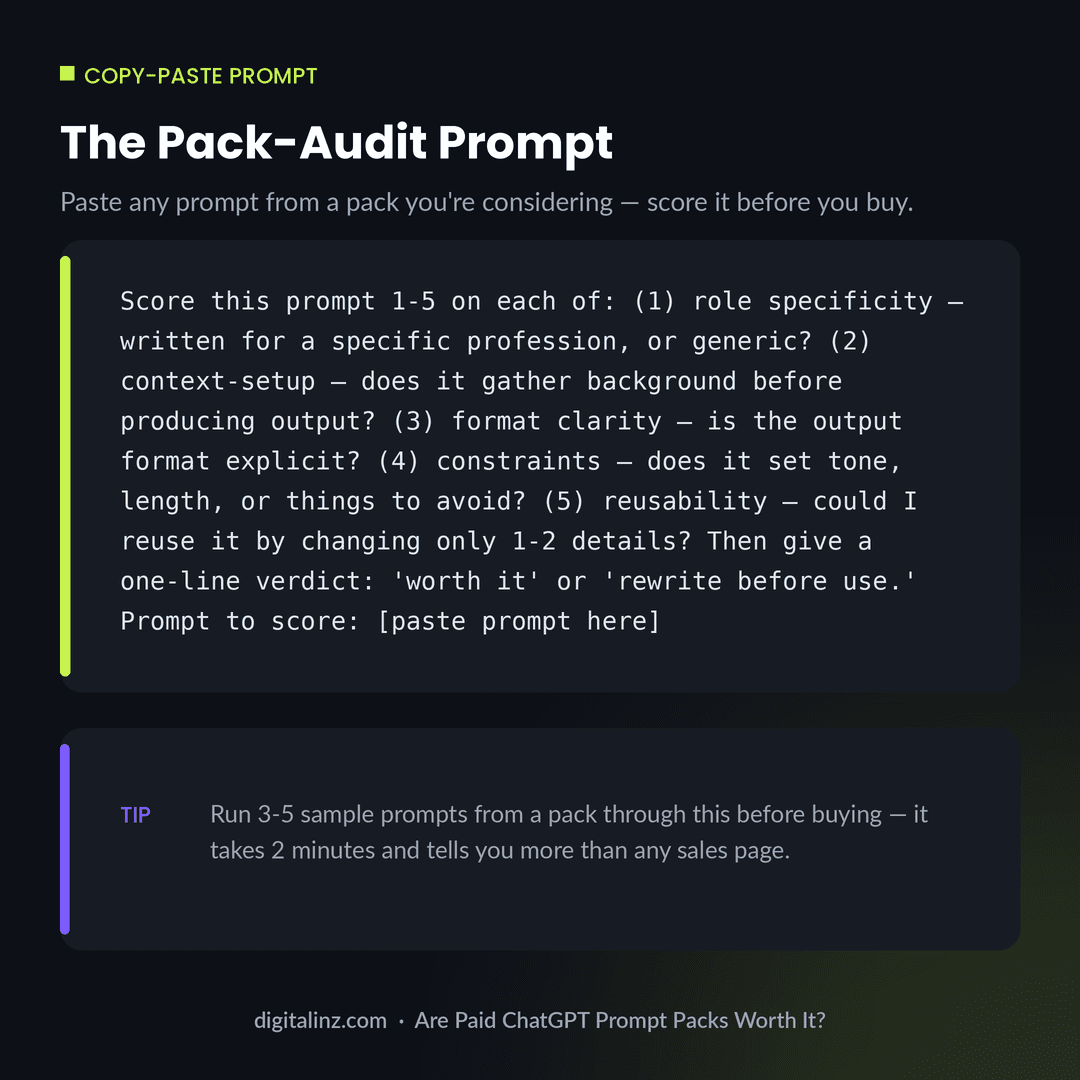
Before you buy a prompt pack — or to evaluate one you already own — paste a sample prompt from it into ChatGPT along with this audit prompt. It scores the prompt against the same 5 criteria above:
Score this prompt 1-5 on each of: (1) role specificity — written
for a specific profession, or generic? (2) context-setup — does it
gather background before producing output? (3) format clarity — is
the output format explicit? (4) constraints — does it set tone,
length, or things to avoid? (5) reusability — could I reuse it by
changing only 1-2 details? Then give a one-line verdict: 'worth it'
or 'rewrite before use.'
Prompt to score: [paste prompt here]
Run this on 3-5 sample prompts from any pack — most sales pages show at least a couple of examples — and you’ll know within minutes whether the rest of the pack is likely worth it.
What This Looks Like in Practice
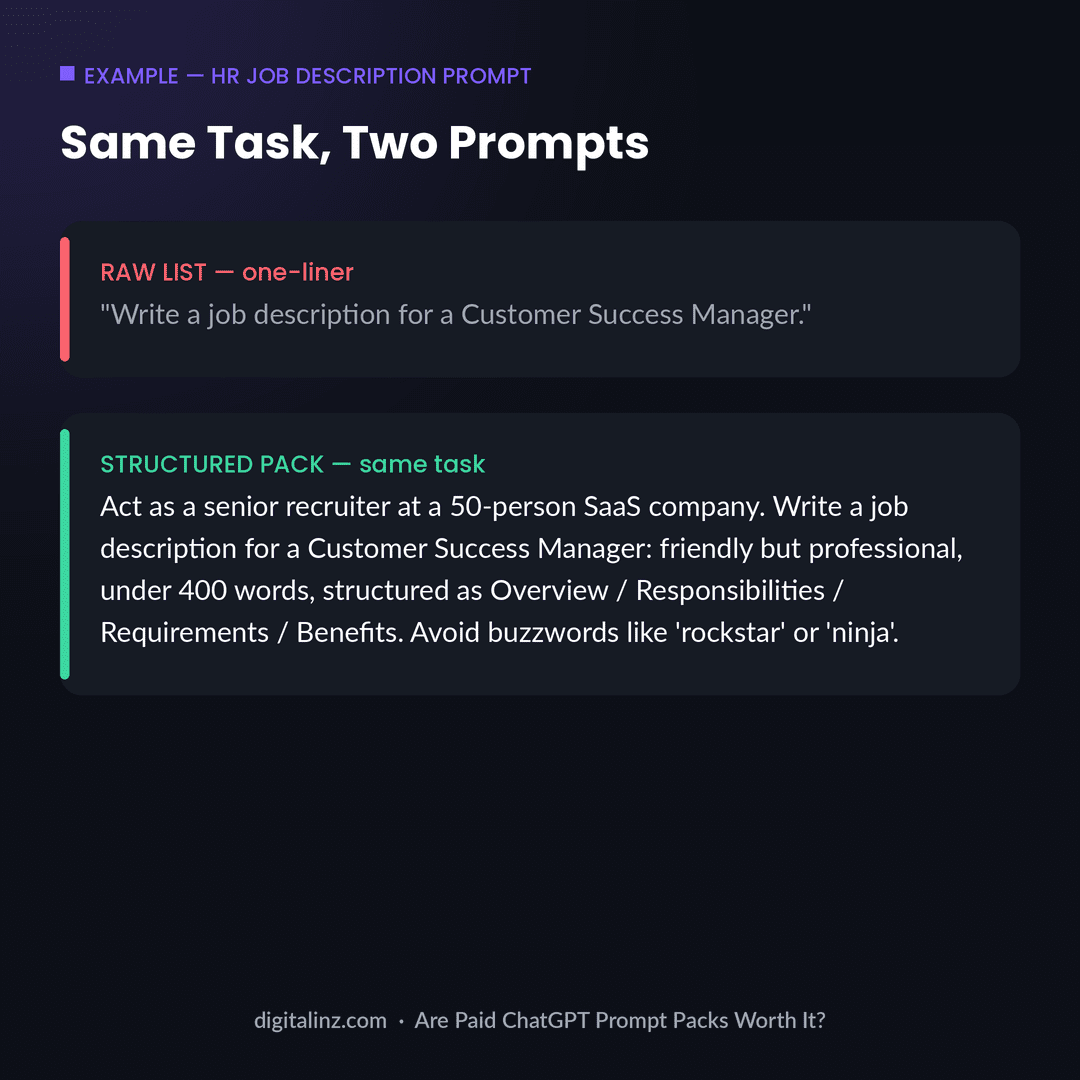
Here’s the same task — writing a job description for a Customer Success Manager — as a raw one-line prompt versus a structured prompt from a well-made pack.
The raw version forces ChatGPT to guess your company size, tone, and structure, so it defaults to generic. The structured version has all of that built in — which is the entire value proposition of a good paid ChatGPT prompt pack: someone else already did the context-stacking for you.
FAQ
What’s the difference between a free prompt list and a paid prompt pack?
In theory, a paid pack should include role-specific context, formatting, and testing that a free list skips. In practice, many “paid” packs are just free lists repackaged, which is why it’s worth running a few sample prompts through the audit prompt above before buying.
How much should a good ChatGPT prompt pack cost?
Most well-made, role-specific prompt packs sell for $15-$40. Packs priced well below that tend to be generic, and packs priced well above that without clear evidence of curation — testimonials, sample outputs, regular updates — are harder to justify. Price alone isn’t a reliable signal; use the 5-point test instead.
Are prompt packs with 10,000+ prompts better than smaller, curated ones?
Usually not. A smaller pack of 50-200 prompts that are role-specific and tested is almost always more useful than a 10,000-prompt mega-pack, because you’ll realistically only ever use a tiny fraction of it — and huge packs are rarely curated for any one role.
Will a prompt pack work with GPT-4, Claude, and Gemini?
Well-written prompts are largely model-agnostic. The role, context, format, and constraints structure works across ChatGPT, Claude, Gemini, and other major models, sometimes with small wording tweaks. If a pack’s prompts only work with one specific model or tool, that’s a sign they weren’t built around general prompting principles.
The Shortcut
If you’d rather skip the audit process entirely, our AI Prompt Toolkits are built role-first — every prompt already passes the 5-point test above, with role, context, format, and constraints baked in for HR, teaching, therapy, and social media work. See how our HR pack stacks up against the field in our HR prompt pack comparison, or browse the full set on Gumroad.