Prompt vs. Prompt Engineering: 5 Key Differences (2026 Guide)
Prompt vs. prompt engineering — if you’ve seen both terms thrown around and wondered whether they’re the same thing, you’re not alone. Most people use “prompt” and “prompt engineering” interchangeably, but they describe two different things: one is a single request, the other is a process. Knowing the difference helps you figure out how much effort a task actually needs — and when it’s worth building a reusable system instead of typing from scratch every time.
Prompt vs. Prompt Engineering: The Key Difference
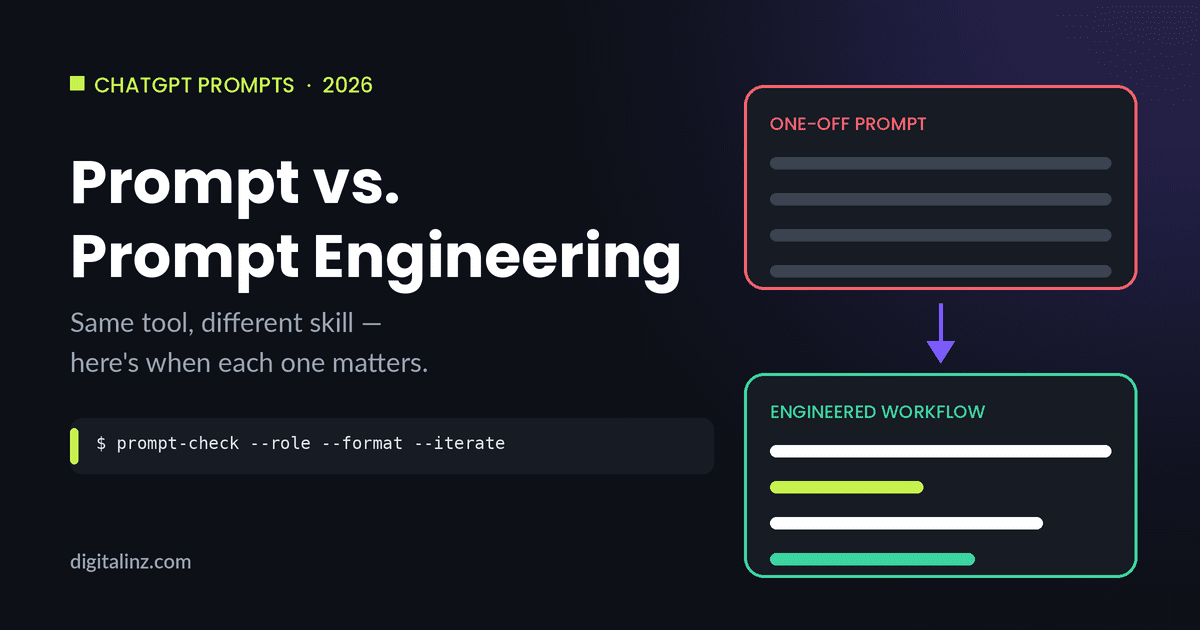
A prompt is whatever you type into ChatGPT to get a response — a question, an instruction, a request. Prompt engineering is the practice of deliberately designing, testing, and refining prompts so they produce a specific, reliable result — often one you can reuse. Here’s how that plays out in practice, across five key differences.
Scope: A prompt is a single message. Prompt engineering is a process that spans multiple attempts, edits, and tests before you land on a version worth keeping.
Goal: A prompt is usually written to get an answer right now. Prompt engineering is written to get a reliable answer — one that holds up the next time you (or someone else) uses it.
Structure: A prompt can be as casual as “write me an email.” Prompt engineering follows a deliberate structure — typically a role, context, format, and constraints — so the model has less room to guess wrong.
Iteration: A prompt is usually one-shot: you send it, you read the output, you move on. Prompt engineering treats the first output as a draft and adjusts the prompt until the output meets a standard.
Output: A prompt gives you a result. Prompt engineering gives you a template — something you can save, share, and reuse on the next ten similar tasks.
When Does Prompt Engineering Actually Matter?
Most day-to-day ChatGPT use doesn’t need full prompt engineering — a clear, specific prompt is enough. But there are a few situations where the extra structure pays off:
You’re doing the same kind of task repeatedly — job descriptions, social captions, client emails — and want consistent quality without rewriting instructions every time.
You’re getting inconsistent or generic results and need a more reliable process for narrowing down what the model produces.
You’re building something other people will use — a prompt library for a team, a template for clients, or a product like a prompt pack.
For a deeper technical breakdown of the discipline, IBM has a solid overview of what prompt engineering involves and why it matters for AI outputs.
3 Signs You’ve Moved From Prompting to Prompt Engineering
1. You’re solving the same problem in your prompt, over and over
If you keep adding the same fix — “make it shorter,” “stop using that word,” “match this tone” — to every prompt you write for a task, you’ve already started prompt engineering. The next step is just writing those fixes into the prompt itself instead of correcting after the fact.
Example: instead of asking for a caption and then asking ChatGPT to “make it less cringey” every time, you build that constraint into the original prompt — “avoid clichés like ‘game-changer’ or ‘level up.'”
2. You’re using a repeatable formula instead of a one-off sentence
Prompt engineering usually settles into a formula — role, context, format, constraints — that you reuse across tasks. If you’ve started writing prompts this way, you’re already engineering them, even if you’ve never used the term. Our guide on how to write good ChatGPT prompts breaks down this exact 4-part formula.
Example: every prompt you write for client emails now starts with “Act as [role]. Context: [situation]. Format: [length/tone]. Avoid: [list]” — that’s the formula doing the engineering for you.
3. You’re testing output against criteria before you accept it
A one-off prompt ends when you get a response. Prompt engineering doesn’t end there — you check the output against a standard (length, tone, accuracy, format) and revise the prompt if it doesn’t hold up.
Example: you ask ChatGPT to draft a policy FAQ, then check whether each answer is under 60 words and free of legal jargon — and if it isn’t, you add that as a constraint and regenerate.
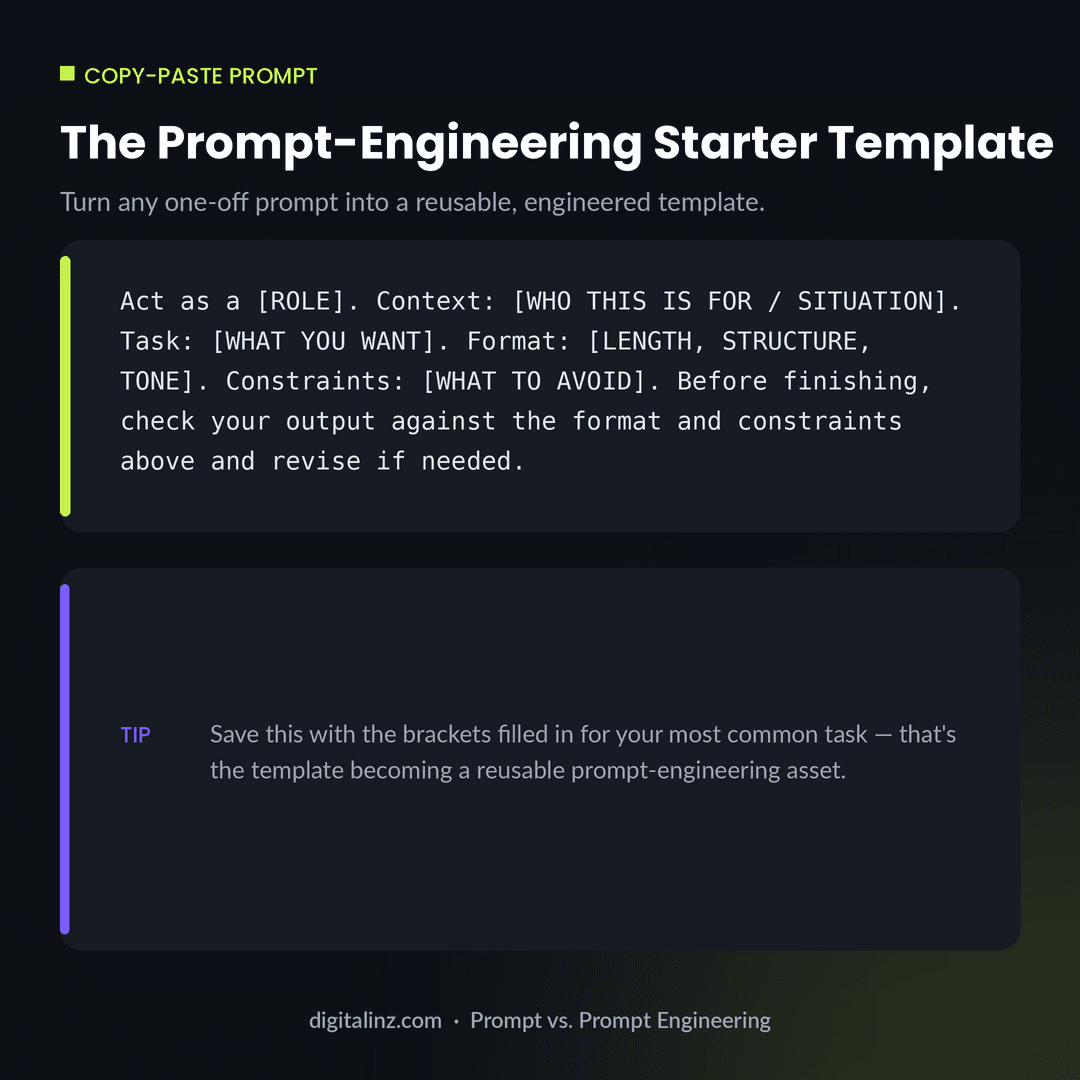
Copy-Paste: A Prompt-Engineering Starter Template
You don’t need to memorize a framework to start prompt engineering — you just need a template that forces the structure for you. Fill in the brackets below and you’ve turned a one-off request into an engineered prompt.
Before and After: What Changes When You Engineer a Prompt
The difference between a prompt and a prompt-engineered version isn’t about being more polite to ChatGPT — it’s about removing ambiguity. Here’s the same request, before and after.
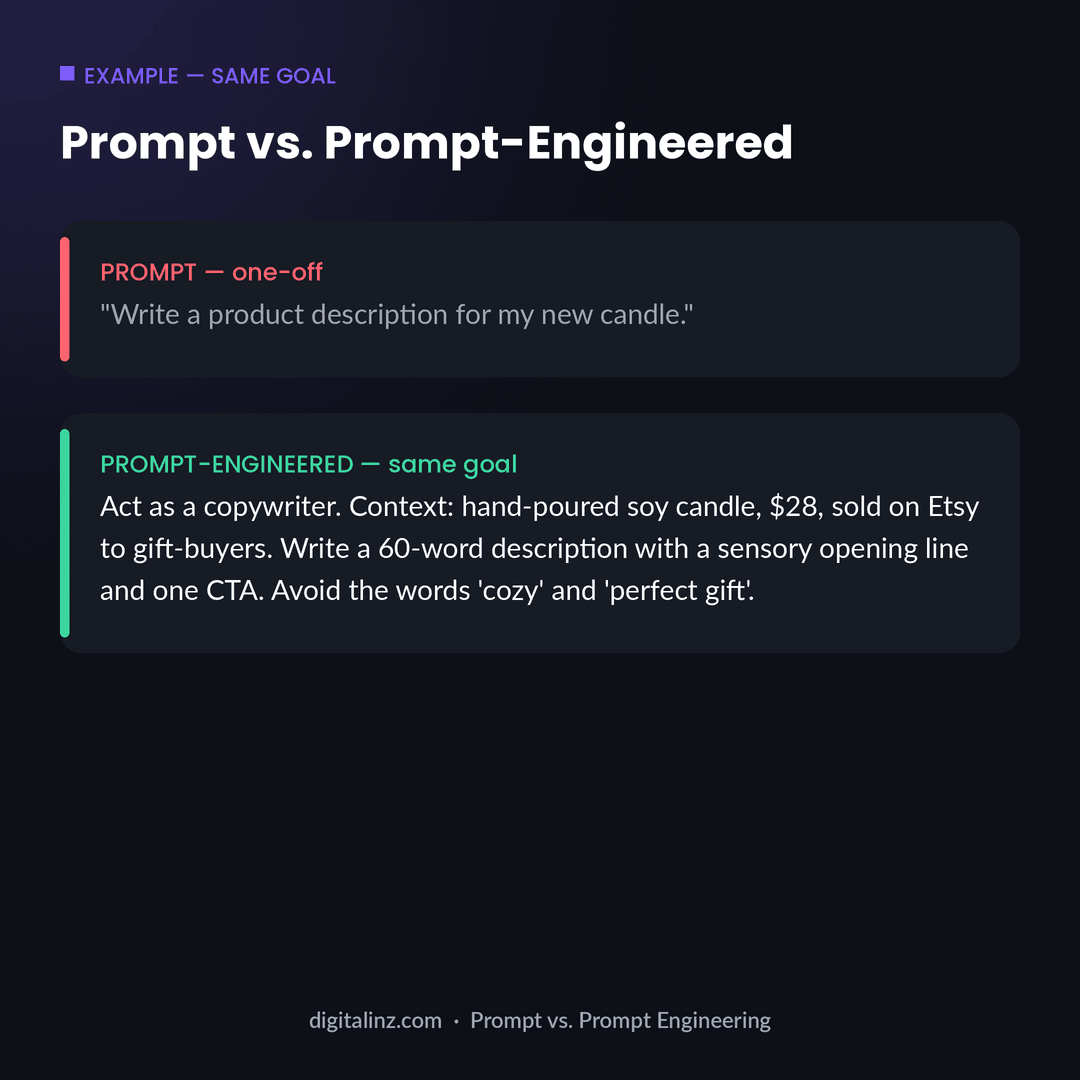
Notice that the “after” version doesn’t ask for anything fundamentally different — it just removes the guesswork. That’s the entire point of prompt engineering: trading a vague request for a specific one, once, so you don’t have to negotiate with the output every time. If your prompts tend to come back generic no matter what you ask, our post on why ChatGPT gives generic answers covers the most common causes.
FAQ: Prompt vs. Prompt Engineering
Is prompt engineering just a fancy term for writing prompts?
Not exactly. Writing a prompt is a single request. Prompt engineering is the repeatable process of designing, testing, and refining prompts so they reliably produce the result you want — even as the task or model changes.
Do I need to learn prompt engineering to use ChatGPT well?
No. Most everyday tasks just need a clear, well-structured prompt. Prompt engineering becomes useful once you’re repeating a task often, need consistent formatting, or are building prompts other people will reuse.
What does a prompt-engineered prompt actually look like?
It usually defines a role, gives context about the situation, specifies the format and tone you want, and lists constraints to avoid — then gets tested and adjusted until the output is consistently usable.
Is prompt engineering a real skill worth learning in 2026?
Yes, especially if you use AI for work regularly. It’s less about memorizing tricks and more about a structured habit: define what you want, test it, and save what works as a reusable template.
The Shortcut
Building your own prompt-engineering templates from scratch works — but it takes time you might not have. Our AI prompt toolkits are pre-engineered: every prompt already has the role, context, format, and constraints built in, so you can skip the trial-and-error.
Pick the one that matches your work: The HR AI Toolkit for HR and recruiting, The Teacher’s AI Toolkit for K-12 educators, AI-Powered Practice Prompts for therapists, or the Social Media Manager AI Prompt Vault for content and social teams.
Prefer to browse everything in one place? All of our prompt packs are also available on Gumroad.