ChatGPT Prompts for HR Policies (15 Templates, 2026)
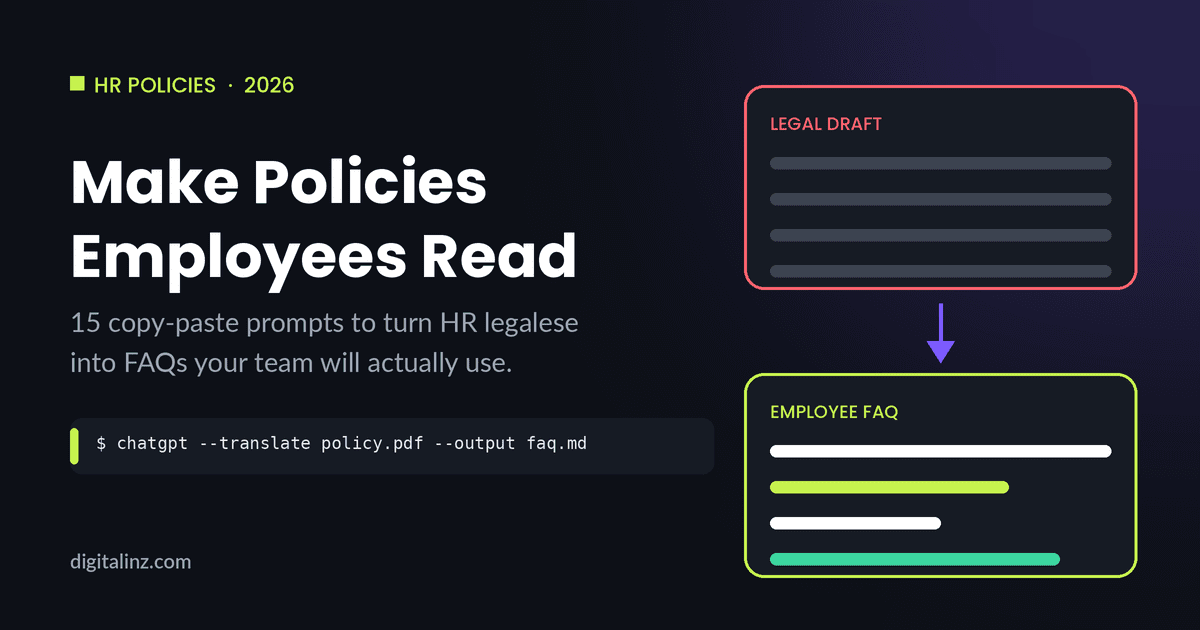
ChatGPT prompts for HR policies can turn a 10-page policy manual that nobody reads into a set of plain-English FAQs that employees actually refer back to. The gap isn’t that employees don’t care about policies — it’s that most HR policies are written for legal protection, not for the person who needs to know what happens if they call in sick three times in a month. These 15 prompts close that gap.
Why Most HR Policies Fail Before Employees Read Them
The average HR policy is written by legal and HR teams who are thinking about compliance, not comprehension. The result is language that covers every edge case but answers none of the questions employees actually have. The U.S. Plain Language Guidelines — the federal standard for clear government communication — put it directly: if your audience can’t find what they need, understand what they find, and use it, the writing has failed. Most HR policies fail all three tests before anyone prints them.
ChatGPT doesn’t rewrite your policies for you. What it does is translate them — the legal language stays in the original document, and ChatGPT produces the employee-facing FAQ version that sits next to it in the handbook or on the intranet. HR still owns the policy. ChatGPT just makes it readable.
15 ChatGPT Prompts for HR Policies
Time-Off and Leave Policies
Prompt 1 — PTO accrual FAQ:
“You are an HR communications specialist. I’m going to paste our PTO accrual policy. Rewrite it as a 3-question FAQ covering: how much PTO employees earn, when they can use it, and what happens to unused PTO at year-end. Use plain English. Max 60 words per answer. [PASTE POLICY TEXT]”
Prompt 2 — Leave of absence explainer:
“Here is our medical leave policy. Rewrite it as a step-by-step guide: what an employee should do first, what forms to submit, how long leave can last, and whether their job is protected. Use numbered steps and avoid legal terms. [PASTE POLICY TEXT]”
Prompt 3 — Sick leave quick reference:
“Turn this sick leave policy into a one-page cheat sheet. Include: how many sick days employees get, whether they carry over, whether a doctor’s note is required, and the call-out procedure. Bullet points preferred. [PASTE POLICY TEXT]”
Code of Conduct and Ethics
Prompt 4 — Conflict of interest plain English:
“Our conflict of interest policy needs to be understood by employees without legal training. Summarize it in 4–5 sentences that answer: what a conflict of interest is, what employees must disclose, and what happens if they don’t. [PASTE POLICY TEXT]”
Prompt 5 — Harassment policy FAQ:
“Rewrite this harassment policy as a 5-question FAQ. Include: what counts as harassment, what employees should do if it happens to them, what managers must do when told about it, and what the company’s investigation process looks like. No legal jargon. [PASTE POLICY TEXT]”
Prompt 6 — Social media policy employee guide:
“Turn this social media policy into a practical employee guide. Format: three sections — what you can post, what you can’t post, and what to do if you’re unsure. Each section: 3–4 concrete bullet points. [PASTE POLICY TEXT]”
Benefits and Compensation
Prompt 7 — Health insurance enrollment FAQ:
“Rewrite this health insurance enrollment section as a FAQ for a first-year employee who has never enrolled before. Cover: when they can enroll, what their options are, what happens if they miss the window, and who to contact for help. [PASTE POLICY TEXT]”
Prompt 8 — 401(k) plain-English summary:
“Here is our 401(k) policy. Write a plain-English summary for an employee who has never had a retirement account. Cover: what a 401(k) is in one sentence, how much the company matches, when vesting kicks in, and how to get started. [PASTE POLICY TEXT]”
Prompt 9 — Pay and bonus policy FAQ:
“Rewrite this compensation policy as a 4-question FAQ covering: how often employees are paid, how bonuses are calculated, when raises are reviewed, and what an employee should do if they think their paycheck is wrong. [PASTE POLICY TEXT]”
Performance and Discipline
Prompt 10 — Performance review process guide:
“Turn this performance review policy into a step-by-step timeline for an employee: when reviews happen, what they need to prepare, how ratings are determined, and how the review connects to pay decisions. Use a numbered list format. [PASTE POLICY TEXT]”
Prompt 11 — Progressive discipline FAQ:
“Rewrite this progressive discipline policy as a plain-English FAQ. Cover: what triggers a verbal warning, what comes next, when termination is immediate versus graduated, and whether employees can appeal. Keep answers under 60 words each. [PASTE POLICY TEXT]”
Prompt 12 — PIP explainer for employees:
“An employee has just been put on a performance improvement plan. Rewrite this PIP policy section as a guide that answers: what a PIP is, what it means for their job, what they need to do during the PIP period, and what success looks like. [PASTE POLICY TEXT]”
Remote Work and Tech Use
Prompt 13 — Remote work policy summary:
“Rewrite this remote work policy as a one-page employee reference. Cover: who is eligible, how many days remote are allowed, what equipment the company provides, and what the home office requirements are. Use short paragraphs. [PASTE POLICY TEXT]”
Prompt 14 — Acceptable use policy plain English:
“Turn this acceptable use policy for company devices into a plain-English do/don’t list. Format: two columns — what you can use company devices for, and what you cannot. 5–7 items per column. [PASTE POLICY TEXT]”
Prompt 15 — Data privacy employee FAQ:
“Rewrite this data privacy policy as a 4-question employee FAQ. Cover: what employee data the company collects, how it’s used, who has access, and what employees can do if they have concerns. Plain English, no legal terms. [PASTE POLICY TEXT]”
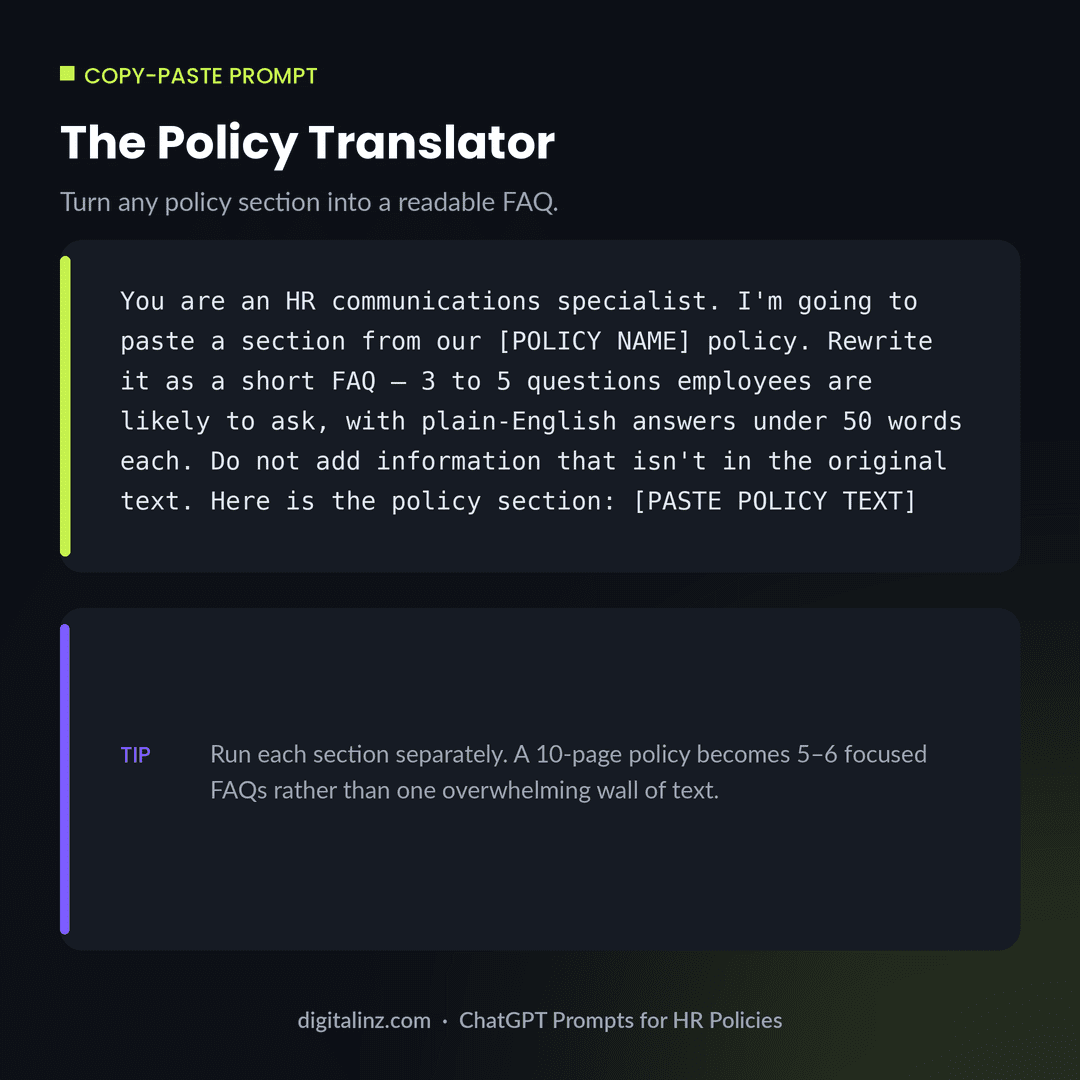
Copy-Paste: The Policy Translator
Use this as your go-to prompt whenever you’re starting a new policy rewrite — it works on any section before you customize it for a specific policy type.
Before and After: Legal Text vs. Employee FAQ
The same information — one version written for legal compliance, one written so an employee can actually use it.
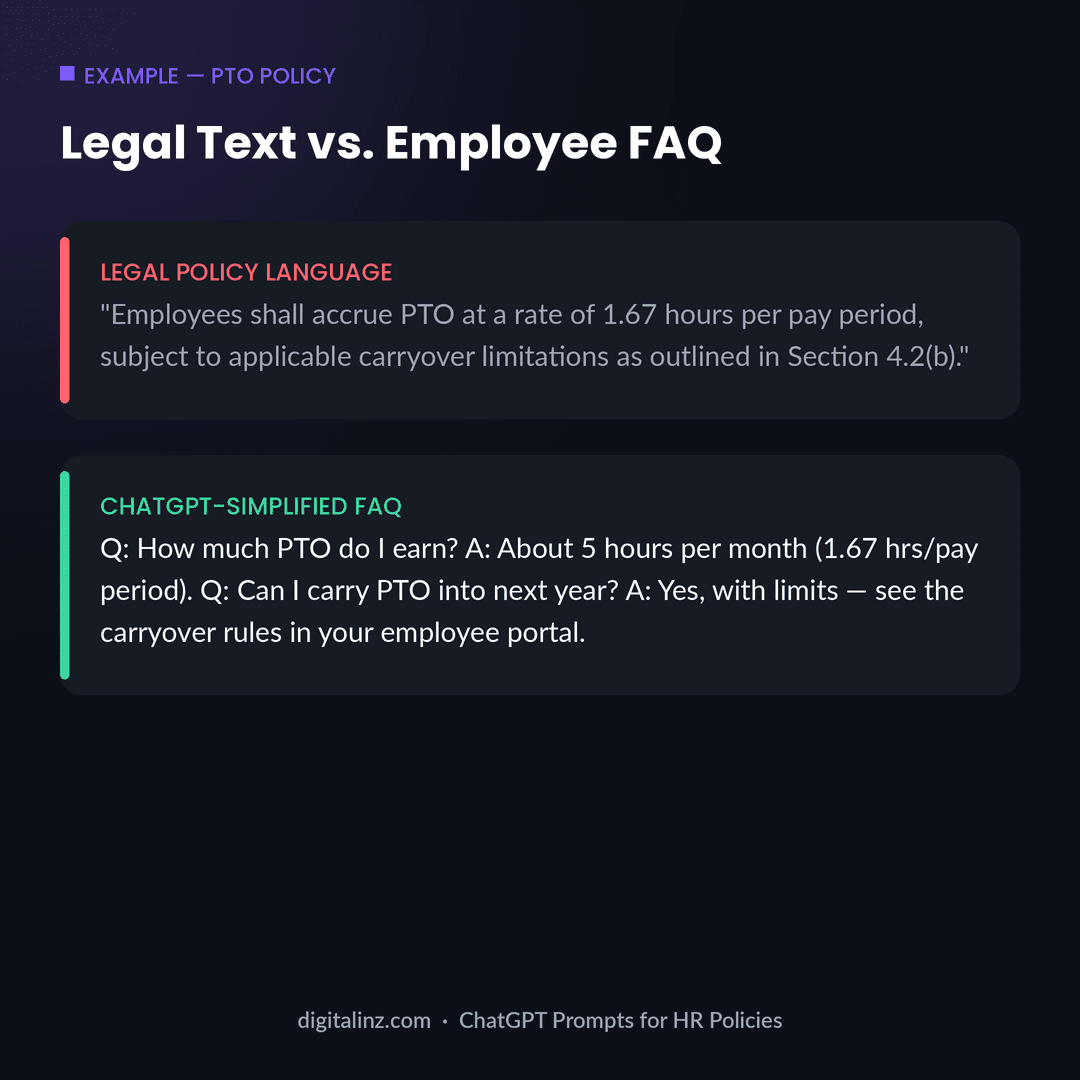
The legal version isn’t wrong — it just answers questions no employee is asking. The FAQ version answers the questions employees actually Google at 9pm before calling in sick. The policy can handle both jobs at once: legal protection in the original, ChatGPT prompts for HR policies producing the plain-English version that lives next to it on the intranet. For more on keeping sensitive policy content safe while using ChatGPT, see the guide on ChatGPT and employee confidentiality.
FAQ: ChatGPT Prompts for HR Policies
Can ChatGPT write HR policies from scratch?
It can draft a first version, but HR policies have legal and compliance requirements that vary by state, industry, and company size. Use ChatGPT-drafted policies as a starting point, not a final document — always have legal or HR counsel review before publishing.
How do I use ChatGPT to simplify an existing HR policy?
Paste the policy section into ChatGPT with a specific instruction — ask for a FAQ, a step-by-step guide, or a plain-English summary with a defined word limit. The more specific the format you request, the more usable the output. The Policy Translator prompt above is a good starting template.
Is it safe to paste HR policies into ChatGPT?
HR policy text is generally safe to use — it’s not employee-specific data. If the policy contains examples with real employee names or identifying details, remove them first. For a full checklist of what’s safe to paste, see the guide on ChatGPT and employee confidentiality.
Which HR policies should I simplify first?
Start with the policies that generate the most employee questions: PTO, performance reviews, and benefits enrollment. If your HR inbox gets the same five questions every quarter, those are the policies that need a plain-English FAQ version.
The Shortcut
Rewriting every policy in your handbook one section at a time is a project, not an afternoon. Our HR AI Toolkit includes 200+ ready-to-use prompts for policy simplification, onboarding communication, job descriptions, and performance reviews — all written with plain-language output in mind from the start.
Also available on Gumroad.