
Use ChatGPT unit study planner homeschool for success
Did you know that over 3 million families in the United States have chosen to educate their children at home? This remarkable trend highlights a growing interest in personalized education. With tools like the ChatGPT unit study planner, you can transform your daily routine and elevate your child’s learning experience.
Integrating this innovative resource into your home can help you organize study materials effectively. You’ll discover new ways to manage your time and enhance your child’s engagement with various subjects. A structured approach can foster deeper understanding, making complex topics more accessible.
This guide will reveal how you can harness the power of artificial intelligence to craft a tailored learning path. It’s time to simplify the intricate task of creating a comprehensive curriculum that meets your family’s unique needs. Start your journey today and explore the possibilities that lie ahead!
Key Takeaways
- Personalized education is on the rise, with millions opting for home learning.
- AI tools can revolutionize how you organize and manage educational resources.
- A structured approach helps children engage with complex subjects more effectively.
- This guide provides insights on creating a tailored learning path.
- Embrace technology to simplify curriculum planning for your family.
Introduction to AI-Driven Homeschooling
Home education is becoming increasingly popular among families in the United States. With the rise of technology, parents now have access to innovative tools that can enhance their children’s learning experiences. One such tool is the unit study planner, which integrates artificial intelligence to streamline educational processes.
Integrating AI into your daily routine allows you to save time while providing your children with high-quality, customized educational content and resources. Charlotte Jones explored the capabilities of AI in a recent podcast, highlighting how this tool can assist parents in managing diverse academic requirements.
A well-designed unit study planner helps kids stay focused on a single topic. This often leads to better retention and a deeper understanding of concepts. By organizing your homeschooling efforts with AI, you can reduce the stress of lesson planning and create more spontaneous learning opportunities.
| Benefits of AI in Homeschooling | Description |
|---|---|
| Time Efficiency | Saves time on lesson planning and resource gathering. |
| Customized Learning | Offers tailored content to meet individual needs. |
| Focus on Topics | Encourages deeper exploration of subjects. |
| Reduced Stress | Minimizes the anxiety of managing multiple subjects. |
By focusing on one unit study at a time, parents can create a cohesive environment where kids feel supported and encouraged in their academic pursuits.
Understanding the ChatGPT Unit Study Planner Homeschool
The rise of personalized education tools is changing how families approach learning at home. One such resource is the ChatGPT unit study planner, which offers a variety of features to enhance your educational experience.
This tool is available in a free version, ChatGPT 3.5, which allows users to generate educational content efficiently. However, it’s important to note that this version has a knowledge cutoff from 2021. Thus, it is best suited for subjects like history, science, and literature.
When using this tool, consider it a digital assistant rather than a search engine. It can help you craft lesson plans and organize materials, but you must oversee the output to ensure accuracy.
Understanding the capabilities of this version helps set realistic expectations for the type of data you can generate. Remember, this AI is here to support your educational goals!
Setting Up Your Personalized Unit Study Planner
Creating a tailored educational framework can significantly enhance your child’s learning journey. Setting up your unit study planner is a straightforward process that allows you to customize your approach.
To begin your setup, create a dedicated account. This will let you save your chat history and easily return to your study plan later. You can personalize your planner by entering your child’s specific grade level. This ensures that the content is appropriate for their developmental stage.
If you have multiple kids, consider creating separate chat threads for each student. This helps keep their individual progress organized. A successful study requires you to provide clear instructions about the topics and goals you want to achieve.
By organizing your digital workspace, you ensure that every lesson plan is easily accessible. This makes it easier to tailor the content to the unique interests of your family.
| Setup Steps | Description |
|---|---|
| Create an Account | Establish a dedicated account to save your plans. |
| Input Grade Level | Ensure content matches your child’s grade. |
| Separate Threads | Create threads for each child to track progress. |
| Provide Clear Instructions | Define specific topics and goals for the AI. |
| Organize Workspace | Keep lesson plans accessible and tailored. |

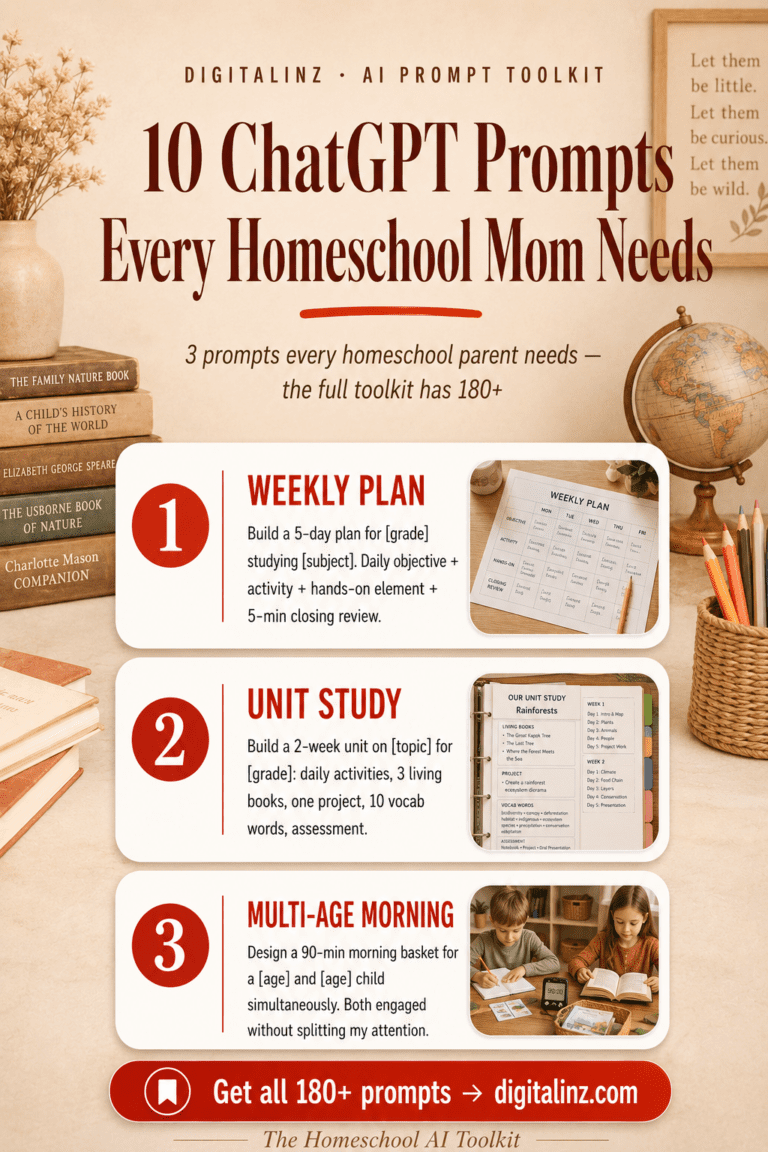
Planning every lesson from scratch is exhausting. The Homeschool AI Toolkit gives you 180 flexible ChatGPT prompts to build activities, assessments, and schedules that actually fit your child — in a fraction of the time.
Creating Effective Study Schedules Using ChatGPT
As educational choices expand, more families are embracing the concept of tailored learning at home. One effective way to enhance your child’s learning experience is by creating structured study schedules.
To start, consider using resources like Brave Writer’s Help for High School. This self-paced course can be transformed into a 36-week schedule, helping your students stay on track.
Additionally, The Well Trained Mind offers suggested schedules for various grade levels, ensuring a balanced approach to subjects like math, science, and history.
Integrating Charlotte Mason principles can also enrich your daily plans. By prompting the AI to include nature studies and art appreciation, you can create a well-rounded educational experience.
Tailoring time allocation is essential. Ensure your children spend adequate time on core skills, such as math and reading comprehension. Organizing your chat threads by subject will further refine your weekly schedule.
Designing a Compelling Unit Study Curriculum
Creating an engaging curriculum can truly ignite your children’s passion for learning. By carefully selecting topics and lessons, you can foster a deeper connection with the material. A well-designed curriculum encourages exploration and critical thinking.
For instance, you can generate a 6-week unit study on Ancient Rome. This study can include weekly focuses, discussion questions, and hands-on projects that make learning enjoyable. When teaching history, ask the AI to list key events, like the 1095 Council of Clermont, to help your kids visualize timelines and understand their significance.
Integrating hands-on activities into your lesson plans can make learning more fun. Projects related to science or history not only enhance retention but also spark creativity. For example, creating a model of the Colosseum or reenacting a historical event can bring the subject to life.
Parents can also use the AI to compile a list of materials and books that support the specific topics they are teaching. By brainstorming creative ways to present each topic, you ensure that your curriculum remains fresh and exciting for your children.
Generating Lesson Plans and Educational Resources
The shift towards personalized learning has led families to seek innovative ways to enhance their children’s education. One effective method is using AI to draft detailed lesson plans tailored to your child’s needs.
You can create a one-week lesson plan focused on teaching your child how to write a paragraph. This plan should include clear objectives and assessment methods to track progress.
The AI assistant can also generate a list of recommended books and educational materials that align with your students’ specific grade levels. Incorporating various resources can make learning more engaging.
| Lesson Planning Features | Description |
|---|---|
| Detailed Lesson Plans | Draft plans with objectives and assessments. |
| Recommended Materials | Generate lists of books and resources. |
| Incorporate Activities | Include fun math drills and science experiments. |
| Language Arts Support | Request grammar rules and vocabulary lists. |
| Review Plans | Create plans to revisit previous topics. |
By incorporating math drills and science experiments into your weekly lessons, you provide a well-rounded education that builds essential academic skills. This approach ensures your children remain engaged and excited about learning.

Crafting Discussion Questions and Interactive Activities
Engaging children in discussions about books can significantly enhance their comprehension and critical thinking skills. By incorporating thoughtful questions into your lesson plans, you can encourage meaningful conversations.
For example, you can ask the AI to generate 10 discussion questions for Part of Your World by Liz Braswell. This can help facilitate a productive book club meeting. For more advanced readers, consider requesting 20 discussion questions and answers for The Great Gatsby by F. Scott Fitzgerald. This will aid your students in analyzing the text deeply.
Creating topic-focused activities is another fun way to reinforce learning. For instance, a quiz about the solar system can check for understanding without requiring extra research. Parents can use these interactive questions to engage their children in discussions about the books they are currently reading.
The AI assistant can also provide a list of hands-on activities for science topics, such as exploring the life cycle of butterflies. These engaging projects will not only enrich your lessons but also keep your kids excited about learning.
Refining Your AI Queries for Optimal Results
Crafting effective prompts is essential for maximizing the benefits of AI in your educational journey. To get the best results, be specific in your queries. Include details like the number of weeks, grade level, and desired learning outcomes. This precision helps the AI generate more relevant content.
Organizing your chat threads by topic allows the AI to remember previous context. This organization is crucial for building a consistent unit study curriculum. If the initial output doesn’t meet your expectations, refine your query. Ask the AI to expand on specific history or science facts for better insights.
You can also create a template paragraph that includes your homeschooling style and the ages of your kids. Paste this at the start of each new chat to streamline the process. Treat the AI as an intern, providing clear instructions. This approach significantly improves your ability to generate high-quality educational resources.
Ensuring Accuracy and Avoiding AI Hallucinations
As you embrace innovative learning tools, maintaining accuracy in educational content is key. AI can be a fantastic resource, but it is not infallible. Sometimes, it may produce incorrect information confidently, known as a “hallucination.” This is why fact-checking is essential.
Tips for Fact-Checking AI-Generated Information
Always verify facts against reliable sources. When generating lists of spelling words or history dates, cross-reference the AI output with your existing curriculum materials. This ensures complete accuracy.
Methods to Cross-Reference Curriculum Data
Since AI may take information out of context, reviewing all generated lesson plans before presenting them to your children is important. Treat the AI as a helpful assistant that requires your final approval, especially with complex scientific or historical data.
By maintaining a skeptical but open-minded approach, you can enjoy the time-saving benefits of AI while protecting the integrity of your child’s education.
| Fact-Checking Methods | Description |
|---|---|
| Verify Sources | Check facts against trusted educational resources. |
| Cross-Reference | Use existing curriculum materials for accuracy. |
| Review Plans | Examine lesson plans before presenting to students. |
| Final Approval | Ensure all AI-generated content meets your standards. |
Conclusion
As you explore the journey towards individualized education, you’ll find that using a dedicated tool can greatly enhance your children’s learning experience. This approach allows you to reclaim your time while providing a more personalized educational path.
By mastering the art of specific prompting, you can generate everything from detailed lesson plans to engaging discussion questions. Remember, while AI is a powerful resource, your role as a parent is crucial in ensuring your kids receive a quality education.
Always fact-check the information provided to avoid errors and maintain accuracy in your curriculum. Start small by experimenting with one tailored learning experience, and you will soon discover how this technology can transform your daily educational routine for the better.
FAQ
How can I start using an AI-driven planner for my homeschooling?
You can begin by exploring various AI tools that help in creating personalized lesson plans and schedules. Look for features that allow you to input your child’s interests and learning styles for the best results.
What are the main benefits of using a unit study approach?
A unit study approach allows for deeper exploration of topics, integrates multiple subjects, and engages children through hands-on activities. This method can make learning more enjoyable and relevant for your child.
How do I create a study schedule that works for my family?
Start by assessing your family’s daily routine and your child’s learning pace. Design a flexible schedule that allocates time for various subjects while leaving room for breaks and spontaneous learning opportunities.
What types of activities can I include in my curriculum?
Consider incorporating hands-on projects, field trips, experiments, and creative arts. These activities can enhance understanding and retention of the material while keeping your child engaged.
How can I ensure that the resources I use are accurate?
Always cross-reference information from multiple sources. Look for reputable educational websites, books, and articles to verify facts and ensure the curriculum is up-to-date and reliable.
Can I customize lesson plans for different learning levels?
Yes! Most planning tools allow you to adjust lesson plans based on your child’s grade level and learning abilities. This ensures that each lesson is appropriately challenging and engaging.
What should I do if my child loses interest in a topic?
If your child seems disengaged, try to introduce a new angle on the topic or incorporate different activities. Sometimes a fresh perspective or a fun project can reignite their curiosity.
How can I incorporate discussion questions into my lessons?
Create open-ended questions that encourage critical thinking and personal reflection. These can be used during discussions or as writing prompts to deepen understanding of the material.
A well-planned unit study doesn’t have to take hours to build. The Homeschool AI Toolkit gives you 180 prompts to design engaging, structured unit studies for any subject — in minutes, not days.