
How to Use ChatGPT to Write Amazon Bullets That Sell
Did you know over 300 million shoppers now use Amazon’s AI, Rufus, to help them decide what to buy? That’s a massive shift in how people find products. Your listing isn’t just for human eyes anymore.
Amazon’s new COSMO system is a game-changer. It ranks items based on structured knowledge, not just old-school keyword tricks. To win, your content must speak clearly to both shoppers and these smart algorithms.
This guide is your roadmap. You’ll learn to craft persuasive bullet points that drive real sales. We focus on deep customer research and clear value communication.
Every prompt you create should generate copy that converts. You’ll turn basic product facts into compelling benefits. The goal is better visibility and more revenue.
Key Takeaways
- Amazon’s AI, Rufus, assists over 300 million shoppers, making your listing’s clarity vital.
- The COSMO algorithm prioritizes structured product knowledge over simple keyword stuffing.
- Effective AI prompts are essential for generating high-converting sales copy.
- Deep customer research ensures your content matches what buyers truly seek.
- Your listing serves as a key data point for AI to recommend your product.
- Integrating search terms naturally maintains flow for both humans and machines.
- The right approach improves organic visibility and boosts conversion rates.
Introduction: Transforming Amazon Listings in the COSMO Era
Your product listing is now a critical data point for intelligent systems that guide millions of shopping decisions. The platform has evolved from a basic keyword-matching engine into the sophisticated COSMO AI.
This system ranks items based on structured knowledge. It’s a complete shift from old optimization tactics.
Simultaneously, Rufus, the conversational shopping assistant, serves over 300 million shoppers. Your content must be clear enough for both humans and this AI to understand instantly.
Overview of Amazon’s Evolving AI Systems
COSMO represents a new paradigm. It doesn’t just scan for keywords; it evaluates the completeness and clarity of your product information.
Success requires a deep understanding of your item’s use cases and primary benefit. This foundational knowledge shapes everything from your title to your bullet points.
Impact of COSMO and Rufus on Seller Strategies
For Amazon sellers, this means outdated methods like keyword stuffing deliver poor results. You must invest time in detailed customer research.
Building a comprehensive knowledge brief is essential. It ensures your listing speaks directly to shopper intent and improves your brand’s visibility.
This strategic foundation prepares you to create compelling sales copy that both algorithms and customers love.
Understanding Amazon’s Advanced AI Systems
Advanced AI evaluates your product’s relevance through intent coverage, semantic completeness, and attribute clarity. This is the new reality for every seller on the platform.
Gone are the days when stuffing your listing with keywords guaranteed good results. Now, systems like COSMO and Rufus analyze the deeper meaning of your content.
Key criteria: Intent coverage, semantic completeness, and attribute clarity
Intent coverage measures how well your listing answers a shopper’s specific questions. It connects your product to the real reason behind a search.
Semantic completeness ensures your content provides a full, holistic picture. It’s about telling the entire story of your item’s use and benefit.
Attribute clarity helps the AI correctly categorize your product. Clear details about materials, size, and life cycle are crucial.
| Criterion | Definition | Seller Action |
|---|---|---|
| Intent Coverage | How well your listing matches shopper search purpose | Research customer questions and address them directly |
| Semantic Completeness | Providing a full, connected story about your product | Detail all use cases and primary benefits clearly |
| Attribute Clarity | Precise and unambiguous product specifications | Use standardized values for size, color, material, etc. |
“The algorithm’s job is to understand the product truth. Sellers who provide the clearest, most structured data win.”
Investing time in this research pays off. Your listing becomes a powerful data point for AI, leading to better search rankings.
This foundational knowledge directly impacts your brand’s visibility and long-term sales success. It shapes everything from your title to your bullet points.
How to Use ChatGPT to Write Amazon Bullets
Crafting effective bullet points now hinges on providing structured context to AI tools. Since its late 2022 launch, this technology has become a primary resource for drafting listing copy. To achieve optimal output, you must move beyond simple keyword lists.
The right approach transforms basic facts into persuasive sales arguments. Your goal is copy that connects with both people and algorithms.
Transitioning from keyword stuffing to structured context
Old tactics focused on density, not clarity. The new method requires a structured narrative. You explain the specific problems your product solves for the customer.
This shift is fundamental. It ensures your content covers intent and provides complete knowledge. Your listing becomes a reliable data point.
| Old Approach | New Approach | Key Outcome |
|---|---|---|
| List of isolated keywords | Structured story about use cases | Better intent coverage |
| Focus on search term repetition | Focus on primary benefit | Clearer value proposition |
| Generic prompts | Detailed prompt with audience data | Output aligned with brand voice |

Effective prompt formulation for clear, persuasive output
Your prompt should include target audience details and specific use cases. Feed the AI comprehensive data about your brand and product life cycle.
This guides the tool toward technically accurate and persuasive content. The time spent here is an investment.
You will see higher-quality bullet points and a stronger title. This effort drives better sales results.
Every seller can improve their listing with this method. It keeps you competitive as AI systems evolve.
Crafting Persuasive Titles That Capture Interest
A persuasive title acts as a critical bridge between your product and potential buyers. It influences both click-through rates and search visibility. This element is the first point of contact for shoppers and the Amazon algorithm.
Your title must instantly communicate value. It sets the stage for the entire listing experience. A strong one grabs attention and compels a click.
Balancing Brand Clarity With Natural Keyword Integration
Your title needs a strategic blend of brand messaging and search-friendly terms. Clarity for the customer is just as important as discoverability. Tools like ZonGuru’s Keywords on Fire provide essential search volume data.
This research helps you prioritize high-impact terms. You integrate them naturally, avoiding awkward phrasing. The goal is a title that reads smoothly and ranks effectively.
| Element | Ineffective Approach | Effective Approach |
|---|---|---|
| Primary Keyword | Buried at the end | Placed at the front |
| Brand Name | Omitted or unclear | Clearly stated for trust |
| Main Feature/Benefit | Vague or generic | Specific and compelling |
| Keyword Integration | Forced and unnatural | Seamlessly woven in |
Follow a proven formula: primary keyword, main feature, secondary keyword, and a unique differentiator. This structure satisfies the COSMO system’s need for structured knowledge.
Test different title variations to see which drives the best sales results. The time you invest here pays off with increased visibility and more qualified traffic.
Developing Structured Product Knowledge for Listings
Think of your product knowledge brief as the blueprint for your entire listing’s success. This document captures everything the COSMO system needs to understand your item. It turns vague ideas into clear, structured data.
Your brief informs every piece of content you create. It ensures consistency across your catalog. This foundation is what separates top sellers from the rest.
Creating a Comprehensive Product Brief With Use Cases
A strong brief goes beyond basic features. It details who your customer is and how they live. You outline specific scenarios where your product solves a real problem.
This depth of research gives AI tools the context needed for accurate output. It transforms a generic prompt into a powerful content generator.
| Brief Section | Core Purpose | Direct Impact |
|---|---|---|
| Target Customer Profile | Defines demographics and pain points | Ensures copy speaks directly to buyer intent |
| Specific Use Cases | Details real-world application scenarios | Helps AI map product to shopper’s life |
| Competitive Positioning | Highlights unique selling advantages | Enables clear communication of key benefit |
When you feed this structured knowledge into your prompts, the results improve dramatically. Your generated bullet points and title will align with your brand voice.
The time you invest in this phase is a critical step. It leads to better optimization and more consistent sales results over the long term.
Creating Bullet Points That Speak to Shopper Intent
Every feature you list must answer a silent question from your potential customer. Your bullet points are the final, persuasive argument before a purchase decision. They must connect directly to what the shopper hopes to achieve.
Rufus, the AI assistant, evaluates this content to see if your product solves specific problems. Your goal is to provide the clear, structured knowledge it needs to recommend your item confidently.

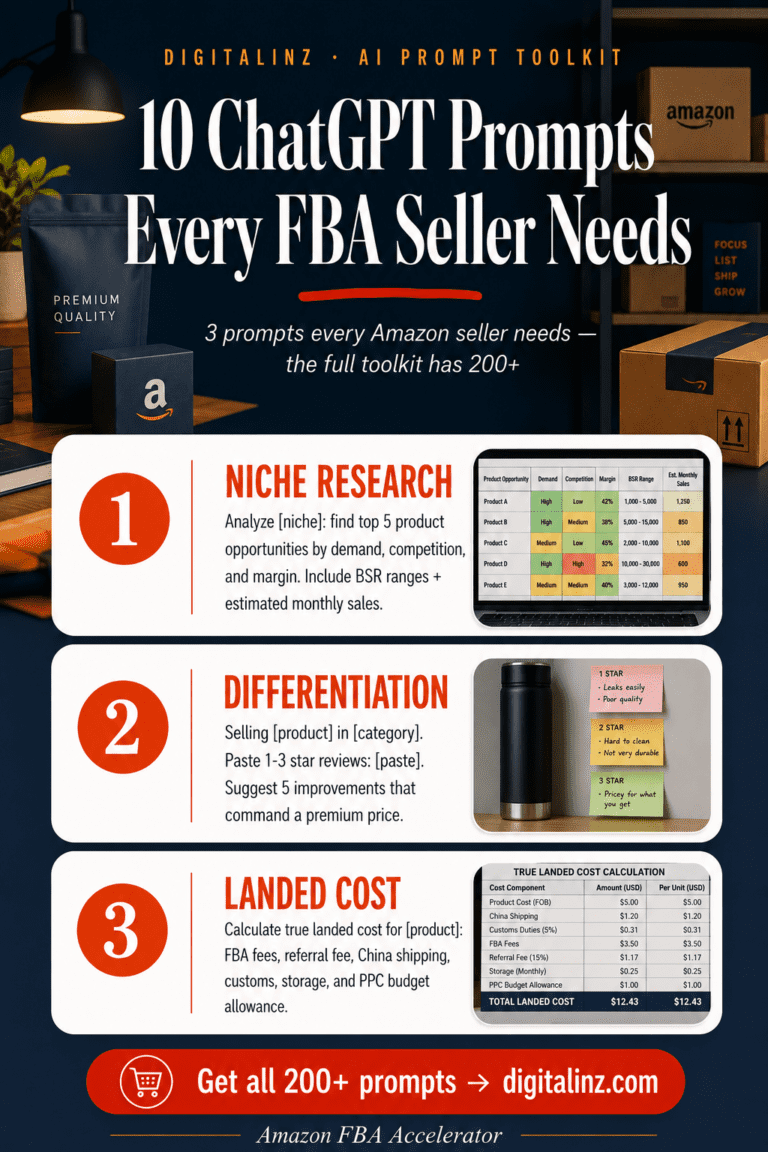
The prompts you use matter more than you think. If you want bullets that actually convert, the Amazon FBA Accelerator gives you prompts crafted specifically for that — no more trial and error, just results.
Linking Product Features to Customer Benefits
Start each point with the benefit, then support it with the feature. For example, don’t just say “stainless steel construction.” Say “Enjoy lasting durability thanks to premium stainless steel that resists rust.”
This approach directly addresses real-world shopper questions about lifecycle and performance. It transforms a spec sheet into a story of improvement.
By covering multiple intent pathways—like ease of use, safety, and materials—you cast a wider net. Different shoppers discover your listing based on their unique needs.
Using ChatGPT Prompts to Generate High-Converting Bullets
Feed the AI a detailed prompt based on your research. Include your target customer profile and specific use cases. This generates copy that is both technically accurate and emotionally compelling.
Sellers should use iterative testing to refine each point. Ensure every bullet contributes to a higher conversion rate for your listing.
“The best bullets don’t describe what the product is; they describe what the customer gains.”
This method turns features into a compelling narrative that drives sales and builds trust for your brand. It’s the key to speaking directly to shopper intent.
Optimizing Product Descriptions for Enhanced Conversions
Imagine your product description as a compelling story that shows customers exactly how their life improves with your item. This section of your listing provides the depth of information Amazon’s AI needs. It also convinces shoppers who are ready to buy.
Your description builds what is called “product truth.” It turns features into a clear narrative of benefit. This approach leads directly to better sales results.
Storytelling Techniques That Build Product Truth
Start by painting a picture of the problem your customer faces. Then, introduce your product as the ideal solution. This narrative structure is engaging and easy for both people and algorithms to follow.
Every seller should ensure their description covers all key attributes. Details like materials, dimensions, and care instructions signal quality. They provide the structured knowledge the system requires.
| Element | Ineffective Description | Effective Storytelling |
|---|---|---|
| Opening | Lists generic features | Paints the customer’s problem |
| Body Content | Dry specifications only | Shows the product in use, improving life |
| Keyword Use | Forced, breaks narrative flow | Naturally woven into the story |
| Closing | Abrupt end | Confidence-building call to action |
You can use a ChatGPT prompt to draft a description with this logical flow. Feed it your customer research and primary benefit. The AI will generate a strong first draft that you can refine.
The time you invest here pays off. Shoppers who read the full text are further along in their decision. A great description enhances conversions for your brand.
Integrate search terms naturally without sacrificing the narrative. This satisfies the algorithm while keeping your content engaging for real people.
Leveraging Data-Driven Tools for Keyword Research
Modern Amazon sellers rely on powerful tools to uncover what customers truly search for. Guessing which terms will drive traffic is a risky strategy. You need hard numbers to make smart decisions.
Platforms like ZonGuru and Helium 10 provide that essential data. They analyze real search volume and revenue potential. This research forms the foundation for your entire optimization effort.
How ZonGuru and Helium 10 Support Data-Backed Decisions
ZonGuru’s Keywords on Fire and Helium 10’s Cerebro are industry standards. They identify high-converting keywords based on actual marketplace behavior. This data directly informs your content strategy.
A major advantage is reverse-searching competitor ASINs. You can see which terms drive traffic to successful products in your niche. This gives you a clear market advantage.
Every seller should use these insights to optimize their product listing. Integrating the right terms into your title and bullet points aligns your content with current trends. It strengthens your entire listing.
| Tool | Core Function | Key Benefit for Seller |
|---|---|---|
| ZonGuru Keywords on Fire | Identifies keywords with high commercial intent | Prioritizes terms that drive actual sales |
| Helium 10 Cerebro | Reverse-engineers competitor keyword strategies | Reveals hidden opportunities in your market |
| Both Platforms | Tracks search volume and ranking difficulty | Provides a complete picture for investment decisions |
This data feeds directly into your AI prompt. It ensures the generated copy includes relevant, high-value terms. Your product’s visibility improves as a result.
Sellers can move beyond guesswork. You build your listing on a foundation of structured knowledge. This approach covers your product’s life cycle and primary benefit.
Enhancing Listings with A+ Content and Visual Storytelling
Beyond text, A+ Content modules provide Amazon’s AI with structured data to better understand your product. This rich media transforms your basic listing into an engaging visual story.
It gives the COSMO system more knowledge to work with. Shoppers also get a clearer picture of your item’s primary benefit.
Designing Impactful Visual Modules and Comparison Charts
Create modules that show your product in real-life scenarios. Help the customer visualize how it improves their daily life.
Comparison charts are powerful tools. They present clear facts that help shoppers choose your brand.
These charts also feed structured attributes to the AI. This improves your listing’s relevance in search results.
| Module Type | Visual Purpose | AI Data Provided |
|---|---|---|
| Lifestyle Image | Shows product in daily use | Contextual use cases, intent coverage |
| Comparison Chart | Highlights vs. competitors | Structured attribute clarity |
| Feature Grid | Details key benefits | Semantic completeness |
Use a detailed prompt to brainstorm creative concepts. This research ensures every module is both beautiful and informative.
Optimize all visuals for mobile users. Most sellers see better conversion rates with a mobile-first design.
This cohesive experience satisfies the shopper and the algorithm. Your sales and visibility will grow.
Integrating ChatGPT in Your Amazon Brand Strategy
Building a lasting brand on Amazon requires more than just a great product. It demands a deep connection with your ideal buyer. Integrating AI moves beyond simple copywriting into strategic planning.
This layer ensures all your content aligns with a core message. Your entire listing becomes a unified story for your brand.
Defining your Ideal Customer Profile (ICP) and target audience
Use AI to analyze reviews, forums, and social media. Identify specific pain points and purchase triggers.
This research reveals the exact language your customer uses. You gain knowledge about their daily life and needs.
Feed these insights into a detailed prompt. The tool helps you build a vivid customer avatar. This avatar guides every piece of content you create.
Crafting a Unique Selling Proposition (USP) that stands out
Your USP is your reason for being. It’s the core benefit that makes you different.
AI can help distill this from competitor analysis and customer data. A clear USP boosts your brand authority instantly.
“A strong USP doesn’t just describe a feature; it defines your position in the market.”
This clarity tells both shoppers and Amazon’s AI why your product is the best choice. It influences your title and bullet points.
Every seller can use this strategy to stand out in search results. It builds a foundation for long-term sales success.
Conclusion
The future of successful selling lies in harmonizing human insight with intelligent automation. Mastering this blend requires strategic prompt engineering and a deep grasp of your product truth.
Focus on structured knowledge and intent coverage. This creates listings that satisfy both real customer needs and the COSMO algorithm. Your content becomes a powerful asset.
Remember, AI boosts efficiency, but human oversight validates your brand voice. As systems evolve, your ability to adapt is key. Leverage data-driven research for long-term success.
Start implementing these techniques today. Improve your search visibility and conversion rates. Turn your product listing into a high-performing engine for consistent sales growth.
FAQ
What is COSMO and how does it change my Amazon listing strategy?
How can I write effective prompts for Amazon bullet points with AI?
Why is balancing brand name and keywords in the title so important?
What tools should I use for keyword research alongside AI writing?
How do I turn product features into compelling benefits in my bullets?
Can A+ Content really improve my conversion rates?
You now know what makes a great Amazon bullet — so why not make writing them effortless? The FBA Accelerator Prompt Pack has everything you need to write compelling bullets, titles, and descriptions with ChatGPT in minutes. Your next listing could be your best one yet.