
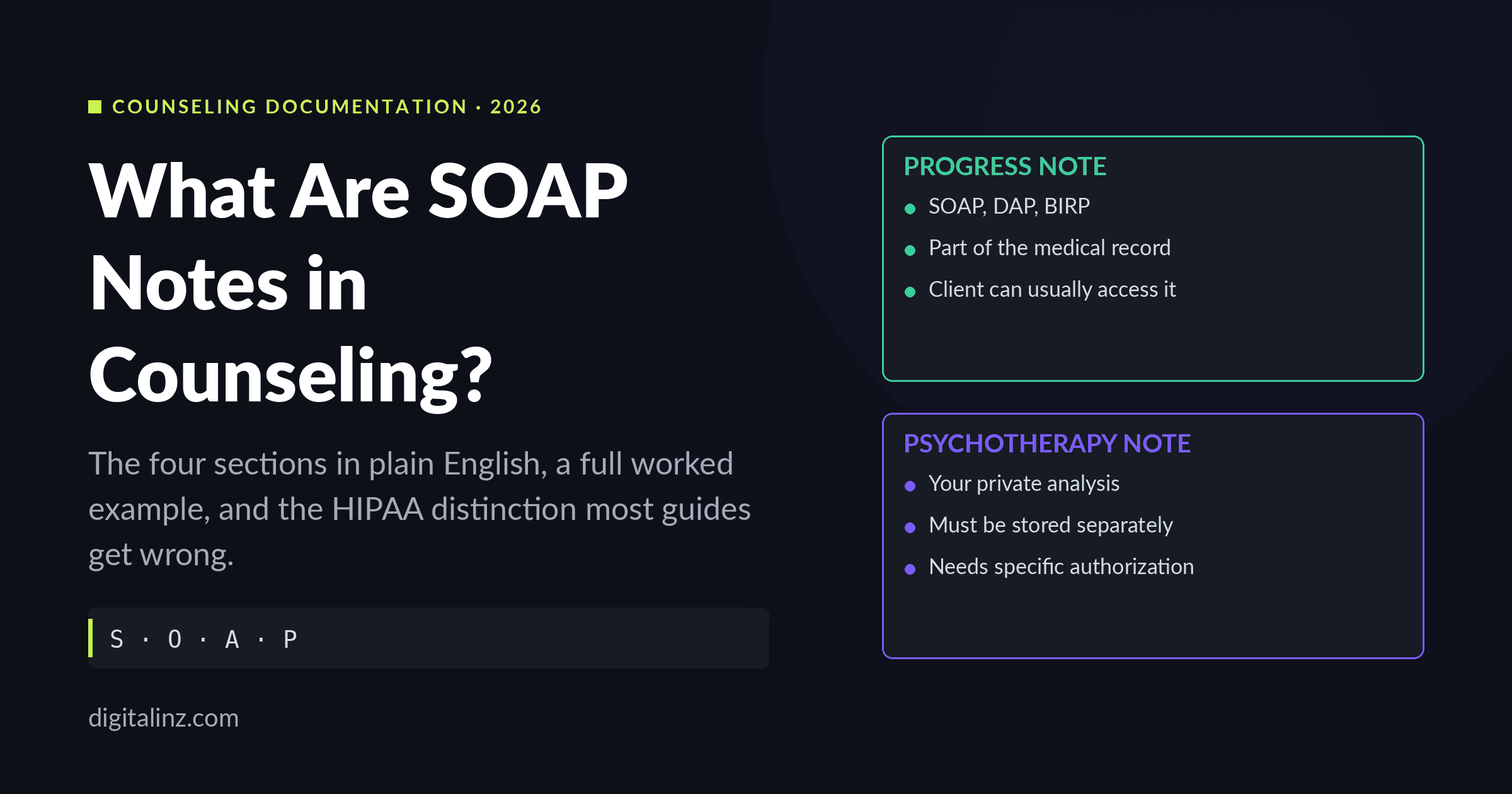
What Are SOAP Notes in Counseling? A Plain-English Guide
If you have just started a counseling program, a practicum, or a new job at an agency
that expects SOAP notes by Friday, this is the short version: a SOAP note is a structured
way of recording what happened in a session, split into four parts — what the client
said, what you observed, what you think it means, and what happens next.
That’s the whole idea. The rest of this guide covers where the format came from,
what actually belongs in each section, a complete example, and one distinction that matters
more than any other and that a surprising number of guides get wrong.
|
Free · no email required Printable progress note templates Want to see the sections laid out on a page? Two free packs — blank and guided SOAP, DAP and BIRP progress notes, plus intake, treatment plan and discharge summary templates. |
What are SOAP notes in counseling?
SOAP stands for Subjective, Objective, Assessment, and Plan. It is a
four-part template for clinical documentation. In counseling, a SOAP note records one
session: the client’s own report, your clinical observations, your professional
judgment about what those mean, and the plan going forward. It becomes part of the
client’s clinical record and can be read by supervisors, auditors, insurers, and in
some circumstances a court.
This guide is written for counselors. If you came here from another discipline — nursing, physical therapy, speech pathology, veterinary practice — the cross-disciplinary version is at what are SOAP notes, which covers how each field adapts the format.
Why counseling borrowed a medical format
SOAP wasn’t designed for therapy. Dr. Larry Weed developed it around fifty years
ago as part of the problem-oriented medical record, aimed at physicians managing multiple
concurrent medical problems. It spread through hospitals, then through every discipline that
shares a chart with a hospital — nursing, physical therapy, speech therapy, social
work, and eventually counseling and psychotherapy.
It stuck in mental health for a practical reason rather than a theoretical one:
behavioral health increasingly shares records and reimbursement systems with the rest of
healthcare, and a format everyone recognises reduces friction. It also happens to be a
decent thinking tool. Forcing yourself to separate what the client reported from what you
observed from what you concluded is genuinely useful discipline, and it makes sloppy
reasoning visible.
The mismatch is real, though. The original format assumes vital signs, lab results and
physical examination findings. A counseling session has none of those. Translating
“Objective” into something meaningful for a fifty-minute conversation is where
most of the confusion starts — and it’s covered in depth in our
complete guide to SOAP notes for therapists.
The four sections in plain English
S — Subjective: what the client tells you
Their report, in their frame of reference. How they say they’ve been, what
happened this week, what they think the problem is. Direct quotes go here when the exact
wording matters.
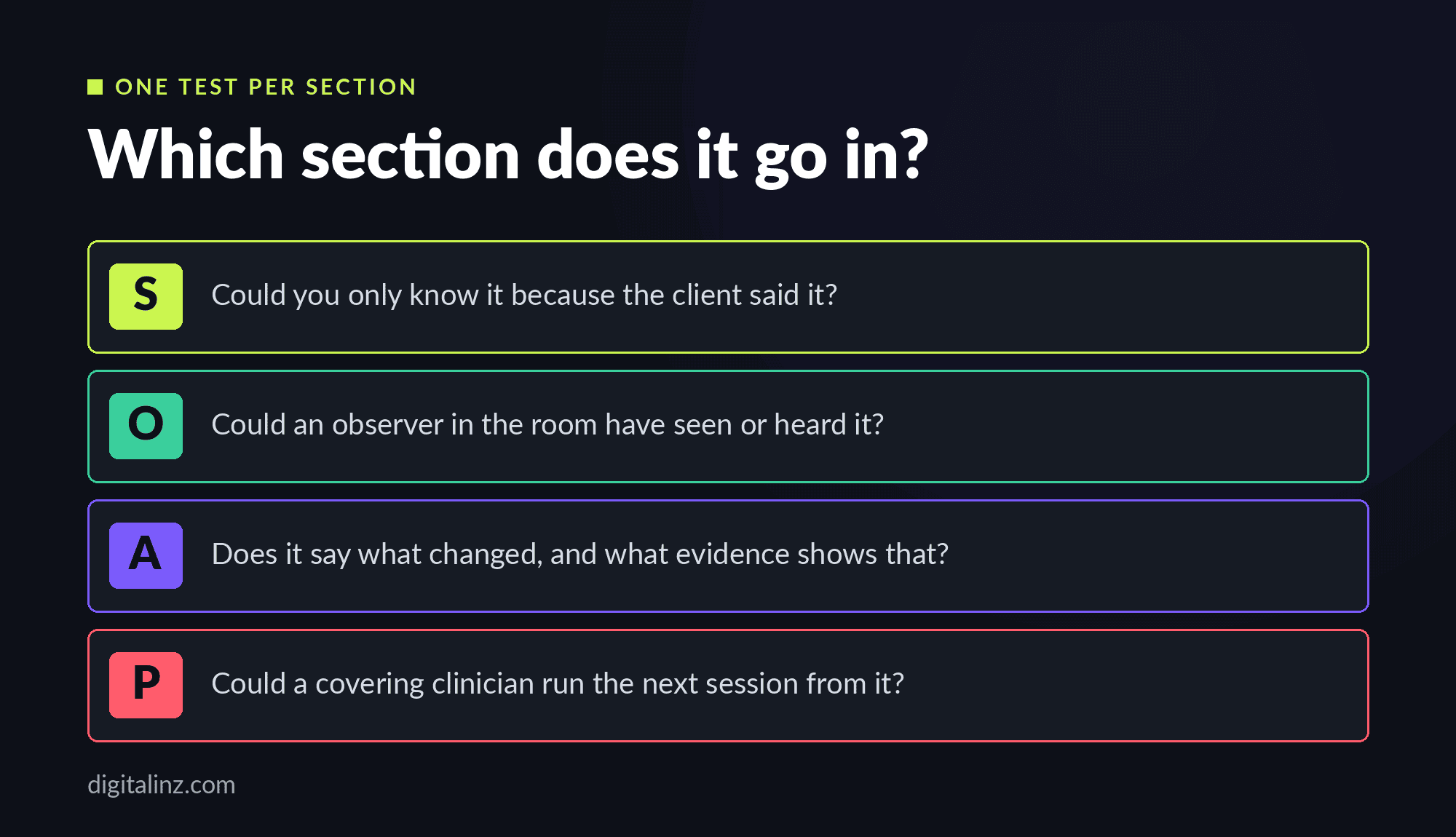
The test: if you could only know it because the client said it, it belongs in
Subjective.
O — Objective: what you observe and measure
Appearance, behavior, speech, affect, orientation, attention. Any scores from
instruments you administered, like the PHQ-9 or GAD-7. Attendance and punctuality. And the
interventions you actually delivered in the session.
The test: could a competent observer sitting in the room have seen or heard it,
and would two clinicians describe it the same way?
A — Assessment: what you think it means
Your clinical reasoning. How the client is progressing against their treatment goals,
how they responded to what you did, your diagnostic impression, your risk judgment and the
reasoning behind it.
This is the section beginners most often under-write, and it is the one that carries the
most weight. “Client seems better” is not an assessment. An assessment says what changed, what evidence supports that, and what you conclude from it — a thin Assessment is the most consequential of the common SOAP note mistakes.
P — Plan: what happens next
The focus of the next session, homework with enough specificity to be actionable, session
frequency, referrals, and any change to the treatment plan.
The test: could a colleague covering for you next week pick up the case from
this alone?
|
A complete example
Composite, not a real client. Note how each section stays in its own lane — the
mood rating sits in Subjective because the client reported it, while the PHQ-9 score sits in
Objective because it was administered and scored.
S — Subjective. Client reported increased conflict at home over the past week, describing two arguments with their partner about finances. Rated their mood as “a 4 out of 10, most days.” Reported sleeping approximately five hours per night. Completed the between-session breathing exercise on three of seven days and said it “helped in the moment but I keep forgetting.”
O — Objective. Arrived on time, casually dressed and appropriately groomed. Speech normal in rate and volume. Affect mildly constricted, congruent with reported mood. Oriented ×4. No psychomotor abnormality observed. PHQ-9 administered: 11. Denied suicidal ideation on direct questioning. Interventions delivered: reviewed homework adherence, introduced a habit-stacking cue for the breathing exercise, psychoeducation on the sleep–irritability relationship.
A — Assessment. Client’s presentation is consistent with the moderate depressive symptoms identified at intake, with situational stress from financial conflict acting as a current maintaining factor. Homework adherence at three of seven days reflects a cueing problem rather than motivation, based on client’s own account, which is why the intervention this session targeted the cue rather than the rationale. Short sleep duration is likely amplifying irritability and is worth addressing before it compounds the relational stress. No risk indicators present. Continued weekly treatment is appropriate.
P — Plan. Continue weekly 50-minute individual sessions. Homework: breathing exercise attached to an existing daily habit (after brushing teeth, morning and evening); brief sleep log. Next session: review sleep log and introduce problem-solving structure for the finance conversation. Re-administer PHQ-9 at session 6.
That note is around 230 words and would take six to eight minutes to write once the
format is habitual. Length isn’t the goal; the goal is that someone reading it
understands what happened, what you thought, and why.
The distinction that matters most: SOAP notes are progress notes
This is the part worth getting right, because it is frequently misunderstood and it has
real legal consequences.
Under HIPAA, clinical documentation in mental health splits into two categories with very
different protection levels. Progress notes are part of the medical record.
Psychotherapy notes — sometimes called process notes or private notes
— get special protection and generally require the client’s specific written
authorization to disclose, separate from any general release.
People often assume that because a note is about therapy, it is a psychotherapy note.
That is not how the regulation works.
45 CFR 164.501 defines psychotherapy notes as notes
analyzing the contents of a counseling conversation that are kept separate from the rest
of the medical record, and it explicitly excludes:
stop times, the modalities and frequencies of treatment furnished, results of clinical
tests, and any summary of diagnosis, functional status, the treatment plan, symptoms,
prognosis, and progress to date.
Look at that exclusion list against a SOAP note. Symptoms, diagnosis, treatment plan,
progress to date — that is essentially the whole of a SOAP note.
is part of the medical record, it is disclosable under a standard authorization, and a
client generally has a right of access to it. Writing something in SOAP format does not give
it heightened protection. If you keep separate reflective notes for your own thinking, those
must be stored genuinely separately from the record to qualify — if they sit in the
same file as your progress notes, they lose the protection entirely.
The practical consequence: write every SOAP note as though the client will read it,
because they may well be entitled to. That is not a reason to write less — it is a
reason to write carefully, and to keep speculation out of a document that was never designed
to hold it.
Who actually requires SOAP notes?
Fewer people than you might think require SOAP specifically. What is near-universally
required is that you document, that the documentation supports medical necessity, and that it
demonstrates skilled clinical care.
- Insurers and managed care require documentation adequate to justify the
service billed. Most do not mandate a format, but they will deny or claw back payment where
the note doesn’t show why the session was clinically necessary. - Agencies and group practices frequently do mandate a format, usually
whichever one their EHR is built around. This is the most common reason a counselor is
required to use SOAP. - Licensing boards set record-keeping standards that vary considerably by
state and by profession, and generally speak to content and retention rather than acronym. - Supervisors during practicum and pre-licensure often require SOAP because
its structure makes your clinical reasoning legible — which is exactly what they need to
assess.
Check your own state board and your payer contracts rather than relying on any general
guide, including this one. The requirements genuinely differ.
SOAP, DAP or BIRP?
SOAP separates the client’s report from your observations. More
structure, slightly slower, holds up well under review.
DAP merges those into a single Data section, leaving Data, Assessment,
Plan. Faster to write and common in community mental health, at the cost of the
subjective/objective distinction.
BIRP — Behavior, Intervention, Response, Plan — foregrounds
what you did and how the client responded. Popular in case management and settings where
demonstrating the intervention is the priority.
All three are defensible. If your setting doesn’t mandate one, pick the one you will
actually complete the same day. Our
SOAP, DAP and BIRP
templates cover all three side by side, and SOAP vs DAP vs BIRP notes writes the same session out in each format so you can see what you gain and lose.
When to write them, and how long they take
Write immediately after the session wherever possible. Recall for session detail degrades
fast, and a note written three days later is measurably thinner than one written in the ten
minutes afterwards. Many agencies and payers set explicit timeliness expectations —
24 or 72 hours are common — and modern EHRs timestamp everything, so a batch of notes
all created on a Sunday evening is visible to anyone who looks.
Six to ten minutes per note is a realistic steady state. If yours consistently take
longer, the bottleneck is usually the Assessment section, and the fix is usually to write it
against the treatment plan rather than from a blank page.
Frequently asked questions
What does SOAP stand for in counseling?
Subjective, Objective, Assessment, Plan. Subjective is the client’s report,
Objective is what you observed and measured, Assessment is your clinical judgment, and Plan
is what happens next.
Are SOAP notes the same as progress notes?
SOAP is a format; progress note is a category. A SOAP note is one kind of progress note.
Both DAP and BIRP notes are also progress notes. All of them sit in the medical record, and
none of them are psychotherapy notes in the HIPAA sense.
Can a client read their SOAP notes?
Generally yes. Progress notes are part of the designated record set, and clients typically
have a right of access, with narrow exceptions. Psychotherapy notes are treated differently.
Write accordingly.
How long should a SOAP note be in counseling?
Usually 150–300 words for a routine session. Long enough to justify your clinical
decisions, short enough that a reader finds what they need. A long note that omits your
reasoning is weaker than a short one that includes it.
Do I write a SOAP note for every session?
Yes. Every billable clinical contact should generate a note, and in most settings so
should significant non-session contacts — crisis calls, care coordination,
collateral conversations — though those may use a different template.
What if I make a mistake in a signed note?
Never delete or overwrite it. Add an addendum stating the correction, the reason and the
date. Every EHR keeps an audit trail, and an altered note looks considerably worse than an
openly corrected one.
This article is general professional information for licensed clinicians and students, not legal, clinical or compliance advice. Documentation requirements vary by state, licensing board, payer and setting. Any example notes are composites written for illustration and do not describe real clients.