ChatGPT Prompts for Progress Notes: SOAP, DAP & BIRP Templates
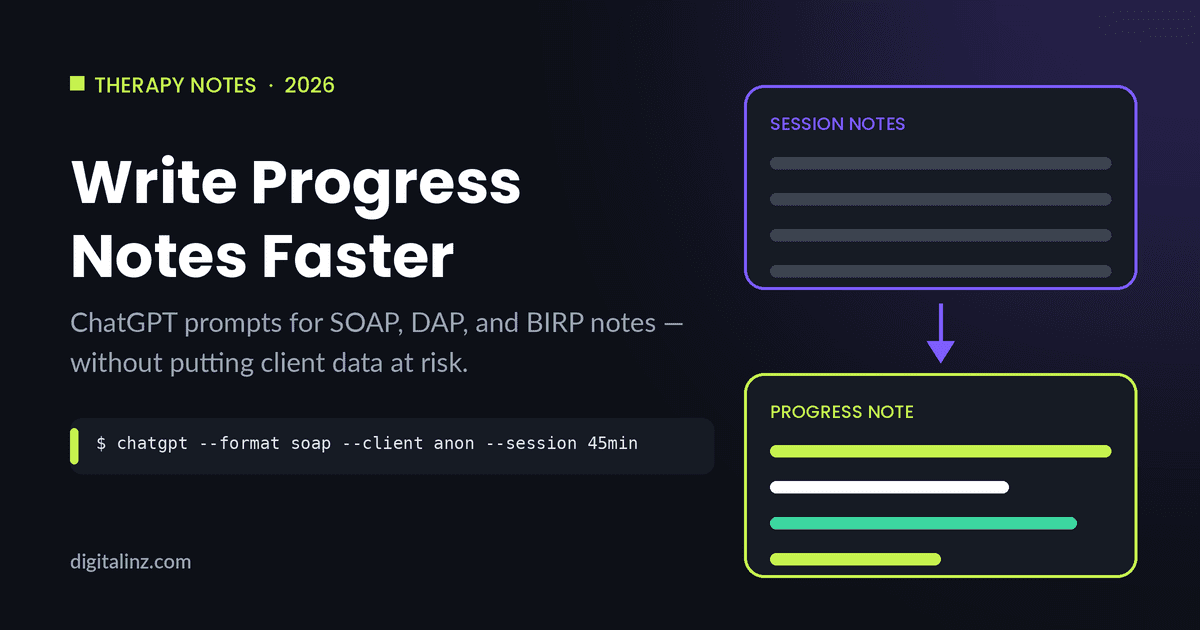
ChatGPT prompts for progress notes can cut the time therapists spend on documentation by 50% or more — without introducing the privacy risk most clinicians worry about. The key is de-identifying your session notes before they ever reach ChatGPT, then using a format-specific prompt (SOAP, DAP, or BIRP) to get output that reads like clinical documentation rather than a chatbot summary. This guide gives you a working prompt for each format and a safe de-identification workflow you can use starting today.
Why Progress Notes Take So Long — and Where ChatGPT Fits
Clinical documentation is time-consuming not because it’s intellectually demanding, but because it requires translating what happened in a session into a specific structured format in professional language — a task that demands consistent mental effort for every single note. After a full caseload, that effort adds up. The APA’s Record Keeping Guidelines outline what progress notes must document (presenting problems, treatment goals, interventions, response, and plan) — and while the guidelines don’t dictate format, they establish the clinical standard ChatGPT output needs to meet.
ChatGPT doesn’t replace your clinical judgment — it handles the drafting and formatting work so you can focus on the accuracy and completeness of the output. The workflow: jot your rough session notes in whatever format is fast for you, strip out all identifying information, paste the de-identified notes into a format-specific prompt, review and edit the output, then paste the final version into your EHR. The total time from rough notes to finalized documentation drops significantly.
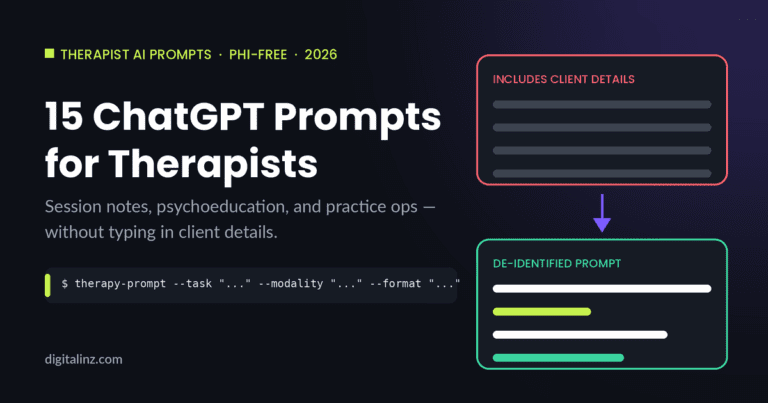
If you’re still building your overall ChatGPT workflow as a clinician, start with our guide to ChatGPT prompts for therapists without PHI — it covers the full de-identification framework before you start using format-specific prompts like the ones below.
ChatGPT Progress Note Prompts by Format
SOAP Notes (Subjective, Objective, Assessment, Plan)
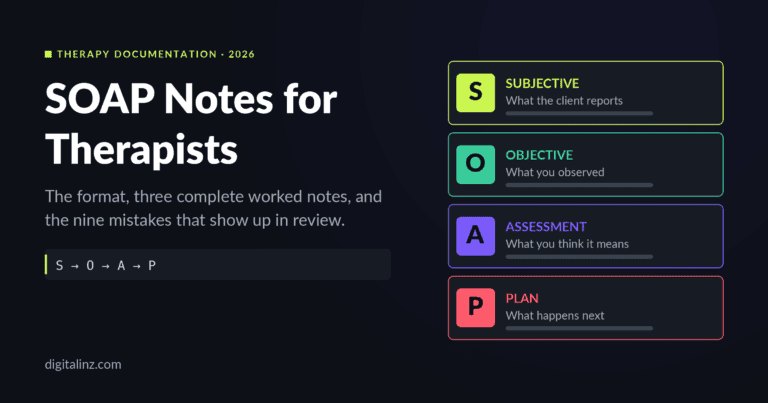
Prefer paper? Our free progress note templates cover all three formats, blank and guided. If you have not settled on a format yet, SOAP vs DAP vs BIRP notes compares all three on the same session. SOAP is the most widely used clinical note format and the one ChatGPT handles best — the four-section structure maps cleanly to prompt instructions. The key is giving ChatGPT actual content for each section rather than leaving it to infer the clinical picture — our guide to SOAP notes for therapists breaks down what belongs in each of the four.
The SOAP Note Prompt:
“You are a clinical documentation assistant. Using the following de-identified session notes, write a SOAP progress note in professional clinical language. S (Subjective): what the client reported. O (Objective): observable behaviors, affect, and presentation. A (Assessment): clinical impression, diagnosis context, and progress toward goals. P (Plan): interventions used this session, homework or referrals, and next session plan. Notes: [PASTE DE-IDENTIFIED NOTES]. Keep each section to 2-4 sentences. Avoid speculation beyond what is in the notes. Do not include any identifying information.”
Example output for a de-identified session on relationship conflict: “S: Client reports ongoing conflict with partner around household responsibilities; rates anxiety at 6/10 and sleep quality as poor. O: Affect dysthymic with occasional tearfulness; maintained eye contact and engaged throughout. A: Generalized anxiety disorder with interpersonal stressors as primary trigger; client demonstrating increased self-awareness of avoidance patterns since last session. P: Practiced cognitive restructuring around demand-withdraw cycle; assigned journaling exercise between sessions; follow-up in one week.”
DAP Notes (Data, Assessment, Plan)
DAP condenses the SOAP format into three sections, combining subjective and objective observations into a single “Data” section. It’s faster to write than SOAP and works well for outpatient settings where detailed behavioral observations aren’t always required. ChatGPT handles DAP reliably when the prompt is clear about what belongs in D versus A.
The DAP Note Prompt:
“You are a clinical documentation assistant. Using the following de-identified session notes, write a DAP progress note. D (Data): combine the client’s self-report with your behavioral observations in 3-5 sentences. A (Assessment): your clinical impression, link to diagnosis, and progress toward treatment goals. P (Plan): interventions used, between-session work assigned, and plan for next session. Notes: [PASTE DE-IDENTIFIED NOTES]. Use clear clinical language. No identifying information.”
Example output for a de-identified grief session: “D: Client reports difficulty returning to work following bereavement; describes intrusive memories and avoidance of the deceased’s belongings; affect subdued with flat speech. A: Prolonged grief disorder consistent with presenting history; mild improvement in daily functioning reported since previous session, though avoidance behaviors remain pronounced. P: Introduced imaginal revisiting exercise; reviewed sleep hygiene strategies; scheduled weekly sessions for the next month.”
BIRP Notes (Behavior, Intervention, Response, Plan)
BIRP is structured around what the client did and how they responded to your interventions — making it well-suited for CBT, DBT, and other structured modalities where the link between intervention and response is central to documentation. It’s also the format most likely to satisfy managed care documentation requirements. Give ChatGPT the specific intervention and the client’s observable response and you’ll get tight, defensible output.
The BIRP Note Prompt:
“You are a clinical documentation assistant. Using the following de-identified session notes, write a BIRP progress note. B (Behavior): client’s presentation and reported symptoms this session. I (Intervention): the specific therapeutic interventions used, including techniques or modalities. R (Response): how the client responded to each intervention — what they said, did, or shifted. P (Plan): next steps, homework, referrals, and next session frequency. Notes: [PASTE DE-IDENTIFIED NOTES]. Keep clinical language precise. No identifying information.”
Example output for a de-identified DBT skills session: “B: Client reported urge to self-isolate following workplace conflict rated 8/10 distress; arrived 10 minutes late and presented with guarded affect. I: Reviewed TIPP skills applied since last session; practiced interpersonal effectiveness script using DEAR MAN with role-play around the workplace situation. R: Client demonstrated improved affect during role-play; reported reduction in distress to 5/10 after exercise; verbalized awareness of ‘mind reading’ distortion. P: Assigned diary card tracking interpersonal urges; encouraged peer support contact before next session; continue weekly frequency.”
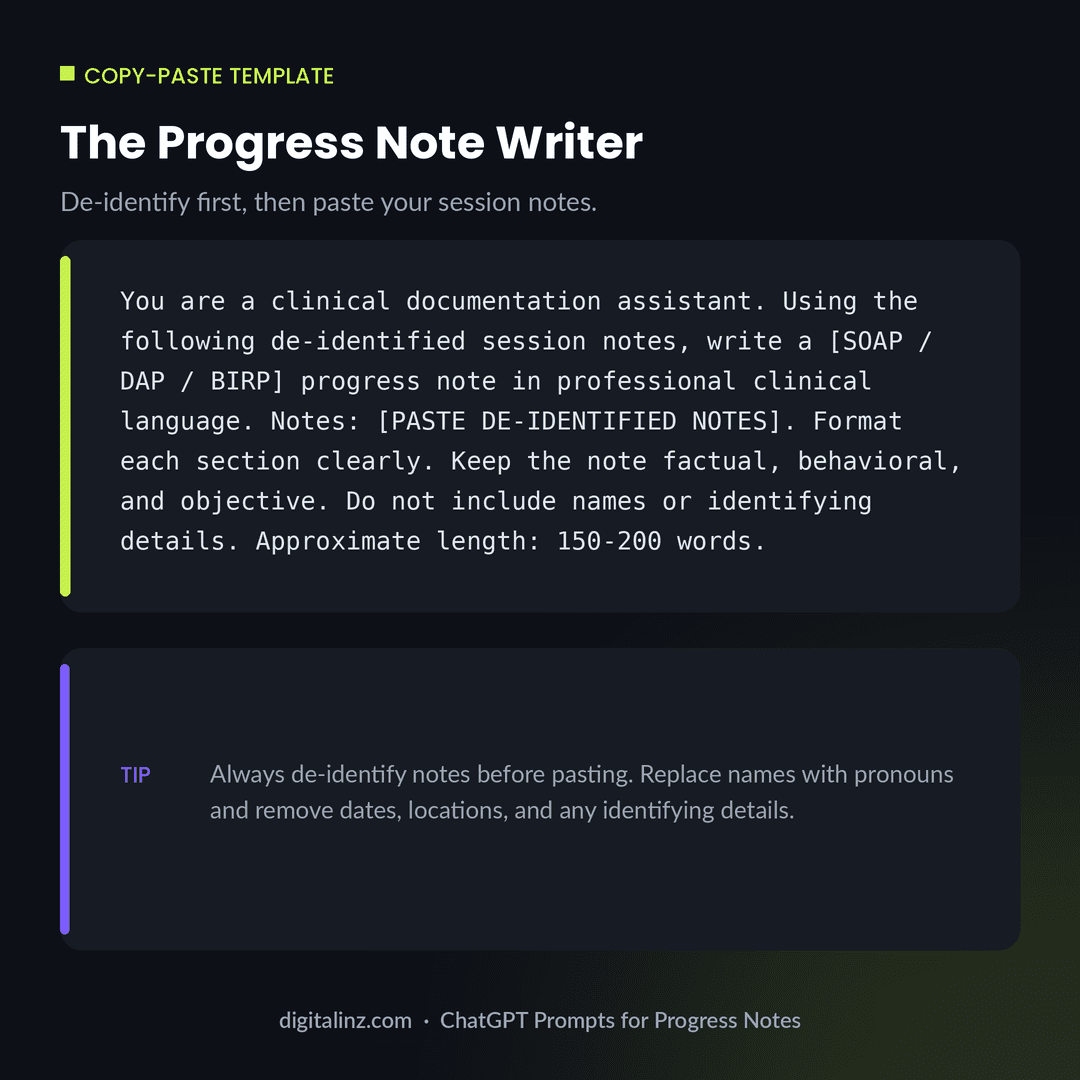
Copy-Paste: The Progress Note Writer
This is the universal starting prompt — swap in your format (SOAP, DAP, or BIRP) and paste your de-identified notes. Edit the output for accuracy before entering it in your EHR.
Before and After: Vague vs. Specific Progress Note
Same session — completely different note quality. The first example would fail an audit; the second meets APA documentation standards.
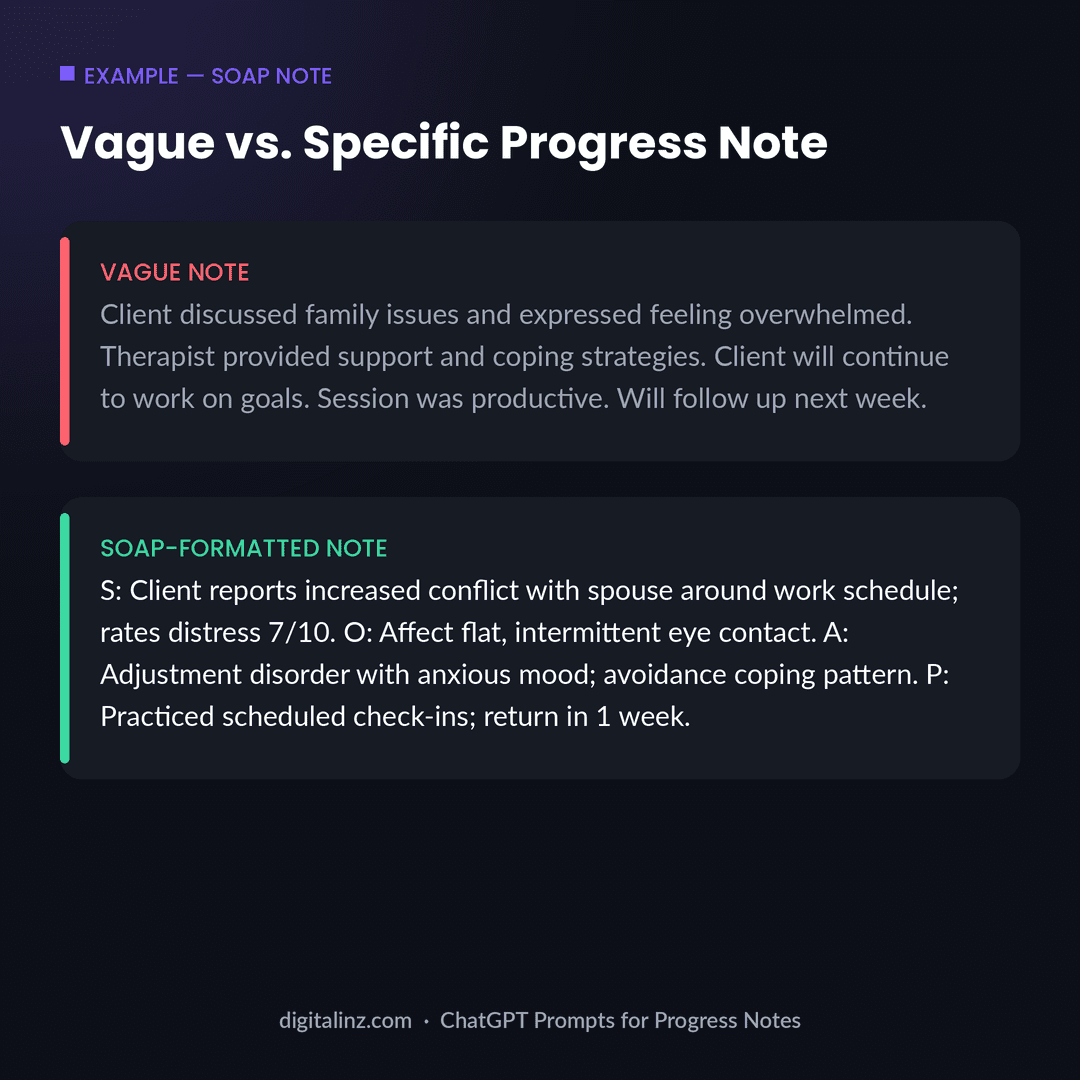
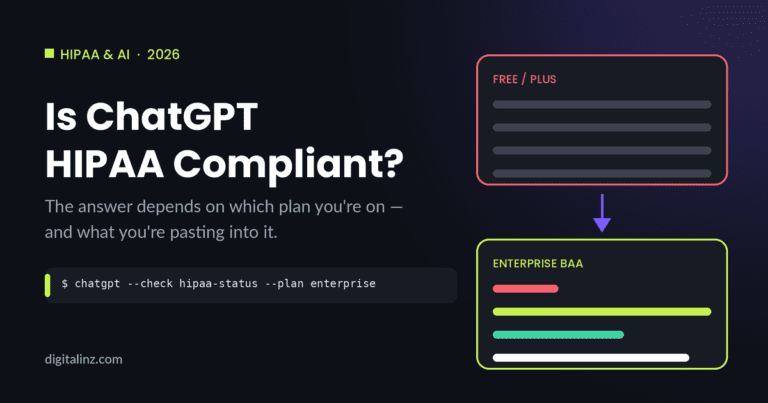
The vague note describes nothing that could be reviewed by a supervisor, insurer, or licensing board. The SOAP-formatted note documents the presenting problem in measurable terms, an observable finding, a clinical impression, and a specific plan — everything required to justify the session and demonstrate progress toward treatment goals. ChatGPT prompts for progress notes don’t make clinical decisions; they make it easier to document the clinical decisions you’ve already made, in the format your license and your payers require. For the full picture on what you can and can’t safely use ChatGPT for as a clinician, see our breakdown of whether ChatGPT is HIPAA compliant — the answer depends on which version you’re using and how.
FAQ: ChatGPT Prompts for Progress Notes
Is it safe to use ChatGPT to write therapy progress notes?
Yes — if you de-identify your session notes before pasting them. The standard ChatGPT interface is not a HIPAA Business Associate, so it cannot receive Protected Health Information (PHI). Remove or replace all identifying details (names, dates, locations, diagnosis combined with identifiers) before using any AI tool. De-identified notes do not constitute PHI under HIPAA, so they can be safely used in ChatGPT prompts.
What’s the fastest way to de-identify session notes for ChatGPT?
Use a consistent template: replace the client’s name with “client” or a pronoun, remove specific dates (use “this session” or “last week”), replace locations with generic descriptors, and avoid including the full diagnosis combined with any other identifier. A quick mental checklist — name, date, location, diagnosis + ID — takes about 30 seconds per set of notes and eliminates the HIPAA risk.
Will ChatGPT-assisted progress notes pass a licensing board audit?
That depends entirely on the accuracy and completeness of your review. ChatGPT produces a draft — the clinician is responsible for verifying that the note accurately reflects what occurred in the session. If you review, edit, and finalize the note before entering it in your EHR, the resulting documentation is yours professionally. The fact that AI assisted with drafting is not inherently a licensure issue, though some state boards are beginning to address AI disclosure; check your jurisdiction’s current guidance.
Which note format — SOAP, DAP, or BIRP — works best with ChatGPT?
SOAP produces the most consistently structured output because the four-section format maps cleanly to prompt instructions. DAP is faster to prompt and review. BIRP is the strongest choice for structured modalities like CBT and DBT where documenting the intervention-response link is clinically and administratively important. Use whichever format your setting and payers require — the prompt structure works for all three.
For the SOAP format specifically — including a full worked example and the four section-by-section prompts — see can ChatGPT write SOAP notes.
The Shortcut
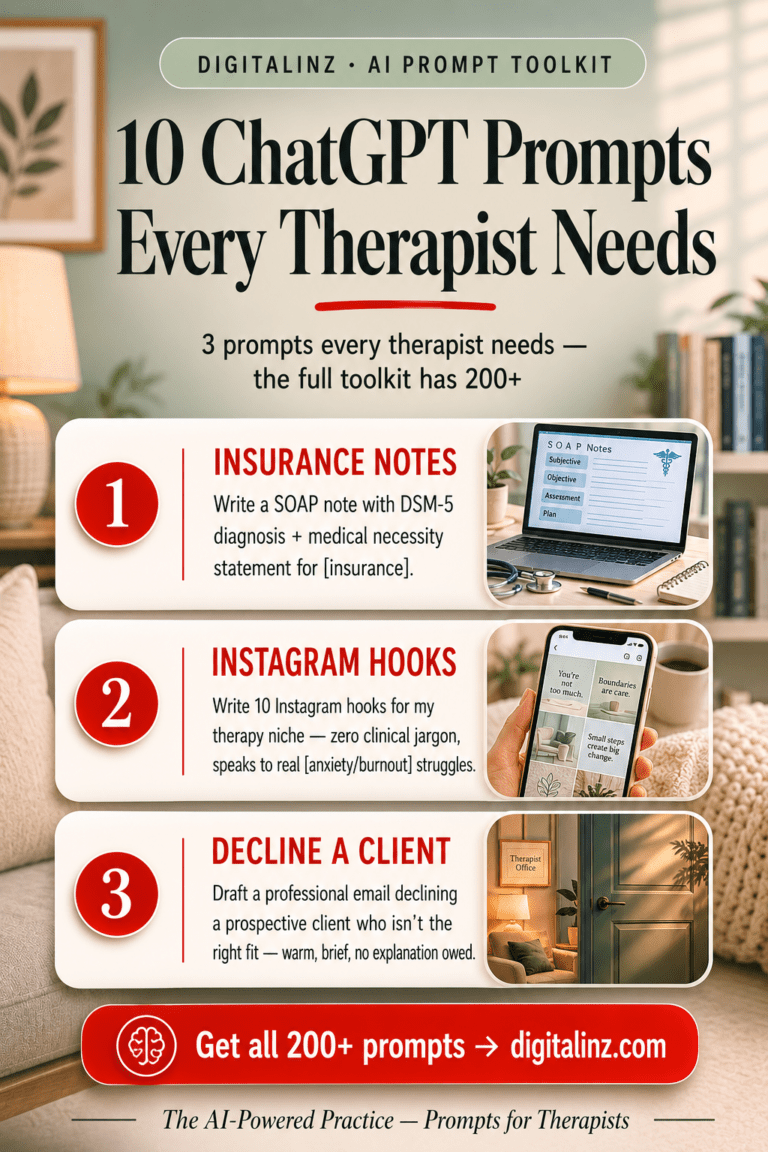
Progress notes are just one of the documentation tasks eating your after-hours time. Our Therapist AI Toolkit includes 200+ ready-to-use prompts for progress notes, treatment plans, intake documentation, psychoeducation, and private practice marketing — all structured so you can de-identify and paste in under a minute.
Also available on Gumroad.