How to Write SOAP Notes for Counseling: A Step-by-Step Workflow
Most guides to SOAP notes explain what goes in each of the four sections and stop there.
That is the easy half. The hard half is that it is 7pm, you have four notes open, and
knowing the definition of “Assessment” is doing nothing to help you write one.
This is a workflow rather than a definition: what to do before the session, what to
capture during it, and the exact sequence to write in afterwards. If you want the anatomy of
each section first, that’s in our complete guide to SOAP notes for
therapists.
|
Free · no email required Printable progress note templates The guided page turns this workflow into questions you answer. Two free packs — blank and guided SOAP, DAP and BIRP progress notes, plus intake, treatment plan and discharge summary templates. |
The counterintuitive part: don’t write in SOAP order
SOAP is the order the note is read in. It is a poor order to write in,
and writing top-to-bottom is the most common reason a note takes twenty-five minutes instead
of eight.
Starting with Subjective means starting with the hardest editorial judgment in the note
— deciding which parts of a fifty-minute conversation mattered. That is a genuinely
demanding call, and making it first, while tired, is why people stall and end up
transcribing the session instead.
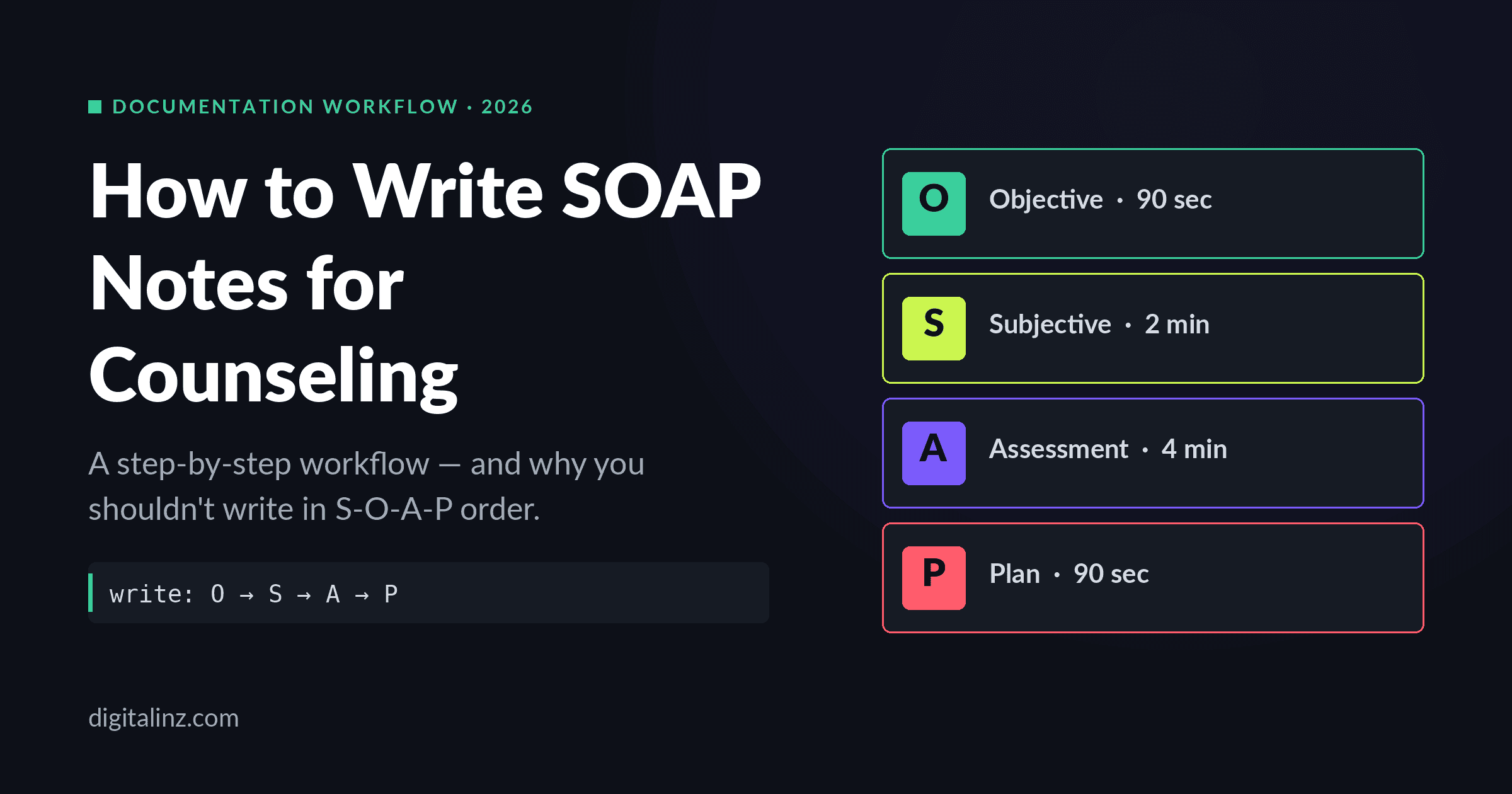
Write O → S → A → P instead. Objective is concrete,
requires no interpretation, and takes ninety seconds. Doing it first gets the note started
and, more usefully, reloads the session into working memory before you have to make any
judgment calls.
This isn’t an idiosyncratic preference. Reordering SOAP is well established in
clinical documentation — the
StatPearls reference on SOAP notes discusses APSO (Assessment, Plan, Subjective,
Objective), which some systems adopt because it puts the clinically actionable material
first for the reader. The section order in the finished note stays conventional. Only your
writing order changes.
If you want the sequence below as something you can print and keep on the desk, the free template pack has a guided SOAP page with the questions for each section.
Before the session: sixty seconds
Open the treatment plan and the last note. Read the goals and the previous Plan section.
That’s it.
This costs a minute and saves five, because the Assessment section is fundamentally a
statement about progress toward goals. If you don’t have the goals in mind, you will
write the Assessment from a blank page every single week — which is exactly the
bottleneck most clinicians describe when they say notes take too long.
During the session: capture four things, not forty
Don’t take running notes. Clients notice, and it costs you the observational data
that fills the Objective section. Instead, hold four things:
- One or two exact quotes that carry clinical weight. Jot these down
verbatim if you need to — wording degrades fast in memory. - Any measure score you administered.
- The one thing that was different from last session, in either
direction. - Anything risk-related, including a negative answer to a direct
question.
Everything else you will still have in the ten minutes afterwards. These four are the
ones that evaporate.
|
The ten minutes after: the writing sequence
Step 1 · Objective — ninety seconds
Step 2 · Subjective — two minutes
Step 3 · Assessment — four minutes
The three-sentence Assessment
1. What changed, and what shows it. Name the change and attach the evidence. “Avoidance has narrowed from all social settings to work meetings; GAD-7 down 16 to 11.”
2. What you think explains it. Your formulation. “Consistent with the exposure hierarchy work in sessions 4–6 rather than situational relief, given the change held across a high-stress week.”
3. What that means for treatment. The clinical consequence, which becomes your Plan. “Ready to move to hierarchy step 4; sleep remains the lagging domain and needs a different intervention.”
Three sentences is a floor, not a ceiling. But a note that has all three is defensible, and one that has none is not — regardless of length.

Step 4 · Plan — ninety seconds
A worked example, built in that order
One example here, and nine more across different presentations and stages of treatment if you want to see the range.
Composite, not a real client. Watch how each step feeds the next — by the time the
Assessment is written, the Plan is almost automatic.
Step 1, Objective. “Arrived on time, appropriately groomed. Speech normal in
rate and volume. Affect brighter than prior sessions, congruent. Oriented ×4. GAD-7
administered: 9 (intake 16, session 4 13). Denied suicidal and homicidal ideation on direct
questioning. Interventions delivered: reviewed thought records, in-session cognitive
restructuring targeting Sunday anticipatory anxiety, introduced stimulus control for sleep
onset.”
Step 2, Subjective. “Client reported a ‘much better’ week,
describing two work meetings attended without leaving early — the first since March.
Reported continued difficulty falling asleep, estimated 45–60 minutes on four nights.
Described Sunday evenings as ‘the worst part of the week.’ Completed thought
records on five of seven days. Stated: ‘I noticed I was catastrophizing and I actually
caught it that time.’”
Step 3, Assessment, using the three sentences. “GAD-7 has moved 16 → 13
→ 9 across seven sessions, corroborated by behavioral change — meeting attendance
— rather than self-report alone. This pattern is consistent with genuine response to
CBT rather than social desirability, and client is now applying cognitive restructuring
independently between sessions, which was Goal 1 of the treatment plan. Sleep onset is the
lagging domain and appears maintained by anticipatory worry rather than sleep hygiene, so it
needs a behavioral rather than educational intervention.”
Step 4, Plan. “Continue weekly 50-minute individual CBT. Homework: stimulus
control protocol nightly; thought record on Sunday evenings specifically. Next session:
review sleep data, begin behavioral experiment at hierarchy step 4. Re-administer GAD-7 at
session 10. If sleep onset has not improved by session 10, discuss PCP referral for
medication consultation.”
Around nine minutes, and every clinical decision in it is traceable.
This workflow adapts to DAP and BIRP with minimal changes — SOAP vs DAP vs BIRP notes covers what differs.
Making it stick
Write it in the gap, not at the end of the day. Ten minutes between
clients is the single highest-value scheduling change most clinicians can make. Notes written
same-day are more accurate, and batching them on a Sunday is one of the
most common SOAP note mistakes — visible in any EHR audit log.
Time-box it. Set eight minutes. A note that is 80% written in eight
minutes beats a note that is 100% written in twenty-five, because the second one
doesn’t get written at all on a bad week.
Keep your treatment plan goals somewhere visible. Almost all Assessment
paralysis is the absence of a reference point.
Objective and Plan safely. Using it in the Assessment is how notes end up identical week to
week, which is the most damaging documentation habit there is. Keep the Assessment written
fresh every session, even when the content is similar.
Frequently asked questions
How long should it take to write a SOAP note?
Six to ten minutes for a routine session once the workflow is habitual. If yours reliably
run longer, the bottleneck is almost always the Assessment, and the fix is writing it against
the treatment plan rather than from scratch.
Should I write notes during or after the session?
After. Writing during costs you the observational data that fills Objective, and it
changes the client’s experience of the session. The exception is jotting a measure
score or an exact quote.
Is it bad practice to write notes out of order?
No. The finished note appears in standard S-O-A-P order; only your writing sequence
differs. Nobody reading the note can tell, and reordering for readability is well established
in clinical documentation generally.
What if nothing changed this session?
Then say so, with evidence, and say what you conclude from it. “No measurable
change on PHQ-9 across three sessions; client engagement remains strong, which suggests the
intervention rather than the alliance needs revisiting” is a perfectly good Assessment.
Plateau is clinical information, not a documentation failure.
Do I need a SOAP note for a cancelled or no-show session?
You need a record of the contact, though usually not a full SOAP note. Document the
no-show, any outreach you made, and any clinical concern it raises — particularly for a
client with elevated risk, where a pattern of missed sessions is itself clinically
meaningful. Follow your agency or practice policy.
Where do I start if I’m completely new to this?
Start with what are SOAP notes in counseling for the plain-English
version, then come back to this workflow once the four sections make sense.
This article is general professional information for licensed clinicians and students, not legal, clinical or compliance advice. Documentation requirements vary by state, licensing board, payer and setting. Any example notes are composites written for illustration and do not describe real clients.