
Can ChatGPT Write SOAP Notes? 5 Rules for Therapists
Yes — ChatGPT can write SOAP notes, and it’s genuinely good at the part most clinicians find tedious: turning shorthand session observations into clean, structured clinical language. What it cannot do is form the clinical impression, and what you must never do is paste protected health information into it. Get those two boundaries right and it turns a 12-minute note into a 3-minute one. Get them wrong and you have a HIPAA problem instead of a time-saver. Wondering whether you are permitted to at all, rather than how? Is it okay to use ChatGPT for therapy notes covers the consent and ethics side. New to the format entirely? What are SOAP notes in counseling covers it in plain English. If you want the format itself first, our full guide to SOAP notes for therapists covers what belongs in each section with three complete worked notes. Here are the five rules, four section-by-section prompts, and a complete worked example.
For finished notes to compare AI output against, see ten complete SOAP note examples.
|
Free · no email required Printable progress note templates Prefer to work on paper before anything goes near a model? Two free packs — blank and guided SOAP, DAP and BIRP progress notes, plus intake, treatment plan and discharge summary templates. |
The short answer, before the caveats
ChatGPT writes language. You supply the clinical content. That division is the whole thing.
What it does well:
- Turning rough shorthand into full sentences in a consistent clinical register
- Keeping S, O, A and P properly separated — most rushed notes blur subjective and objective
- Producing behavioral, observable descriptions instead of vague ones
- Keeping tone and structure consistent across a whole caseload
- Rewriting a note you’ve already drafted so it’s tighter and more defensible
What stays with you:
- The clinical impression — the A in SOAP is your judgment, not a language model’s
- Risk assessment, and any decision that follows from it
- Diagnosis, and any change to it
- What actually happened in the room
- Whether the finished note is accurate — you’re signing it
A model that wasn’t in the session cannot assess the client. It can only make your assessment read better. That sounds like a small distinction until you’re the one whose license is attached to the record.
The rule that isn’t optional: de-identify first
Standard consumer ChatGPT is not covered by a Business Associate Agreement. Without a BAA in place, putting protected health information into it is a disclosure you almost certainly aren’t permitted to make. Some enterprise and API arrangements can be covered — if you believe yours is, confirm it in writing rather than assuming.
The practical fix costs you nothing. HHS’s guidance on de-identification of PHI sets out the Safe Harbor method: strip the 18 categories of identifier and the information is no longer PHI. For note-writing, that means describe the presentation, never the person.
Never enter: names or initials, dates of birth, the date of the session, addresses or ZIP codes, phone numbers or email addresses, record or insurance numbers, employer or school names, or any other detail that could reasonably identify someone in a small community.
Write instead: “Adult client, mid-30s, presenting with generalized anxiety, session 6 of a CBT course.” That produces exactly the same quality of note, and nothing identifying has left your practice. We go deeper on this in ChatGPT prompts for therapists without PHI, and on the wider compliance question in is ChatGPT HIPAA compliant.
The five rules
Rule 1: Give it the section, not just the session
“Write a SOAP note about anxiety” returns four vague paragraphs. Prompting section by section — or naming all four explicitly — is what produces something you’d actually file.
Tell it what belongs where: Subjective = what the client reported, in their framing. Objective = what I observed. Assessment = my clinical impression. Plan = next steps and interventions. Without that, models routinely put observations in Subjective and impressions in Objective, which is exactly the error that makes notes indefensible.
Rule 2: Supply the observations — all of them
This is where quality is won or lost. ChatGPT can only work with what you give it, and it will happily invent plausible-sounding clinical detail to fill gaps.
Feed it your actual shorthand: “Reported sleep 4–5 hrs, 3 panic episodes this week, declined medication referral again, tearful when discussing work, completed 2 of 7 thought records.” That produces a note about this session. “Client had a difficult week” produces a note that could describe anyone.
Rule 3: Write the Assessment yourself, then let it polish
The A is clinical judgment. Do not outsource it and do not let a model generate it from thin material.
Write your impression in whatever rough form you think in — “anxiety still moderate, some improvement in avoidance, sleep is the maintaining factor” — and ask ChatGPT to render it in professional language. You keep the judgment, it fixes the prose. Anything it produces that you didn’t put in, delete.
Rule 4: Ban invention explicitly
Add this to every prompt: “Use only the information I have provided. Do not add symptoms, history, interventions or clinical detail that I have not stated. If something is missing, mark it [MISSING] rather than filling it in.”
Models are built to produce fluent, complete-looking text, and a half-empty clinical note doesn’t look complete. Without an explicit instruction, that pressure gets resolved by inventing. The [MISSING] convention gives it a permitted way to leave a gap.
Rule 5: Read it back before you sign it
You are attesting to the accuracy of the record. Read the finished note against what actually happened, not against what reads well.
Two things to check every time: has anything appeared that you didn’t say, and does the Assessment still sound like your clinical reasoning rather than a generic formulation? If the note could describe three different clients on your caseload, it needs more of your material and less of the model’s.
|
Four prompts, one per section
Most clinicians don’t write a note in one pass — they think in sections. These four are shorter than the master template and better suited to that rhythm.
Subjective
Rewrite these client-reported details as the Subjective section of a
SOAP note. Keep the client's own framing and attribute statements to
them ("client reported…", "client described…"). Do not add anything
I have not stated. No identifying details.

My notes: [shorthand]
Objective
Rewrite these observations as the Objective section of a SOAP note.
Observable and behavioral only — affect, presentation, engagement,
participation, measurable data. Remove anything interpretive; that
belongs in Assessment.

My notes: [shorthand]
Assessment
Render my clinical impression below in professional documentation
language for the Assessment section of a SOAP note. Do not add
clinical conclusions, diagnoses or formulations I have not stated.
Preserve my hedging exactly — if I wrote "possible", keep "possible".

My impression: [rough wording]
That last instruction matters more than it looks. Models routinely upgrade “seems somewhat improved” into “demonstrates marked improvement”, which is a clinical claim you didn’t make and may not be able to defend.
Plan
Rewrite these next steps as the Plan section of a SOAP note. Include
intervention, homework, frequency and any referral. State the next
session interval. Do not invent interventions I have not listed.

My notes: [shorthand]
Copy-paste: the full de-identified SOAP prompt
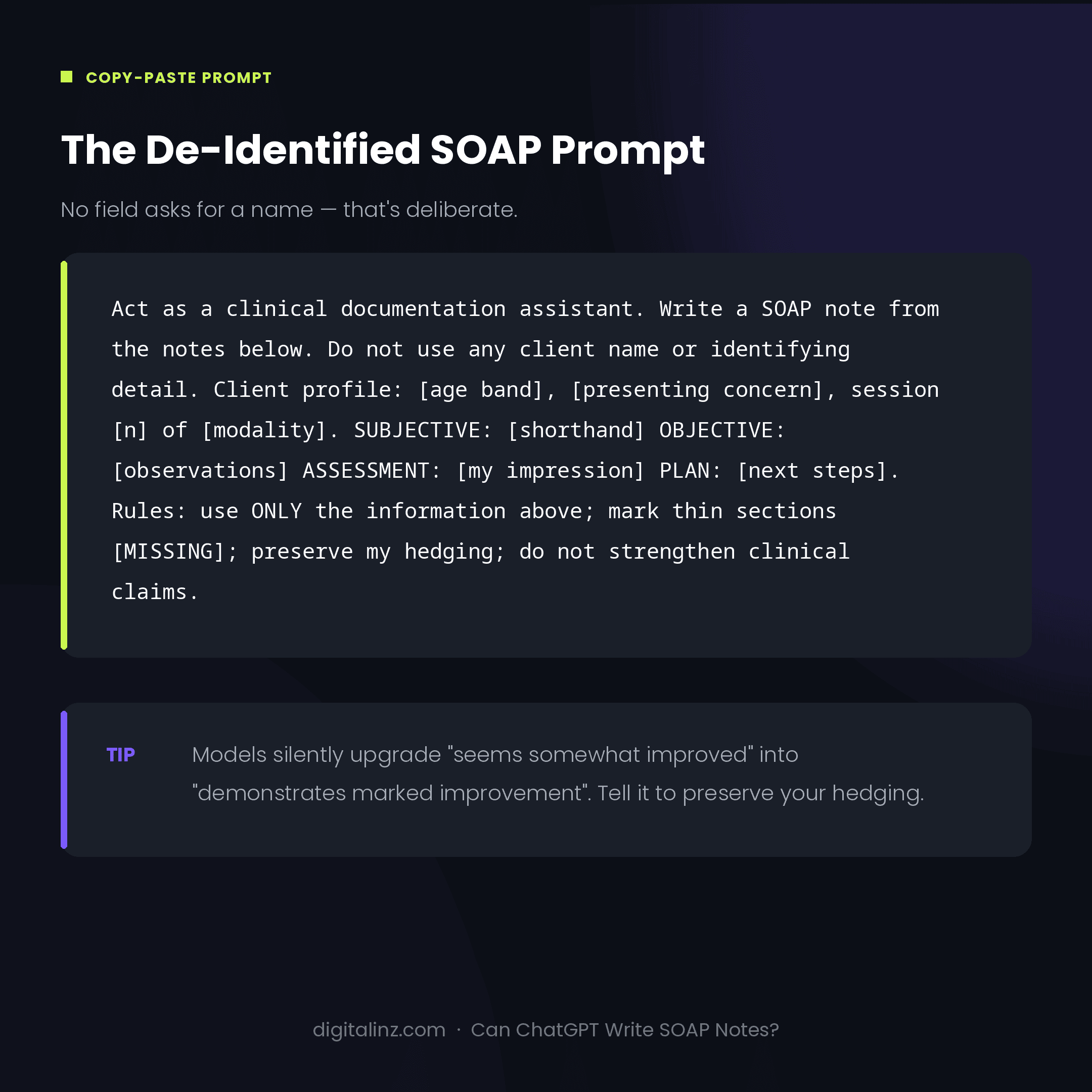
When you do want the whole note in one pass. No field in this template asks for identifying information — that’s deliberate.
Act as a clinical documentation assistant. Write a SOAP note from the
notes below.

Do not use any client name or identifying detail. I will describe a
de-identified presentation only.

Client profile: [age band], [presenting concern], session [number] of
[modality].

SUBJECTIVE — what the client reported: [your shorthand]
OBJECTIVE — what I observed: [affect, presentation, engagement,
participation]
ASSESSMENT — my clinical impression: [your impression, roughly worded]
PLAN — next steps: [interventions, homework, referrals, next session]

Rules:
- Use ONLY the information above. Do not add symptoms, history or
  interventions I have not stated.
- If a section is thin, write [MISSING] rather than filling it in.
- Keep Subjective in the client's framing and Objective to observable
  behavior only.
- Preserve my hedging. Do not strengthen clinical claims.
- Professional clinical register. No therapeutic advice to me.
Save it as a saved prompt or custom instruction. The only parts you change per session are the four content blocks.
A complete worked example
Here is the same session run two ways. The difference is entirely in what went in.
What a vague prompt produces. Given “client had a rough week with anxiety, we did some CBT”, a model returns something like this:
S: Client reports experiencing significant anxiety over the past week,
   describing it as overwhelming at times and impacting multiple areas
   of functioning.
O: Client presented as anxious and appeared to be experiencing
   distress. Engagement in session was good.
A: Client continues to experience symptoms consistent with an anxiety
   disorder. Progress is ongoing and the therapeutic alliance appears
   strong.
P: Continue CBT. Client to practice coping strategies. Follow up next
   week.
Fluent, correctly formatted, and clinically worthless. It could describe any anxious client anywhere. Note also that the model asserted “therapeutic alliance appears strong” and “impacting multiple areas of functioning” — neither was supplied.

Now the same session with real input. Shorthand entered: adult, mid-30s, GAD, session 6 CBT. Sleep 4–5hrs. 3 panic episodes. Declined med referral again. Tearful re work. 2 of 7 thought records done. My read: anxiety still moderate, avoidance improving, sleep is the maintaining factor. Plan: sleep hygiene module, reduce thought records to 3/wk, revisit referral in 2 wks.
S: Client reported sleeping four to five hours per night and
   experiencing three panic episodes since the previous session. Client
   again declined a referral for medication consultation. Client became
   tearful when discussing work.
O: Client was tearful when work was raised, otherwise engaged and
   participatory throughout. Completed two of seven assigned thought
   records.
A: Anxiety symptoms remain at a moderate level. Some improvement noted
   in avoidance behavior. Sleep restriction appears to be a
   maintaining factor.
P: Introduce sleep hygiene module next session. Reduce thought record
   assignment to three per week to improve completion. Revisit
   medication referral in two weeks. Next session in one week.
Every line traces back to something you supplied. The homework non-completion is documented rather than glossed. The hedge on avoidance survived. That note supports your clinical reasoning if anyone ever reads it back to you.
Same two minutes of typing. Completely different record. For the section-by-section prompts applied to other note types, see ChatGPT prompts for progress notes.
Does this work for DAP and BIRP notes?
Yes, and the rules don’t change — only the container does.
DAP merges Subjective and Objective into a single Data section, then Assessment and Plan. If anything the merge makes AI drafting easier, because the most common model error is putting observations in the wrong one of those two. Swap the section labels in the master prompt and add: “Data section should contain both client-reported information and my observations, clearly distinguishable.”
BIRP uses Behavior, Intervention, Response, Plan — and it’s the format where models struggle most, because Intervention and Response are about what you did and how the client reacted. That’s material only you have. Expect to supply more per section, and be stricter about the no-invention rule.
Whichever format your setting uses, the two boundaries hold: no identifying information goes in, and the clinical judgment stays yours. If you work across several settings with different requirements, ChatGPT for private practice covers the wider admin workflow.
The mistake that causes real problems
Not the privacy one — most clinicians get that on the second attempt. It’s accepting a note that reads well but says nothing.
AI-written notes fail in a characteristic way: fluent, well-structured, and generic enough to describe any client with that presenting problem. They pass a glance and fail an audit, because the thing an auditor is looking for is evidence of individualised clinical reasoning — and that’s precisely what generic prose lacks.
The test takes five seconds. Read the note and ask whether it could be about a different client on your caseload. If yes, it needs more of your observations, not better wording.
FAQ
Can ChatGPT write SOAP notes?
Yes. It can turn session shorthand into a properly structured SOAP note in under a minute, and it’s good at keeping Subjective and Objective correctly separated. It cannot form the clinical assessment, and it should only ever receive de-identified information — no names, dates of birth, session dates, or other identifiers.
Is it okay to use ChatGPT for therapy notes?
It can be, with de-identified input. Standard consumer ChatGPT is not covered by a Business Associate Agreement, so entering PHI is a disclosure you likely aren’t permitted to make. Describing a presentation without identifiers avoids that. Check your licensing board’s position and your liability carrier’s guidance before making it routine.
Can you use AI for SOAP notes without breaking HIPAA?
Yes, if no protected health information is entered. HHS’s Safe Harbor method treats data with all 18 identifier categories removed as no longer PHI. Purpose-built clinical documentation tools that sign a BAA are a different matter and may accept identified data — general-purpose chatbots, by default, do not.
What are the most common mistakes when using ChatGPT for SOAP notes?
Three: entering identifying details, letting the model write the Assessment, and accepting fluent output that contains information you never supplied. A fourth worth watching is silent hedge-stripping, where “seems somewhat improved” becomes “demonstrates marked improvement”. All are prompt and review problems rather than model problems.
Will an AI-written note hold up in an audit?
A note holds up because it documents individualised clinical reasoning tied to what happened in the session — not because of what drafted it. If you supplied the observations and the impression and reviewed the output, it’s your note. If the model filled the gaps, it won’t survive scrutiny.
This article is general information about documentation workflow, not legal or compliance advice. Verify any AI use against your licensing board’s requirements, your employer’s policy and your liability carrier’s guidance.