Can ChatGPT Write IEP Goals? The 4-Part Formula (2026)
Yes — ChatGPT can write IEP goals, and it’s genuinely good at the part most teachers find tedious: turning “he needs to get better at reading” into measurable, properly structured goal language. What it cannot do is decide what a student needs, and it cannot be trusted with a student’s name. Get those two boundaries right and it will save you hours every spring. Get them wrong and you’ll have a compliance problem instead of a time-saver. Here’s the 4-component formula, the privacy rule that isn’t optional, and a copy-paste prompt.
What ChatGPT Can and Can’t Do for IEP Goals
The split is sharper here than almost anywhere else in teaching, because an IEP is a legal document.
What ChatGPT does well:
- Converting a vague description of need into observable, measurable language
- Producing the condition / behavior / criterion / measurement structure consistently
- Generating a range of criterion levels so you can pick a realistic one
- Rewriting a goal you’ve drafted so it’s clearer to parents at the meeting
- Suggesting progress-monitoring methods that actually match the goal you wrote
What has to stay with the team:
- Deciding what the student needs — that comes from evaluation data, not a model
- Setting the baseline, which only your data collection can tell you
- Judging whether a criterion is ambitious but achievable for this specific student
- Anything involving the student’s actual identifying information
- The team decision itself, which under IDEA belongs to the IEP team, not to any individual or tool
That last point is the one to keep in front of you. IDEA requires goals to be based on the child’s present levels of performance and designed to meet needs that result from their disability. ChatGPT has no access to either. It’s a drafting assistant for language, not a participant in the decision.
The Privacy Rule: Never Put a Student in the Prompt
This deserves its own section because it’s the mistake with real consequences. Student education records are protected under FERPA, and a general-purpose chatbot is not an approved system of record. The U.S. Department of Education’s Student Privacy Policy Office is the reference point if your district hasn’t issued its own guidance yet.
The practical version is simple: describe the profile, never the person. Not “write a reading goal for Marcus, a 4th grader with dyslexia at Lincoln Elementary” — instead, “write a reading fluency goal for a 4th-grade student reading at a 2nd-grade level.” You get an identical draft, and nothing identifying ever leaves your building. The same de-identification habit applies across every AI tool a school uses, and it’s worth confirming where your district stands before this becomes routine — we cover that in are teachers allowed to use ChatGPT.
The 4 Components of a Measurable IEP Goal
Every defensible IEP goal contains the same four pieces. Ask ChatGPT for “an IEP goal for reading” and it will hand you a sentence missing two of them. Name all four in the prompt and the output is usable on the first pass.
Component 1: The Condition
What support, setting, or materials will the student have when performing the skill? This is the piece teachers most often leave out, and it’s what makes a goal reproducible by anyone reading the document.
Given a graphic organizer and a grade-level informational text… A goal without a condition can’t be measured consistently, because two staff members will set up the task differently.
Component 2: The Observable Behavior
What will the student actually do — something you could watch and count. “Will improve reading comprehension” fails this test; you can’t observe improvement directly. “Will answer five literal comprehension questions” passes.
The verb is doing the work here. Identify, write, solve, state, and select are observable. Understand, know, appreciate, and improve are not, and a goal built on them can’t be progress-monitored honestly.
Component 3: The Criterion
How well, how often, and across how many opportunities? This is where a goal becomes measurable rather than aspirational.
…with 80% accuracy across 4 of 5 consecutive trials. ChatGPT will default to 80% for nearly everything if you let it, which is worth watching — the criterion should come from the student’s baseline and a realistic year of growth, not from a model’s habit.
Component 4: The Measurement and Timeframe
How will you know, and by when? Name the method, not just the deadline.
…as measured by teacher-scored curriculum-based measures, by the end of the IEP year. Specifying the measurement method at the goal-writing stage is what makes progress reporting straightforward later, instead of a scramble in January.
Copy-Paste: The 4-Component IEP Goal Prompt
De-identified by design — there’s no field in this template that asks for a name.
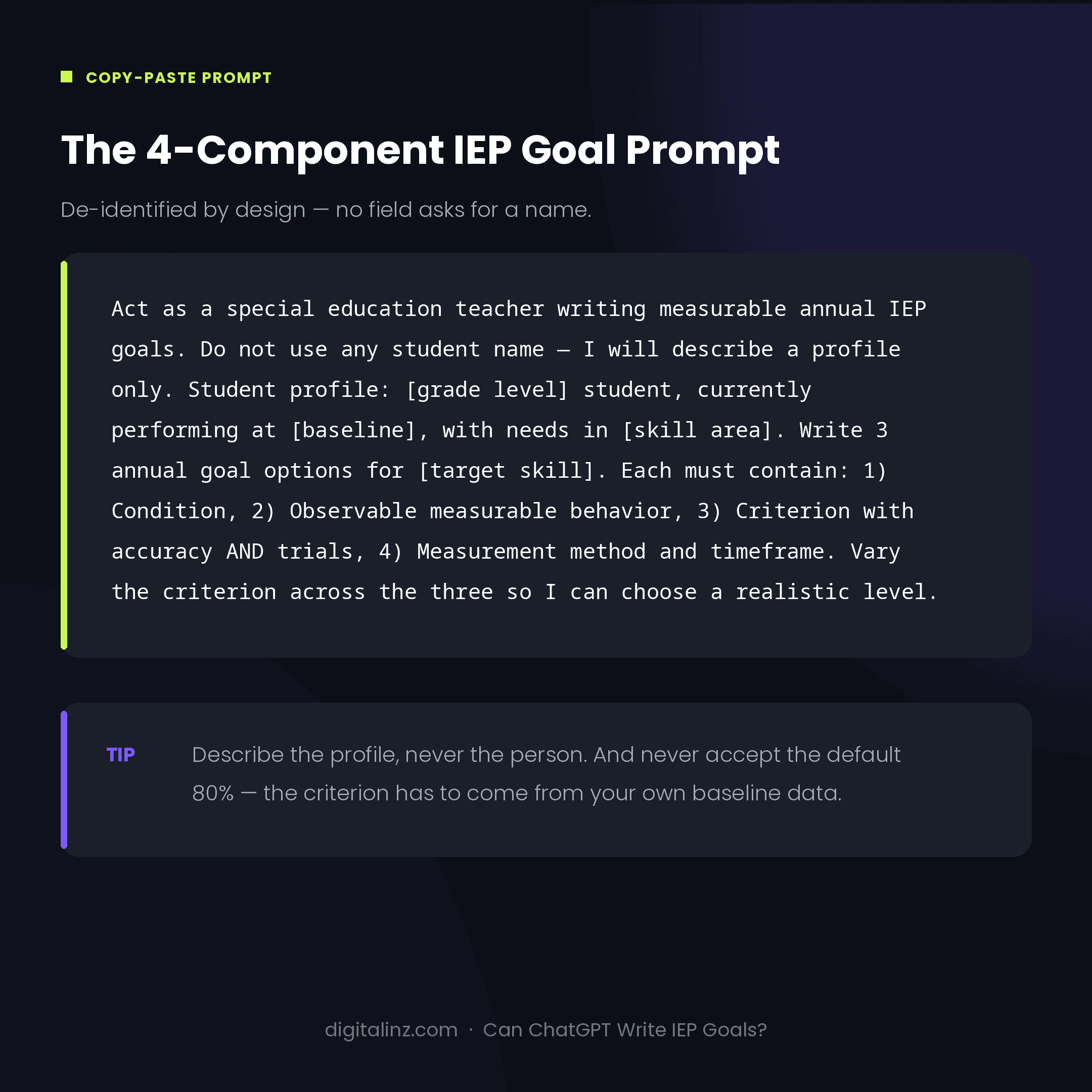
Act as a special education teacher writing measurable annual IEP
goals. Do not use any student name — I will describe a profile only.

Student profile: [grade level] student, currently performing at
[baseline — e.g. reads 45 WPM on 2nd-grade text], with needs in
[skill area].

Write 3 annual goal options for [target skill]. Each goal must
contain all four components:
1. Condition (materials, setting, or support provided)
2. Observable, measurable behavior (use an action verb)
3. Criterion (accuracy AND number of trials or opportunities)
4. Measurement method and timeframe

Vary the criterion across the three options so I can choose a
realistic level. After each goal, list 2 short-term objectives
and the progress-monitoring method you'd recommend.
If you would rather start from goals that are already written, our IEP Goal Bank has 54 of them across six skill areas, each with objectives and a monitoring method. Two things make this template work: it forbids names up front, and it asks for three options rather than one. You’re picking from a range against your own baseline data instead of accepting whatever number the model reached for first.
Before and After: Vague vs. Measurable
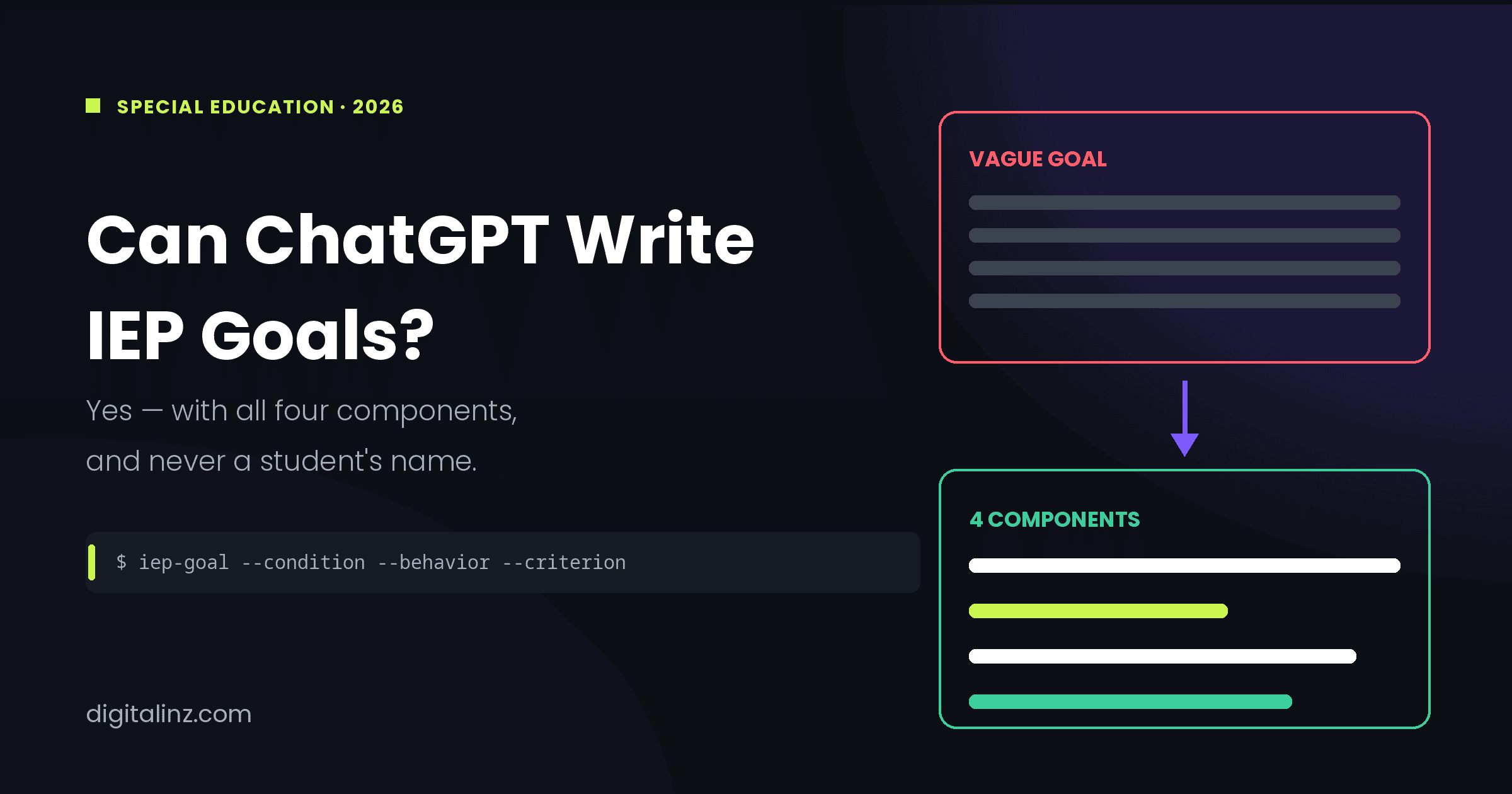
The difference is easiest to see side by side. A goal like “the student will improve reading comprehension” has no condition, an unobservable verb, no criterion, and no measurement method — four out of four missing. It will pass through some meetings unchallenged and then be impossible to report progress against.
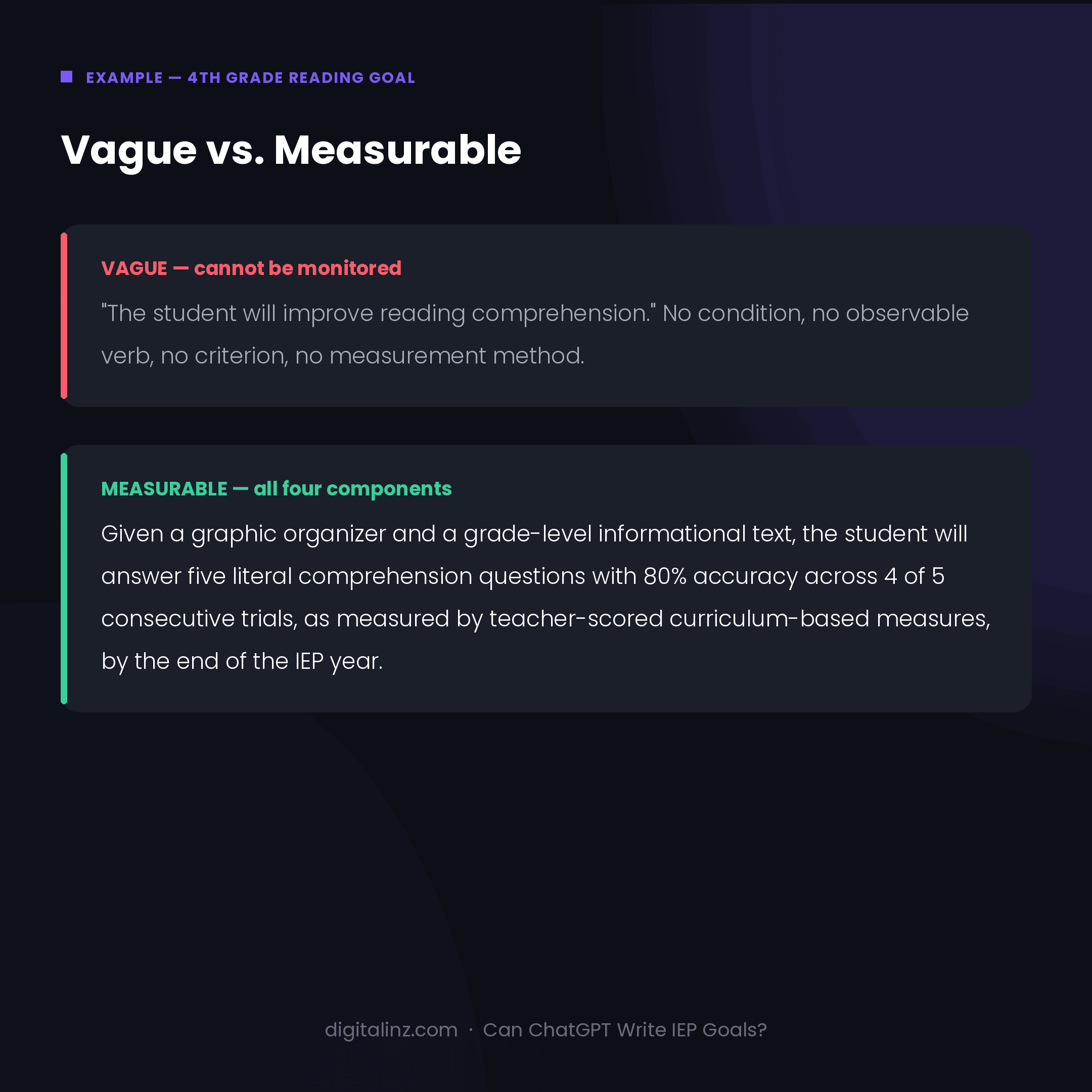
The measurable version names the materials, uses a verb you can watch, sets accuracy across a defined number of trials, and says how you’ll collect the data. Same student, same intent, but only one of them can actually be monitored — or defended.
Once the goals are written, the follow-on work is differentiating instruction to hit them, which we cover in ChatGPT prompts for differentiation and IEP accommodations, and building assessments that generate the data you’ll report against in quiz and assessment prompts.
The Two Mistakes That Cause Real Problems
Accepting the default criterion. ChatGPT reaches for “80% accuracy across 4 of 5 trials” almost reflexively, regardless of the skill or the student. For a student whose baseline is 20%, that may be a year’s growth or it may be fantasy. The number has to come from your data.
Letting the goal drift from the present levels. A well-written goal that doesn’t connect to the documented present levels of performance is a compliance gap, no matter how elegant the language. Draft with ChatGPT, then read the goal back against your PLOP statement before it goes in the document.
Both mistakes share a root: treating a polished sentence as a finished decision. The writing is the easy part, and it’s the only part you’re delegating.
FAQ
Can ChatGPT write IEP goals?
Yes. ChatGPT can draft measurable, properly structured IEP goals if your prompt specifies all four required components — condition, observable behavior, criterion, and measurement method. It cannot determine what a student needs or set a realistic baseline, and it should never receive a student’s name or identifying details.
What are the 4 components of an IEP goal?
Condition (the materials, setting, or support provided), observable behavior (an action you can watch and count), criterion (accuracy plus the number of trials or opportunities), and measurement method with a timeframe. A goal missing any of these can’t be progress-monitored consistently.
Is it a FERPA violation to use ChatGPT for IEP goals?
It depends entirely on what you enter. Describing a de-identified profile — grade level, baseline performance, skill area — does not involve education records. Pasting a student’s name, school, or identifying details into a general-purpose chatbot may. Describe the profile, never the person, and check your district’s policy.
What is a good IEP goal example?
“Given a graphic organizer and a grade-level informational text, the student will answer five literal comprehension questions with 80% accuracy across 4 of 5 consecutive trials, as measured by teacher-scored curriculum-based measures, by the end of the IEP year.” It contains all four components and can be monitored by anyone on the team.
Can ChatGPT write IEP goals for autism or ADHD?
It can draft goals for any skill area you describe, including communication, social skills, executive functioning, and self-regulation. The disability category itself shouldn’t drive the goal — the student’s documented present levels and needs should. Describe the skill and the baseline rather than the diagnosis.
The Shortcut
If goal-writing season is the problem rather than any single goal, the IEP Goal Bank is 54 measurable goals with all four components already in place — plus 108 short-term objectives, a progress-monitoring method per goal, and a blank goal builder. Written de-identified throughout.
Writing goals for a full caseload means rebuilding this prompt for every skill area, every baseline, and every progress-monitoring method — usually in the same two weeks of the year. Our Teacher’s AI Toolkit includes ready-to-use prompts for IEP goals, accommodations, differentiation, progress reporting, and parent communication across K–12 — all written de-identified from the start, so the privacy rule is built in rather than remembered.
Also available on Gumroad.