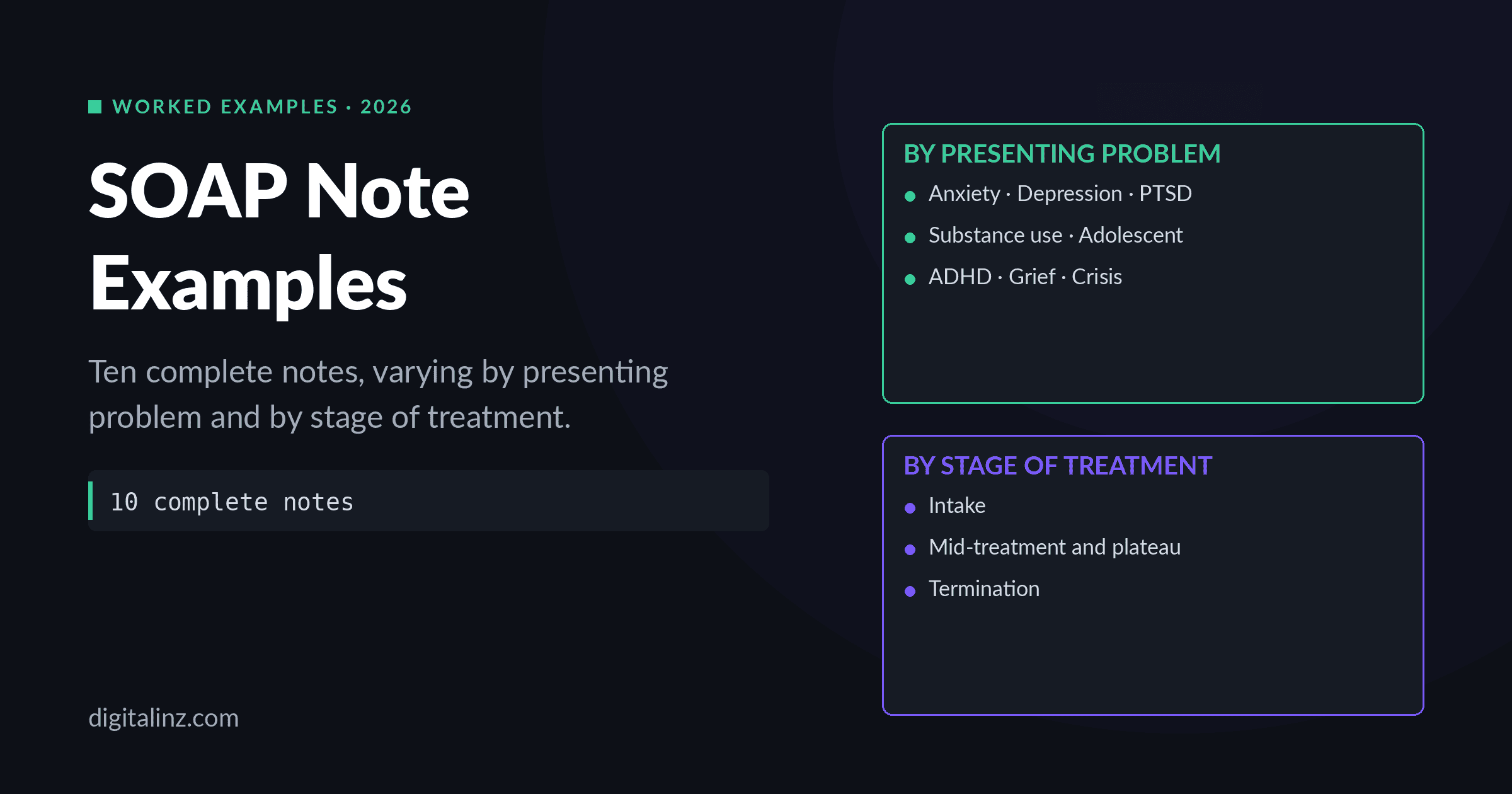
SOAP Note Examples: 10 Complete Samples for Mental Health
Below are ten complete SOAP note examples, written out in full. They vary on two axes
rather than one — presenting problem and stage of treatment — because a
note at intake, a note at a plateau and a note at termination are genuinely different
documents, and most example sets only ever show you the middle of a course of treatment.
real client. Use them as models for structure, specificity and clinical reasoning — not
as language to copy into a live record. A note that reads like a template is a note that
tells a reviewer nothing about the client in front of you.
|
Free · no email required Printable progress note templates Blank versions of the format these examples use. Two free packs — blank and guided SOAP, DAP and BIRP progress notes, plus intake, treatment plan and discharge summary templates. |
What to look for as you read
Three things distinguish these from a note that would be flagged in review, and they are
worth watching for in each example:
- The Subjective and Objective sections never blur. If the client said it,
it is in S. If it was observed or measured, it is in O. - Every Assessment states what changed, the evidence for it, and what it means.
No example below says “client is improving” and stops. - Every Plan could be picked up by a covering clinician. No
“continue treatment,” no “homework as discussed.”
If you want the reasoning behind those, it is in the
complete guide to SOAP notes for therapists, and the failure modes are in
common SOAP note mistakes.
Ten SOAP note examples
S — Subjective. Client self-referred, reporting six months of “constant low-level dread” that began after a restructure at work. Reported difficulty falling asleep most nights, reduced appetite, and withdrawal from a running group they had attended for four years. Denied prior mental health treatment. Reported one maternal aunt with “depression, I think.” Stated their goal as “I want to stop feeling like something bad is about to happen.”
O — Objective. Arrived on time, appropriately dressed and groomed. Speech normal in rate and volume. Affect mildly anxious, congruent. Oriented ×4. Attention and memory grossly intact. Insight good; judgment intact. GAD-7 administered: 15. PHQ-9: 11. Denied suicidal and homicidal ideation on direct questioning; no history of attempts or self-harm. Interventions: clinical interview, symptom and risk screening, psychoeducation on the anxiety cycle, collaborative goal setting.
A — Assessment. Presentation is consistent with generalized anxiety disorder, moderate, with onset temporally linked to workplace change six months ago. Secondary depressive symptoms appear reactive to withdrawal from valued activity rather than indicating a primary mood disorder — the running group cessation followed rather than preceded the anxiety onset. No risk indicators. Client is psychologically minded, articulates a specific goal, and presents as a good candidate for time-limited CBT. Sleep onset and behavioral withdrawal are the appropriate first targets.
P — Plan. Weekly 50-minute individual CBT, initial course of 12 sessions with review at session 6. Homework: daily anxiety log noting time, trigger and intensity. Next session: complete the shared formulation and introduce cognitive restructuring. Re-administer GAD-7 at sessions 6 and 12. Treatment plan and informed consent completed and signed this session.
S — Subjective. Client reported the “best fortnight in a long time,” describing a work presentation delivered without requesting a colleague’s support — the first time in two years. Reported the anticipatory anxiety beforehand was “awful but it passed quicker.” Completed thought records six of seven days. Reported sleep onset now approximately 20 minutes, down from 45–60.
O — Objective. On time, well groomed. Speech normal. Affect euthymic and notably brighter than sessions 1–5. Oriented ×4. GAD-7: 8 (intake 15, session 6 11). Denied suicidal ideation on direct questioning. Interventions: reviewed the presentation as a behavioral experiment, cognitive restructuring targeting the residual prediction that visible anxiety would be judged, introduced relapse-prevention framing.
A — Assessment. Client is responding well to CBT. GAD-7 movement of 15 → 11 → 8 is corroborated by a specific behavioral change rather than self-report alone, which supports genuine symptom reduction. The presentation functioned as an unplanned behavioral experiment and disconfirmed the central prediction, which is why it is worth consolidating explicitly rather than moving on. Sleep onset has normalized without a dedicated sleep intervention, consistent with it having been anxiety-maintained. Residual social-evaluative concern is now the main remaining target.
P — Plan. Continue weekly 50-minute CBT. Homework: one deliberate behavioral experiment testing the “visible anxiety will be judged” prediction. Next session: review experiment, begin relapse prevention plan. Re-administer GAD-7 at session 12. Anticipate stepping to fortnightly from session 12 if gains hold.
S — Subjective. Client reported the past three weeks as “the same, just grey.” Reported attending all scheduled activities on the activity schedule but experiencing “nothing much” while doing them. Reported sleep and appetite unchanged. Denied any worsening. Stated: “I’m doing everything you asked and I still feel the same, so maybe this isn’t going to work.”
O — Objective. On time, adequately groomed. Speech normal rate, slightly reduced volume. Affect restricted; mood reported and observed as low. Oriented ×4. Psychomotor activity within normal limits. PHQ-9: 14 (intake 16, session 4 15). Denied suicidal ideation on direct questioning. Interventions: reviewed activity schedule adherence and mood ratings, psychoeducation on the lag between behavioral activation and subjective mood change, explored the hopelessness statement directly.
A — Assessment. Client is at a genuine treatment plateau: adherence is high, PHQ-9 has moved only two points across eight sessions, and anhedonia is not responding to behavioral activation alone. This is clinically meaningful information rather than a failure of engagement. The statement about treatment not working reads as an accurate observation with a depressive interpretation attached, and warrants direct discussion rather than reassurance. Given severity, duration and limited response, medication consultation is now indicated. No risk indicators, but hopelessness about treatment warrants continued monitoring.
P — Plan. Continue weekly 50-minute sessions. Referral to psychiatry for medication evaluation — release signed, referral to be sent this week. Homework: continue activity schedule with mood rating before and after each entry. Next session: review whether any activity category shows differential response; consider adding cognitive work. Re-administer PHQ-9 at session 10. Reassess treatment plan at session 12 if no change.
|
S — Subjective. Client reported completing two of three planned imaginal exposure recordings between sessions, describing the third as “the one I couldn’t make myself press play on.” Reported nightmares reduced from four to one in the past week. Reported continued avoidance of the route past the incident location. Stated: “It feels less like it’s happening now and more like it happened.”
O — Objective. On time, appropriately groomed. Speech normal. Affect anxious at the start of the session, settling markedly by the close. Oriented ×4. No dissociation observed during the session; grounding was not required. PCL-5: 41 (intake 58, session 6 49). Denied suicidal ideation on direct questioning. Interventions: imaginal exposure (25 minutes) with SUDS ratings recorded at five-minute intervals, post-exposure processing, cognitive work on the responsibility appraisal.
A — Assessment. Client is responding to prolonged exposure. PCL-5 movement of 58 → 49 → 41 is supported by reduced nightmare frequency and, more meaningfully, by the client’s own description of the memory shifting from present to past tense — a marker of successful reconsolidation rather than symptom suppression. In-session SUDS declined from 8 to 4 across the exposure, indicating habituation within trial. The avoided recording and the avoided route are the same avoidance in two forms and should be addressed together. Responsibility appraisal remains the principal cognitive target.
P — Plan. Continue weekly 90-minute sessions for exposure work. Homework: daily listening to the completed recordings; one planned in vivo exposure approaching, not passing, the route. Next session: imaginal exposure to the remaining hot spot, continue responsibility work. Re-administer PCL-5 at session 14. Anticipate 4–6 further exposure sessions.
S — Subjective. Client reported drinking on two consecutive evenings the previous weekend after 41 days abstinent, describing the trigger as a family gathering where “everyone had a glass and nobody asked.” Reported stopping after the second evening without external prompting and attending their scheduled group two days later. Reported significant shame, stating: “I ruined the whole thing.”
O — Objective. Arrived on time, appropriately groomed. Speech normal. Affect ashamed, with reduced eye contact when describing the weekend, improving during the session. Oriented ×4. No signs of intoxication or withdrawal. AUDIT-C: 5. Denied suicidal ideation on direct questioning. Interventions: functional analysis of the lapse, psychoeducation distinguishing lapse from relapse, cognitive work on the abstinence-violation effect, revised the coping plan for social settings.
A — Assessment. This is a lapse rather than a relapse, and the distinction is clinically important and worth stating plainly to the client. Client self-arrested the episode after two days without external intervention and re-engaged with treatment independently — both are protective indicators and both are evidence of change that the client is currently unable to see. The abstinence-violation effect is the primary risk here: the shame response is a stronger predictor of escalation than the drinking itself. The identified gap is an absent plan for unstructured social settings where alcohol is normative and unremarked.
P — Plan. Continue weekly 50-minute individual sessions alongside existing group attendance. Homework: written refusal script and an exit plan for two upcoming social events. Next session: rehearse the refusal script, review any high-risk situations. Continue coordination with the group facilitator under the signed release. Re-administer AUDIT-C at session 10.
S — Subjective. Client (15) reported attending school three of five days, an increase from one of five at intake. Reported the two absences followed nights of poor sleep. Described morning stomach pain as “real, not fake,” and reported it eases by mid-morning on days they attend. Parent reported by phone, with client’s knowledge and consent, that morning conflict has decreased.
O — Objective. Arrived on time with parent, attended session alone as agreed. Casually dressed, adequately groomed. Speech normal. Affect guarded initially, engaging by mid-session. Oriented ×4. SCARED total: 34 (intake 45). Denied suicidal ideation and self-harm on direct questioning. Interventions: reviewed the graded return-to-school hierarchy, psychoeducation on somatic anxiety symptoms delivered to client and, separately, to parent, problem-solved the morning routine.
A — Assessment. Client is progressing on the graded exposure hierarchy, with attendance up from 20% to 60%. The somatic complaints are consistent with anxiety rather than a medical cause — the timing pattern of easing by mid-morning on attended days, and the absence of pain on weekends, both support this. Validating the pain as genuine while reframing its cause has reduced the morning conflict, which was itself a maintaining factor. Sleep is the clearest remaining lever: both absences followed poor nights, so sleep is now the highest-yield target rather than further exposure steps.
P — Plan. Continue weekly 50-minute sessions with fortnightly parent check-ins. Homework: fixed wake time including weekends; hierarchy step 4, full day attendance twice. Next session: review sleep and attendance data. Continue liaison with the school counsellor under the signed release. Re-administer SCARED at session 8.
S — Subjective. Client requested an unscheduled appointment following a relationship ending three days prior. Reported not sleeping more than two hours a night since. Reported thoughts that “everyone would be better off,” present most of the day. When asked directly, denied a plan, denied intent, and denied having taken any steps. Reported one prior attempt eleven years ago in a different relationship context. Identified their brother and their two cats as reasons for living.
O — Objective. Arrived on time, dishevelled relative to baseline. Speech slowed. Affect distressed, tearful for much of the session. Oriented ×4. Psychomotor retardation present. PHQ-9: 21, item 9 endorsed at 2. Columbia protocol: positive for passive ideation and for wish to be dead; negative for active ideation, method, intent, plan and preparatory behavior. Interventions: risk assessment, collaborative safety planning, means-restriction counselling, crisis resources entered into client’s phone, brother contacted with client’s written consent and present at the close of session.
A — Assessment. Acute increase in risk relative to this client’s baseline, precipitated by an identifiable interpersonal loss three days ago and compounded by severe sleep deprivation. The prior attempt is a significant historical risk factor and the current presentation shares a contextual similarity with it, which raises rather than maintains my level of concern. Against that: no active ideation, no plan, no means identified, no preparatory behavior, help-seeking behavior was self-initiated, protective factors are specific and client-generated, and a support person is now engaged. I assess risk as moderate and currently manageable in outpatient care with an active safety plan, frequent contact and collateral support — contingent on close monitoring rather than assumption. Hospitalisation is not indicated at this time; the threshold for revisiting that judgment is documented below.
P — Plan. Increase to twice-weekly sessions plus a brief scheduled phone check tomorrow. Safety plan completed, copy provided to client and, with written consent, to brother. Means-restriction agreed: brother to hold medications for two weeks. Client agreed to contact 988 or attend the emergency department if ideation becomes active or intent emerges. Urgent psychiatry referral for medication evaluation and sleep, faxed today. Re-administer PHQ-9 and Columbia protocol every session. Reassess level of care immediately if active ideation emerges, a plan or means are identified, contact is lost, or the support arrangement fails.
S — Subjective. Client reported implementing the externalised task system on four of seven days, describing the failure days as “I just didn’t look at the board.” Reported completing two long-postponed administrative tasks. Reported continued difficulty with the transition from work to home, describing sitting in the car for up to 40 minutes. Reported their partner has noticed fewer forgotten commitments.
O — Objective. Arrived 12 minutes late, consistent with prior sessions. Casually dressed. Speech rapid with frequent topic shifts; redirection required three times and was accepted readily. Affect bright and engaged. Oriented ×4. ASRS Part A: 4 of 6 positive (intake 6 of 6). Denied suicidal ideation on direct questioning. Interventions: reviewed the task system, problem-solved the cueing failure, introduced a transition ritual for the work-to-home boundary, psychoeducation on time blindness.
A — Assessment. Client is responding to environmental scaffolding rather than effort-based strategy, which is the expected and appropriate direction for adult ADHD. The four-of-seven adherence is a cueing failure, not a motivation failure — on days the board was seen, the system worked without exception, which localises the problem precisely and makes it solvable. Partner-reported reduction in forgotten commitments is useful external corroboration. The car-sitting is best understood as a transition difficulty rather than avoidance, and responds better to a ritual than to insight. Continued lateness to session is symptom-consistent and not treated as ambivalence.
P — Plan. Continue weekly 50-minute sessions. Homework: relocate the task board to the bathroom door, tying it to an unavoidable morning routine; trial the three-step transition ritual daily. Next session: review both, begin work on the email backlog. Re-administer ASRS at session 8. Client already established with prescriber; continue coordination under the signed release.
S — Subjective. Client reported the first week since their father’s death in March in which they “didn’t cry every day.” Reported this produced guilt rather than relief, stating: “If I stop being sad, what does that say?” Reported returning to work part-time and managing it. Reported continued avoidance of their father’s house and of the voicemail they have not deleted.
O — Objective. On time, appropriately groomed. Speech normal. Affect sad but with a fuller range than in earlier sessions; smiled twice when recounting a memory. Oriented ×4. PHQ-9: 12 (intake 18). Denied suicidal ideation on direct questioning. Interventions: psychoeducation on the non-linear course of grief and on continuing bonds, explored the meaning attached to reduced crying, normalized the retained voicemail.
A — Assessment. Client is moving through an uncomplicated grief process at an expected pace five months post-loss. The guilt about reduced crying is a common and important juncture: it reflects a belief that grief intensity measures love, which is worth addressing directly because it can otherwise maintain distress. Return to part-time work and the restored affective range are both markers of adaptation rather than avoidance. The retained voicemail is a continuing-bond behavior rather than a symptom and does not require intervention. Presentation does not meet criteria for prolonged grief disorder; PHQ-9 reduction is consistent with normal adaptation rather than treatment of a depressive episode.
P — Plan. Continue fortnightly 50-minute sessions, stepped down from weekly by agreement. Homework: none assigned this session, by design. Next session: explore the anniversary of the diagnosis, which falls in six weeks. Re-administer PHQ-9 at session 10. Discuss planned ending at session 10.
S — Subjective. Client reviewed the course of treatment, identifying the behavioral experiments as “the part that actually changed things.” Reported maintaining gains across the four weeks since stepping to fortnightly. Reported one anxious week following a job interview and described using the thought record independently and without prompting. Reported feeling “ready, and a bit nervous about that.”
O — Objective. On time, well groomed. Speech normal. Affect euthymic and appropriate to content. Oriented ×4. GAD-7: 4 (intake 15). PHQ-9: 3 (intake 11). Denied suicidal ideation on direct questioning. Interventions: structured review of treatment gains, completed the written relapse-prevention plan, identified early warning signs and specific responses, discussed the process for re-referral.
A — Assessment. Client has met all three treatment plan goals. GAD-7 movement from 15 to 4 across 16 sessions is corroborated by durable behavioral change and, most importantly, by independent use of skills during a stressor after the reduction in session frequency — which is the outcome that best predicts maintenance. Ambivalence about ending is appropriate rather than a contraindication. No residual risk indicators. Planned termination is clinically appropriate and the relapse-prevention plan is adequate to support it.
P — Plan. Treatment concluded by mutual agreement this session. Written relapse-prevention plan provided to client. Client advised they may self-refer directly without a new assessment if symptoms return, and understands the process. Discharge summary to be completed within five working days. Copy to PCP with the client’s written consent. No further sessions scheduled.
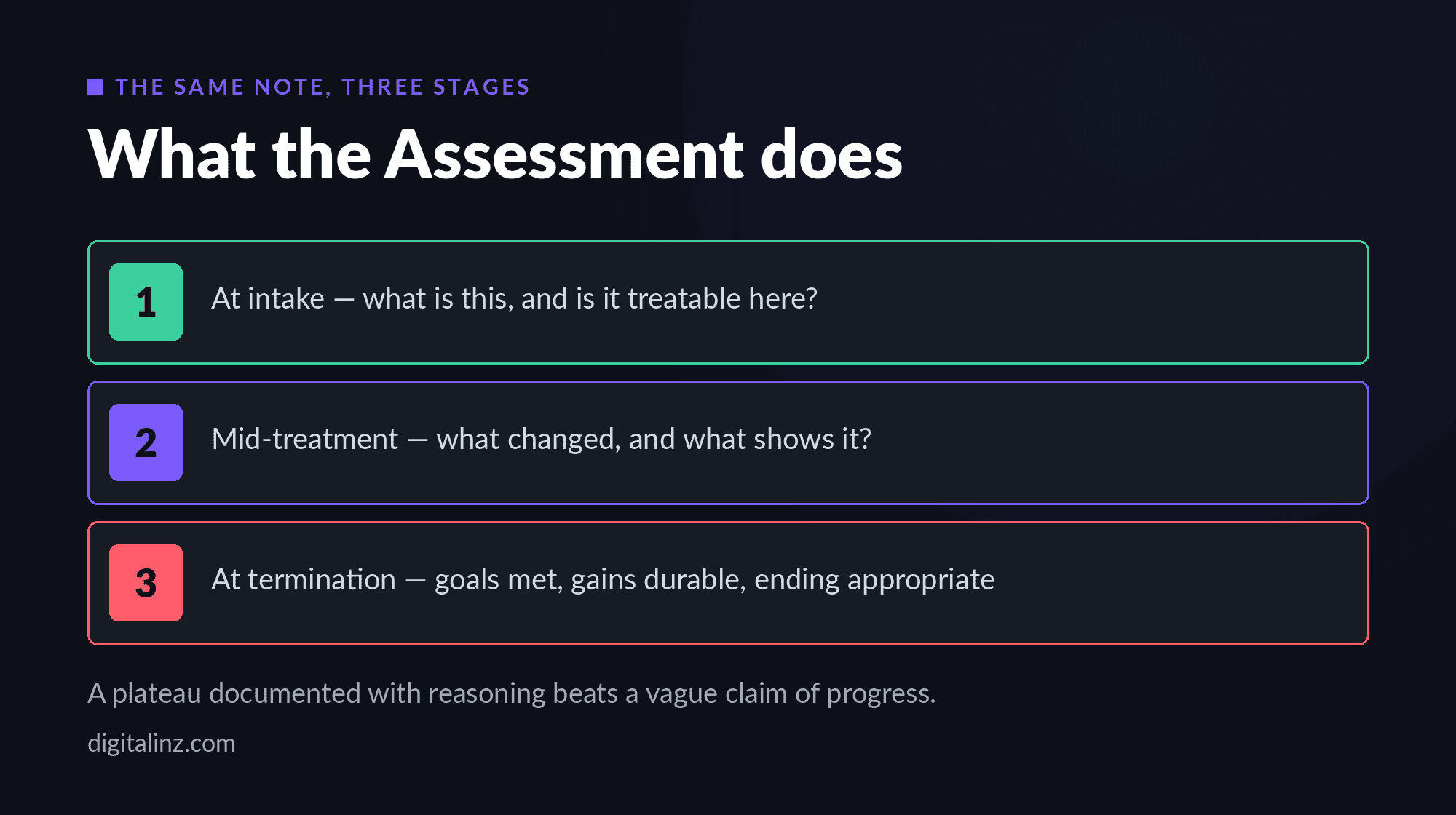
What changes across the course of treatment
Read examples 1, 2 and 10 in sequence and a pattern emerges that is worth being deliberate
about.
At intake, the Assessment is largely diagnostic: what is this, what is
maintaining it, is this person a candidate for what you offer. The Plan is heavy on structure
— frequency, expected duration, consent, review points.
Mid-treatment, the Assessment becomes almost entirely about change:
what moved, what evidence shows it, and whether the mechanism you hypothesized is the one
doing the work. This is where notes most often go thin, because “the same as last
week” feels like nothing to write — and where example 3 is the useful model,
because a documented plateau with reasoning is far stronger than a vague note claiming
progress.
At termination, the Assessment is making a case: goals met, gains
durable, ending clinically appropriate. Example 10 does this by pointing to independent skill
use during a stressor after session frequency dropped, which is more persuasive than any
score.
Notes on the risk example
Example 7 is the one worth reading twice, because risk documentation is where clinicians
are most exposed and where the gap between what was done and what was recorded is usually
widest.
Notice what it documents: the specific questions asked and the specific answers given, the
historical risk factor and how it changed the judgment, the protective factors and that they
came from the client, the concrete steps taken, and — critically — the
reasoning for the level-of-care decision, with the threshold for revisiting it.
A note that records a risk assessment but not the reasoning behind the resulting decision is
the hardest kind to defend, because a reviewer cannot reconstruct why you concluded what you
concluded.
Using these
The most useful exercise is not to copy the wording but to take your own last five notes
and compare their Assessment sections against these. The gap is almost always in the same
place: a statement of what happened where there should be a statement of what it means.
Printable blank and guided templates in all three common formats are in our
free progress note template pack, the writing sequence is in
how to write SOAP notes step by step, and if you are still choosing a
format, SOAP vs DAP vs BIRP compares all three on the same session.
Frequently asked questions
How long should a SOAP note be?
The examples above run 150–300 words, which is the normal range for a routine
outpatient session. Intake and risk sessions legitimately run longer. Length is not the
measure — a 400-word note with no clinical reasoning is weaker than a 180-word note
that has it.
Can I copy these notes into my records?
No. Beyond being clinically wrong, notes that don’t describe your actual client are
a records-integrity problem. Copy the structure and the level of specificity, and write about
the person you saw.
Why do the examples include measure scores?
Because they do most of the work in the Assessment section. A score gives you an objective
anchor to reason from and makes change legible across a course of treatment. If you
aren’t administering measures, the Assessment has to carry that weight on observation
alone, which is harder to write and harder to defend.
Do these work for DAP or BIRP notes?
The clinical content transfers directly; the structure doesn’t. DAP merges
Subjective and Objective into one Data section, and BIRP reorganises around what you did and
how the client responded. SOAP vs DAP vs BIRP shows one session written
out in all three.
What should a note look like when nothing happened?
Like example 3. A plateau documented with reasoning — adherence high, measure barely
moved, therefore the intervention rather than the engagement needs revisiting — is a
strong note. “Client attended and we discussed coping skills” is not.
This article is general professional information for licensed clinicians and students, not legal, clinical or compliance advice. Documentation requirements vary by state, licensing board, payer and setting. Any example notes are composites written for illustration and do not describe real clients.