ChatGPT for Private Practice: 15 Prompts for Admin and Marketing
ChatGPT for private practice can handle the marketing copy, client communication templates, and intake documents that solo therapists typically spend their evenings writing — not because AI understands therapy, but because it’s exceptionally good at generating professional prose from structured input. The average private practice therapist handles two jobs: providing clinical care and running a small business. These 15 prompts address the second job so you can spend more of your time on the first.
Why Private Practice Admin Eats More Time Than It Should
The administrative overhead of running a solo or group practice — writing your website, updating your Psychology Today profile, drafting intake paperwork, responding to prospective clients, managing referrals — isn’t clinically demanding work, but it compounds. APA’s private practice resources identify business development as one of the core competencies private practitioners need beyond clinical training. Most therapists weren’t trained for it, and many either outsource it expensively or avoid it entirely until their caseload suffers.
ChatGPT doesn’t replace good marketing judgment — knowing your niche, understanding your ideal client, and positioning your practice clearly still require your expertise. What it does is dramatically accelerate the drafting phase, so you’re spending 10 minutes reviewing and refining rather than 90 minutes staring at a blank screen. Use these prompts with your own client knowledge and clinical voice; ChatGPT provides the structure and the draft.
15 ChatGPT Prompts for Private Practice Admin and Marketing
Marketing and Visibility
Prompt 1 — Niche-specific therapist bio:
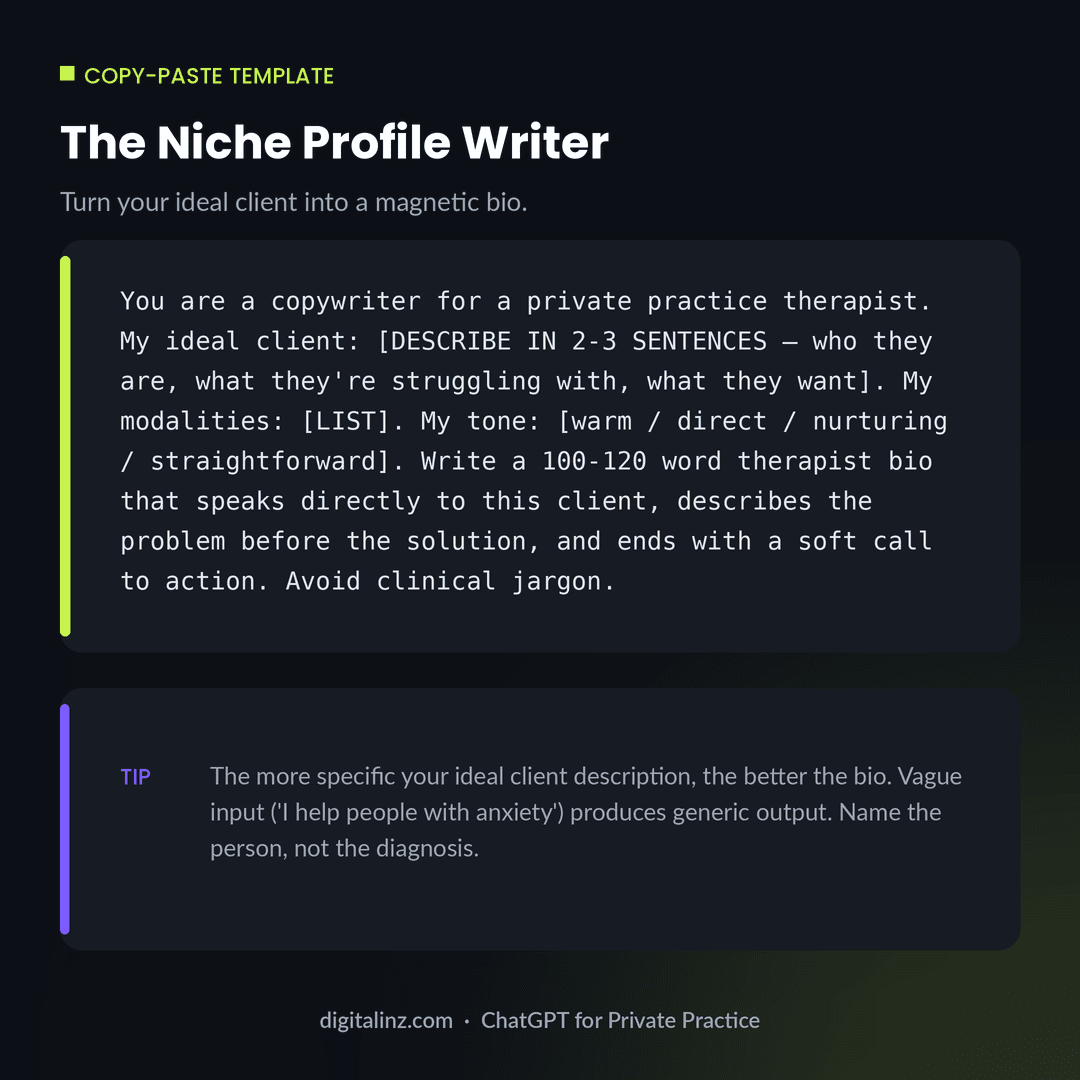
“You are a copywriter for a private practice therapist. My ideal client: [DESCRIBE IN 2-3 SENTENCES — who they are, what they’re struggling with, what they want]. My modalities: [LIST]. My tone: [warm / direct / nurturing / straightforward]. Write a 100-120 word therapist bio that speaks directly to this client, describes the problem before the solution, and ends with a soft call to action. Avoid clinical jargon and credential-listing.”
Prompt 2 — Psychology Today or Zencare profile:
“Write a therapist directory profile for [DIRECTORY NAME] for a [MODALITIES] therapist who specializes in [NICHE]. Ideal client: [2-SENTENCE DESCRIPTION]. Include: a headline that speaks to the client’s problem (not my credentials), a 100-word ‘About Me’ section in first person, and a 50-word description of what sessions look like. Tone: [WARM / PROFESSIONAL / DIRECT]. Avoid generic phrases like ‘safe space’ and ‘life’s journey.'”
Prompt 3 — Website homepage headline options:
“You are a copywriter for a private practice therapist. Ideal client: [DESCRIBE]. Specialty: [NICHE]. Write 5 homepage headline options that: lead with the client’s problem or goal (not the therapist’s credentials), are 10 words or fewer, avoid therapy clichés, and would make the ideal client feel seen immediately. Then write a 2-sentence subheadline for your top recommendation.”
Intake and Onboarding
Prompt 4 — New client welcome email:
“Write a warm welcome email to send to a new therapy client after they schedule their first appointment. Include: a brief warm welcome, what to expect from the first session (general structure, not clinical content), what paperwork they’ll receive and how to complete it, how to contact the office if they have questions, and an encouraging closing line. Tone: [WARM / PROFESSIONAL]. Practice name: [NAME]. Therapist name: [NAME]. Under 200 words.”
Prompt 5 — Intake questionnaire questions:
“I’m creating an intake questionnaire for new therapy clients at a [SPECIALTY] practice. Generate 15 intake questions that: cover presenting concerns, therapy history, goals for treatment, relevant medical and medication history, emergency contact, and preferred communication. Write each question in plain, non-clinical language. Include at least 3 open-ended questions that give the client space to describe things in their own words.”
Prompt 6 — Cancellation and no-show policy:
“Write a cancellation and no-show policy for a private practice therapy office. Details: [HOURS OF NOTICE REQUIRED], [FEE FOR LATE CANCELLATION OR NO-SHOW], [EXCEPTIONS — e.g. emergency illness]. Tone: firm but warm — this should feel like a policy from someone who respects both their time and their clients’ circumstances. Keep it under 150 words. Write it in second person (‘You agree to…’).”
Client Communication
Prompt 7 — Appointment reminder message:
“Write a brief appointment reminder message to send to therapy clients 48 hours before their session. Include: the appointment date, time, and location or telehealth link [FILL IN DETAILS], a reminder of the cancellation policy [SUMMARIZE], and a warm closing. Keep it under 80 words. Format suitable for email or text. Tone: friendly and professional.”
Prompt 8 — Prospective client inquiry response:
“Write a response email to a prospective therapy client who has inquired about services. Their message: [PASTE THEIR INQUIRY]. I [DO / DO NOT] have current availability. If available: include next steps (schedule a free consultation call or book directly). If not available: offer to add them to a waitlist and provide 1-2 referral options. Tone: warm, unhurried, and genuine — not a form letter. Under 150 words.”
Prompt 9 — Waitlist notification when a spot opens:
“Write a brief email to a therapy client on my waitlist letting them know a spot has opened up. Include: the news that a spot is available, the proposed session time [DAY / TIME], how long they have to respond before the spot goes to the next person on the list, and how to confirm. Tone: warm and low-pressure — no urgency language. Under 100 words.”
Content and Social Media
Prompt 10 — Educational Instagram caption:
“Write an Instagram caption for a therapist in private practice. Topic: [MENTAL HEALTH CONCEPT, e.g., ‘the difference between anxiety and an anxiety disorder’]. Format: start with a relatable hook (a situation or feeling, not a definition), explain the concept in plain language in 3-4 sentences, and end with a reflection question for the comments. Tone: [WARM / DIRECT / GROUNDED]. Under 180 words. No therapy clichés.”
Prompt 11 — Blog post intro for a mental health topic:
“Write an engaging blog post introduction for a private practice therapist’s website. Topic: [TOPIC]. Ideal reader: [DESCRIBE]. The intro should: open with a scenario or feeling the reader will recognize, introduce the topic in a way that’s relevant to their experience, and preview what the post will cover. Under 120 words. Tone: [WARM / DIRECT / CONVERSATIONAL]. Avoid overly clinical language.”
Prompt 12 — FAQ page for practice website:
“Write a FAQ section for a [SPECIALTY] therapist’s private practice website. Create 8 questions and answers addressing: what a first session looks like, how long therapy takes, whether you accept insurance, what telehealth sessions involve, how to get started, what to do in a crisis, whether you work with [SPECIFIC POPULATION], and one question specific to your niche: [YOUR NICHE QUESTION]. Answers should be 2-4 sentences each. Plain language, no jargon.”
Business and Administrative Tasks
Prompt 13 — Referral thank-you note:
“Write a brief thank-you note to send to a colleague or physician who referred a client to my therapy practice. Referring provider: [NAME / TITLE]. I’d like to express genuine appreciation without overpromising or sharing client details. Optional: mention I’m happy to be a referral resource for them as well. Tone: warm and professional. Under 80 words. Format: suitable for email or a handwritten card.”
Prompt 14 — Voicemail greeting script:
“Write a professional and warm voicemail greeting for a private practice therapist. Include: my name [NAME], my practice name [NAME], that I’m unable to take calls during sessions, how to leave a message, expected callback time, and a reminder that if this is an emergency, the caller should call 988 or go to the nearest ER. Tone: calm and reassuring. Under 60 words.”
Prompt 15 — Out-of-office email for vacation or leave:
“Write an out-of-office email for a private practice therapist who will be unavailable from [DATE] to [DATE]. Include: that I’m away and unavailable during this period, how to reach me for scheduling when I return, who to contact for urgent clinical needs during my absence [NAME / CONTACT], and crisis resources (988 Lifeline and local ER). Tone: warm but clear. Under 120 words.”
Copy-Paste: The Niche Profile Writer
This is the foundational marketing prompt for any private practice therapist — get this one right and your website, directory profiles, and social bio all follow from it.
Before and After: Generic Bio vs. Niche-Specific Profile
Both therapists are licensed and experienced. Only one of them sounds like they’re talking to a specific person.
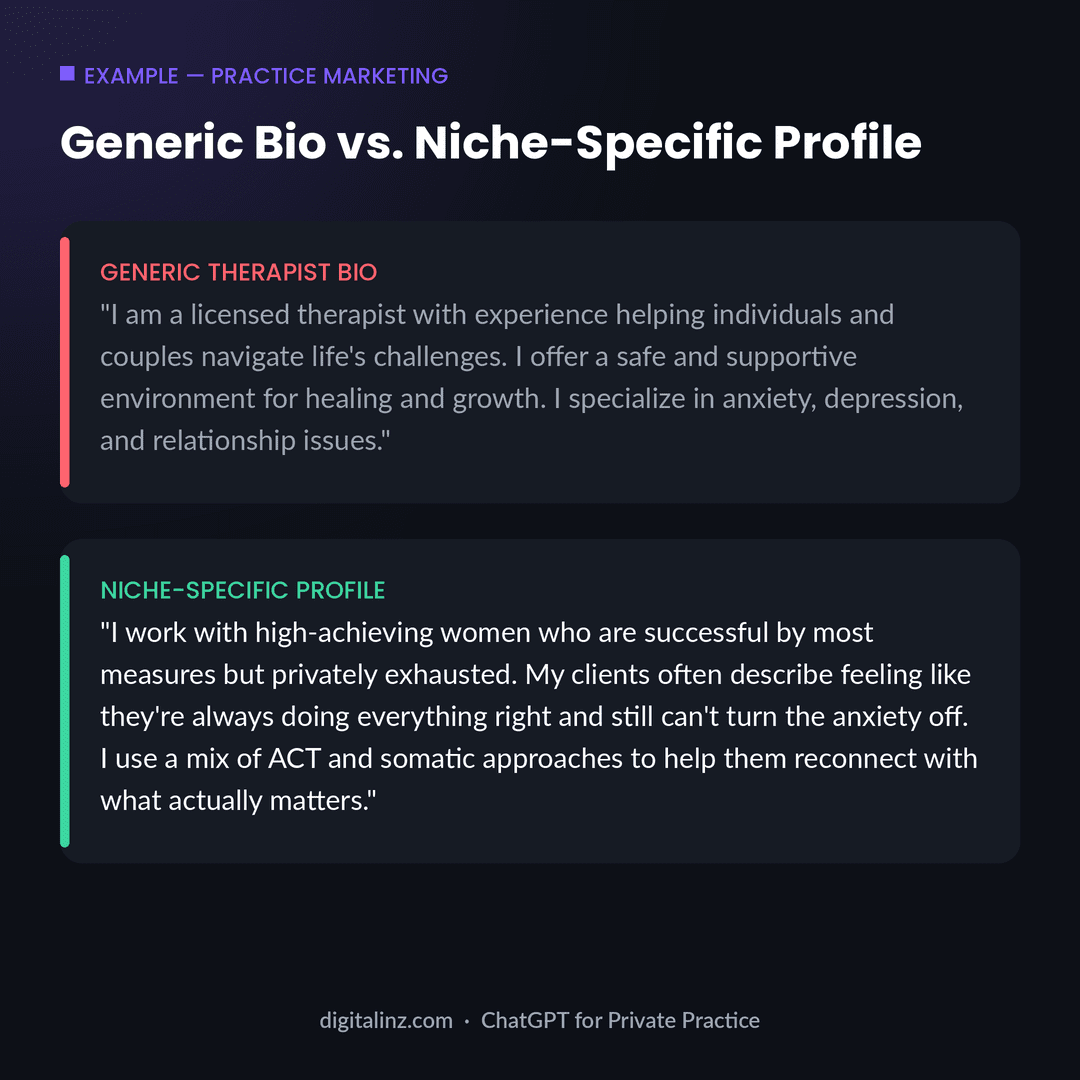
The generic bio is technically accurate and professionally inoffensive — it also describes 40,000 other therapists on Psychology Today. The niche-specific profile describes a person, a feeling, and an approach that someone with that exact struggle will recognize immediately. Using ChatGPT for private practice marketing means generating niche-specific copy in minutes rather than wrestling with a blank page for an hour. For the documentation side of your practice, pair this with ChatGPT prompts for progress notes to cut your end-of-day documentation time as well — and if you want to understand the HIPAA considerations before using AI for any clinical work, see our guide on whether ChatGPT is HIPAA compliant.
FAQ: ChatGPT for Private Practice Admin and Marketing
Can I use ChatGPT to write my therapist website copy?
Yes — with one important caveat: ChatGPT drafts from what you give it. Provide a specific description of your ideal client, your modalities, and your tone, and ChatGPT produces copy that sounds like it came from a real person with a clear specialty. Provide vague input (“I help people with mental health issues”) and you’ll get generic copy that reads like every other therapist website. The prompts above are built for specific input.
Is it ethical to use AI to write marketing content for a therapy practice?
Yes. AI-assisted marketing copy is the equivalent of working with a copywriter — you provide the expertise, positioning, and direction; the tool helps with drafting. As long as the content is accurate, not deceptive, and reviewed by you before publishing, using AI for marketing falls within normal professional standards. You wouldn’t hesitate to use a template for an out-of-office email; ChatGPT prompts are more sophisticated templates.
Will ChatGPT-generated marketing copy sound too generic?
Only if your input is too generic. The most common mistake is describing your practice in diagnostic terms (“I specialize in anxiety and depression”) rather than in client terms (“I work with mid-career professionals who are successful externally but privately exhausted”). Reframe your input around who your ideal client is and what they’re feeling — ChatGPT’s output will follow.
What’s the best ChatGPT prompt for a therapist trying to fill their caseload?
Start with Prompt 1 (niche-specific bio) and Prompt 2 (directory profile). These are the highest-leverage marketing assets for most private practice therapists because they determine whether someone who finds your profile decides to reach out. Once your messaging is specific and client-centered, apply the same client description to Prompt 10 (Instagram caption) and Prompt 11 (blog post intro) to build content consistency across channels.
The Shortcut
The admin and marketing tasks above happen year-round — not just when you’re building the practice from scratch. Our Therapist AI Toolkit includes 200+ ready-to-use prompts for marketing, client communication, progress notes, treatment planning, and psychoeducation — organized so you can pull the right prompt in seconds whenever you need it, not just when you remember AI could help.
Also available on Gumroad.