
Discover AI prompts for therapists to boost your practice
Did you know many mental health professionals spend nearly half their workweek on notes, scheduling, and other admin? That’s time taken away from client care.
What if you could reclaim those hours? Advanced language technology, like ChatGPT from OpenAI, offers a powerful solution. This digital assistant can handle routine tasks with simple, well-crafted instructions.
It’s not about replacing your expertise. It’s about augmenting it. This guide shows you how to use these smart queries to streamline your day.
You will learn to manage your practice with greater precision. Save significant time. And provide more focused support to every person you serve.
Key Takeaways
- Administrative tasks consume a huge portion of a therapist’s work time.
- Sophisticated language models can act as a powerful support tool for your practice.
- Using this technology correctly helps you reclaim hours for direct client care.
- Well-designed queries can streamline note-taking, scheduling, and other routine duties.
- This guide will teach you to craft effective prompts that enhance your clinical efficiency.
- Integrating this resource allows you to maintain the highest professional standards.
- The goal is to augment your skills and improve the quality of your therapy services.
Introduction to AI in Mental Health Therapy
Consider a powerful language model like ChatGPT as a supplementary resource in your clinical toolkit. Developed by OpenAI, this technology mimics human interaction. It processes vast amounts of information to provide supportive responses.
Overview of AI Applications in Therapy
This kind of language model can simulate aspects of a consulting dialogue. It functions as a dynamic reference tool. Think of it as an always-available source for brainstorming treatment angles or clarifying concepts.
It supports the core work psychologists do. They study mental processes to help people. This digital aid offers another layer of support for that mission.
Why Therapists Should Explore This Technology
You might explore this because it provides non-judgmental responses at any hour. That constant availability is a unique benefit for client health. It acts like a vast, instant library to inform your clinical thinking.
It does not replace your professional judgment. Instead, it augments your expertise. Integrating it can reveal insights you might not have considered on your own, enriching your practice.
The Transformation of Modern Therapy with AI
Today’s therapeutic environment is more dynamic than ever, with professionals leveraging new methods to deepen client engagement. This evolution is about enhancing your ability to provide effective support.
Adopting New Technologies for Better Care
You can use digital advancements to foster a safer space for discussion. This is crucial for individuals managing anxiety, depression, or chronic stress. These tools help structure conversations about difficult feelings.
Your expertise is vital for guiding this process. You help clients unpack their emotions and build strong coping strategies. Technology acts as a support for your clinical judgment, not a replacement.
| Traditional Focus | Modern Enhancement | Client Benefit |
|---|---|---|
| Manual note-taking and analysis | Data-informed session insights | More personalized treatment plans |
| Standardized coping techniques | Tailored strategy brainstorming | Relevant, actionable skill development |
| Limited between-session resources | Structured reflective exercises | Continuous support and engagement |
“The most profound tool in therapy is the relationship, but innovation ensures that relationship is supported by the best resources available.”
This shift allows you to utilize insights to improve outcomes. Embracing these changes keeps your practice aligned with leading clinical standards. Your commitment to client health grows stronger with every smart tool you integrate.
Effective AI prompts for therapists
The quality of the output you receive hinges directly on the clarity and specificity of your initial input. This strategic approach to interaction is often called prompt engineering. It can transform your daily workflow.
You must remember that ChatGPT operates through complex algorithms, not consciousness. Always verify the insights provided by this digital tool.
Understanding the Role of Prompts
Think of each prompt as a precise instruction. It guides the language model to generate relevant information for your unique therapy needs. Crafting effective prompts involves asking specific questions.
This method refines your communication. It ensures the assistant delivers accurate and helpful responses for client assessment.
Examples of Impactful Prompts
You can use impactful prompts to assist with treatment planning. A well-designed query helps brainstorm coping strategies tailored to a client’s situation.
Compare generic instructions with specific ones to see the difference in useful output.
| Generic Prompt | Specific, Effective Prompt | Potential Clinical Use |
|---|---|---|
| “Tell me about anxiety.” | “List three cognitive-behavioral techniques a therapist might use with a client experiencing social anxiety, focusing on in-session exercises.” | Session activity brainstorming |
| “Write a progress note.” | “Draft a SOAP note paragraph for a client who reported reduced panic frequency after practicing grounding techniques discussed last session.” | Administrative documentation aid |
| “Give me treatment ideas.” | “Generate a step-by-step plan for introducing mindfulness to a teenager resistant to traditional talk therapy.” | Tailored treatment planning |
By understanding the role of each instruction, you refine your requests. This leads to more precise insights and saves you valuable time.
Understanding Prompt Engineering and Its Benefits
Think of prompt engineering as a skill that sharpens your dialogue with technology. It’s the practice of crafting clear instructions to get the most useful answers. This approach helps you save time and improve the quality of support you receive.

Clarifying Interaction Objectives
Before you start, define what you want to achieve. Are you seeking treatment ideas or help with documentation? Clear goals guide your questions and lead to better responses.
This step ensures your prompts are focused from the beginning. It aligns the digital tool’s output with your clinical intentions.
Optimizing AI Responses with Targeted Questions
Use specific questions that tap into the model’s vast knowledge. For example, ask for techniques tailored to a client’s specific condition. This reduces generic information and yields actionable advice.
Psychologists are trained in assessment and diagnosis. Your expertise combined with targeted questions ensures responses align with professional standards.
By mastering these techniques, you make every interaction productive. Your prompts become precise tools that support your growth as a therapist.
Developing Clear and Specific Prompts for ChatGPT
To get the most useful support, you need to master the art of precise instruction. Think of each prompt as a detailed map that guides the digital assistant. Your clarity directly shapes the quality of the responses you receive.
Identifying Clear Goals for Each Interaction
Start every session with a defined purpose. What specific outcome do you need? Clear goals prevent vague or off-topic responses.
This aligns with how psychologists apply knowledge. They target specific mental health issues. Your prompts should be just as focused.
Defining your aim helps the tool provide unbiased information. This supports your professional decision-making process.
Using Direct and Unambiguous Language
Choose your words carefully. Avoid jargon or abstract phrases. Direct language leaves no room for confusion.
Including specific details tailors the output to your practice’s unique needs. For example, describe a client’s scenario without using personal data.
This skill improves communication with the model. It leads to better outcomes for your clinical tasks. Your goals become achievable with clear language.
Iterative Prompting for Progressive Dialogue
Mastering the flow of conversation allows you to extract increasingly valuable insights for your clinical work. This method, called iterative prompting, builds each new question on the last answer.
You create a more refined and context-aware dialogue. It’s like having a brainstorming partner that remembers your entire discussion.
Building on Each AI Response
Start with a clear initial prompt. Then, listen to the responses you get. Ask follow-up questions that delve deeper into the provided knowledge.
This technique helps you clarify any ambiguities right away. You obtain more detailed guidance tailored to your session’s needs.
Refining Queries Over Time
Your interactions should evolve. Steer the conversation toward the specific information you need. Each refined query sharpens the focus.
As a therapist, this process ensures the digital tool adapts to your evolving questions. It supports a progressive dialogue throughout your planning.
| Linear Approach | Iterative Approach | Outcome for Your Practice |
|---|---|---|
| One isolated question | Series of connected questions | Surface-level information |
| Static, single answer | Dynamic, evolving discussion | Deeper, contextual insights |
| Requires restarting for new angles | Builds naturally on previous answers | Saves time and increases relevance |
By maintaining this progressive dialogue, you ensure the responses become more precise. Your clinical efficiency gets a significant boost.
Segmenting Complex Tasks into Manageable Therapy Steps
Just as you help clients break overwhelming challenges into smaller steps, you can apply the same principle to your own workflow. Segmenting complex duties mirrors the therapeutic process of deconstructing large problems. This method leads to more precise and useful support from your digital tools.
Breaking Down Processes into Subtasks
You can divide broad processes, like assessment protocols or treatment planning, into specific subtasks. This approach guides the language model to provide more focused responses. It turns a vague request into a series of clear, actionable instructions.
If you’ve been curious about AI but weren’t sure where to start, this is it. The AI-Powered Practice gives you 200+ prompts written for therapists — no tech background needed, just copy, paste, and adapt to your style.
Using these strategies ensures your sessions have a clear structure. You gain defined techniques for evaluating a client‘s progress step by step. Each subtask you define helps the tool deliver relevant information.
This systematic style allows you to manage multifaceted issues with greater ease. It ensures no critical detail is overlooked during your planning. Ultimately, this supports the overall well-being of every individual you see in therapy.
Utilizing Descriptive Language for Tailored AI Guidance
Your choice of words acts as a steering wheel, directing the digital assistant toward the exact type of support you need. Descriptive language allows you to provide tailored guidance, ensuring the model’s responses align perfectly with your clinical objectives.
Words like “summarize,” “critique,” or “compare” serve as clear directives. They focus the analytical process on your specific request. This technique turns a simple query into a powerful tool for your practice.
Crafting Directive and Specific Phrases
You should focus on crafting phrases that leave no room for ambiguity. When you use precise words, you help the system understand the exact nature of the task required for your individual client.
This method is particularly useful for a therapist who needs to customize the tone and depth of information. Being intentional with your language ensures the assistant delivers high-quality responses.
By mastering this skill, you gain guidance that is directly applicable to your work with each client. Your communication becomes more effective, saving you valuable time and effort.
Providing Context for Accurate AI Interactions
Setting the stage with relevant background transforms generic advice into personalized guidance. The depth of support you receive hinges on the situational information you share. This context allows the digital tool to understand the broader picture of your work.
When you provide the right framework, the system generates responses that are deeply relevant to specific challenges. It moves beyond surface-level suggestions to offer tailored insights.
Incorporating Relevant Client and Session Details
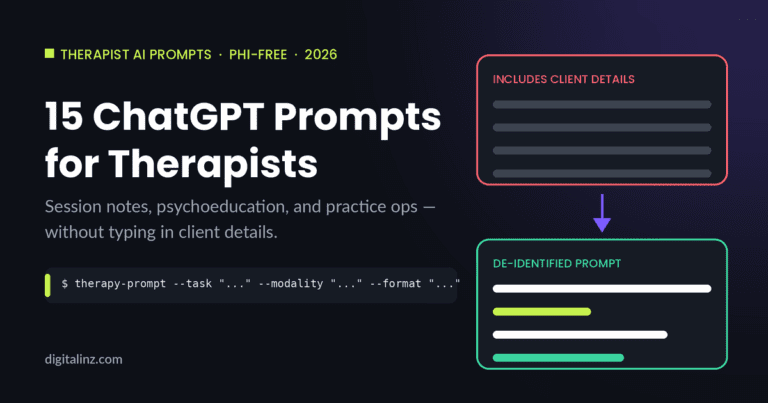
You must include meaningful details about a client‘s situation without using identifiable data. Describe general scenarios, like “a young adult managing work stress,” rather than personal facts.
This approach enriches your interactions with the technology. It ensures the guidance aligns with real-world health considerations. Your expertise in selecting pertinent details is key.
Balancing Specificity with Privacy
A therapist must always protect sensitive mental health information. Craft your prompts to be specific enough for useful context, yet vague enough to avoid PHI.
This balance keeps all interactions compliant with ethical standards. As a client‘s situation evolves, update the context you provide. This ensures continued accurate responses that support your professional care.
Leveraging ChatGPT in Your Practice
Imagine having a versatile assistant that seamlessly fits into the digital tools you already use. This technology integrates directly into your daily workflow, creating a more efficient support system.
Real-World Applications for Therapists
You can use these tools for many practical applications. They help with administrative tasks and creating educational materials for your client. This frees your time for more direct care.
Every therapist can find unique ways to apply this support. It provides a wealth of information at your fingertips.
Practical Tips for Integration
Start by embedding ChatGPT into your existing systems. Connect it to your website, internal app, or team channels like Slack. This makes the tools a natural part of your process.
Always review the responses from the model. Ensure they meet your high professional standards. This step guarantees quality information for every client interaction.
Using ChatGPT this way streamlines your practice. It turns complex tasks into simple, manageable applications. You become more effective in your supportive role.
Best Practices for Integrating AI in Therapy
The core of effective therapy lies in the relationship, a principle that must guide how you use any technological aid. Your connection with each individual is the foundation of healing. Digital resources should support, not overshadow, this vital bond.
Maintaining a Personal Touch with Automated Tools
You should use these tools to handle routine tasks like scheduling. This frees your time to focus on the emotional needs of your client. Your presence and empathy remain irreplaceable.
Always monitor the tone of the responses generated by the software. Ensure they sound empathetic and professional. This maintains the warm atmosphere essential for trust.
You, as a therapist, must verify the information provided before using it. Cross-check facts with reputable sources. This careful review protects your client.
Psychologists in schools help students with various challenges. They can use these strategies to blend efficiency with caring support. Reviewing the information ensures it’s appropriate for each student’s context.
By following these steps, you combine the speed of automated tools with the warmth of traditional care. The tone and content of automated responses should always align with your therapeutic style. Your practice becomes more efficient without losing its heart.
Navigating Ethical Considerations in AI-Driven Therapy
The promise of efficiency must never compromise the sacred trust between you and the person you are helping. When using any digital tool, your first priority is to navigate ethical considerations with care.

This means protecting sensitive data and upholding the highest standards of client care. Your professional judgment is the final authority in all matters of mental health.
Protecting Client Confidentiality and Data
You must operate under a critical assumption. Treat everything you type into a language model as publicly available information.
Never share identifiable details about a client. This includes names, locations, or specific circumstances. Use generalized scenarios instead.
A therapist has a legal and ethical duty. All digital tools must comply with strict privacy regulations like HIPAA.
Always view the information provided by these systems with healthy skepticism. It is not a substitute for your clinical training or professional judgment.
By maintaining these clear boundaries, you protect your client‘s health and privacy. You ensure your use of technology remains safe and responsible for everyone in therapy.
Future Trends and Advanced Techniques in AI Applications
The next wave of innovation in therapeutic support will focus on systems that learn and adapt in real-time. These evolving applications are designed to become more intuitive partners in your clinical work.
You can expect them to move beyond simple question-and-answer formats. The goal is a dynamic dialogue that provides deeper insights into complex mental health issues.
Adaptive Response Generation and Learning
Future techniques will generate responses that feel more contextual and personalized. Imagine a language model that can ask probing questions to encourage client self-reflection.
This adaptive process can reveal insights you might not discover on your own. It offers better solutions for the challenges your clients face, including anxiety.
These systems will learn from vast, improved training data. This development helps them understand the nuances of different therapeutic contexts and professional principles.
For you, this means more personalized strategies for coping with daily life stresses. Your services will remain effective and relevant as the digital landscape changes.
Conclusion
This exploration into supportive technology opens new doors for professional growth and service quality. You have learned strategies to save valuable time and gain deeper insights for your therapy practice.
Mastering these techniques helps you better support every client and address complex mental health issues, like anxiety. Your professional training and the human connection remain the heart of effective care.
Always protect client privacy and ensure the tone of digital responses aligns with your ethical principles. Use generalized context instead of personal details.
As you apply this knowledge in your daily life, you will discover new ways to enhance your services. Continue refining your approach to meet challenges with confidence.
Your journey toward more efficient, insightful therapy is just beginning. Let this advice guide your ongoing development as a skilled therapist dedicated to health and well-being.
FAQ
How can this technology actually help me in my sessions?
I’m concerned about client privacy. How is that handled?
Will using these tools make my interactions feel less personal?
What’s the best way to start integrating this into my daily practice?
How specific do I need to be when making a request?
Are there ethical guidelines I should follow?
Your practice is your livelihood — and AI can be one of the best investments you make in it. The AI-Powered Practice Prompt Pack helps you work more efficiently, serve your clients better, and still have energy left at the end of the day.