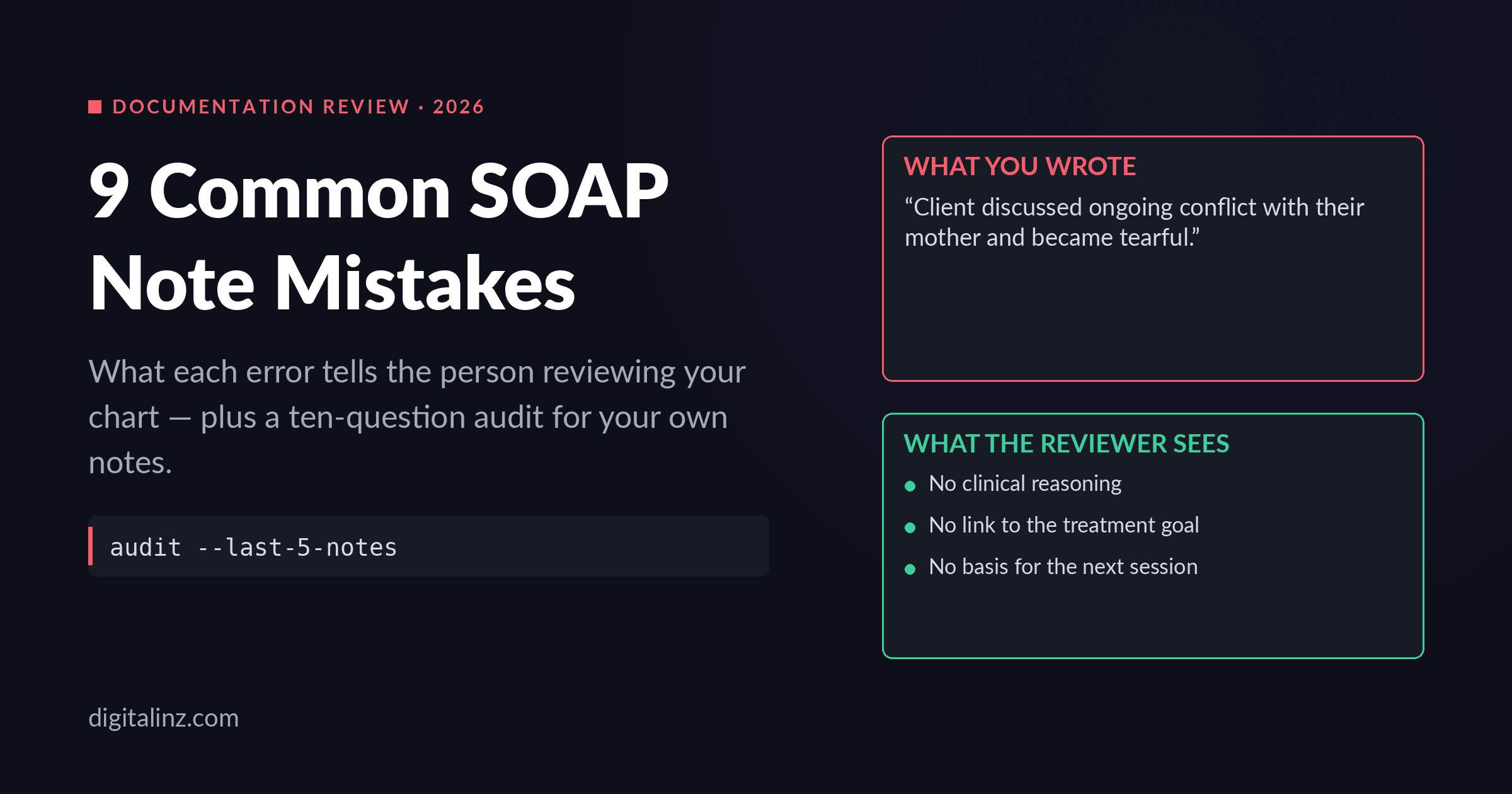
9 Common SOAP Note Mistakes (and What a Reviewer Sees)
Most documentation advice treats a SOAP note as a writing problem. It isn’t. It is
a communication problem, and the thing that makes a note good or bad is what the person
reading it is able to conclude.
So this guide runs through the nine most common SOAP note mistakes
differently from the usual list: for each one, what the error actually signals to whoever
opens your chart. At the end there’s a ten-question audit you can run on notes
you’ve already written.
|
Free · no email required Printable progress note templates The ten-question self-audit is on the last page of pack one. Two free packs — blank and guided SOAP, DAP and BIRP progress notes, plus intake, treatment plan and discharge summary templates. |
Who actually reads your notes
On any ordinary week, nobody. That’s the trap — documentation habits form in
conditions of zero feedback, and the day someone finally reads a note carefully is never a
good day. Four people eventually might:
| The covering clinician | Needs to pick up your client at short notice. Reads the Plan first, then the Assessment. Wants to know what you were working on and what to watch for. |
| The payer or auditor | Is deciding whether the service you billed was medically necessary and skilled. Reads the Assessment. Looks for whether your reasoning connects the intervention to the diagnosis and the goal. |
| The attorney | Arrives years later with a subpoena, reading for what you knew and when. Reads everything, including what you left out. Silence is interpreted. |
| You, in fourteen months | Remembers nothing. Needs the note to reconstruct the case before a session that starts in four minutes. |
Every mistake below is a mistake because of what one of those four takes away from it.
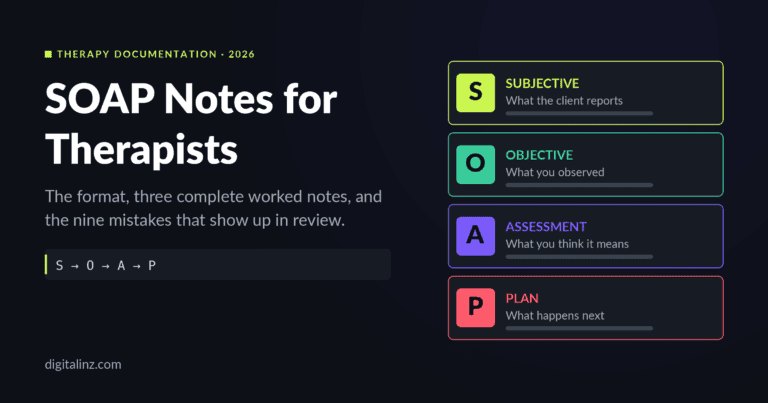
If you are still getting to grips with what each section is for, start with what are SOAP notes in counseling. For the format in full rather than the failure modes, see our
complete guide to SOAP notes for therapists.
The nine mistakes
1. Symptoms filed under Objective
Instead of: “Client is anxious about the upcoming custody hearing.”
Write: “Client reported anxiety about the upcoming custody hearing. Speech was rapid; client shifted position repeatedly and broke eye contact when the hearing was raised.”
What the reviewer concludes: that you may not distinguish report from observation — which quietly undermines every other clinical judgment in the note. This is the single most common error in the format, and it is the easiest to fix. A symptom is what the client describes; a sign is what you observed. Split the sentence in two and put each half where it belongs.
2. An Assessment that restates rather than assesses
Instead of: “Client discussed ongoing conflict with their mother and became tearful.”
Write: “The conflict client described repeats the pattern identified in session 2, supporting the working hypothesis that this is schema-level rather than situational. Tearfulness on this topic — the first affect displayed in six sessions — suggests the therapeutic alliance is now strong enough to approach it directly.”
What the reviewer concludes: that no clinical thinking took place, because none is visible. This is the most consequential mistake on the list. An auditor assessing medical necessity reads the Assessment section and essentially nothing else; if it only narrates, there is nothing to distinguish your session from a supportive conversation with a friend.

3. A Plan that says “continue treatment”
Instead of: “Continue weekly sessions. Homework as discussed.”
Write: “Continue weekly 50-minute individual sessions. Homework: daily thought record targeting morning rumination. Next session: exposure hierarchy step 3. Re-administer PHQ-9 at session 8.”
What the reviewer concludes: that treatment has no direction. “Homework as discussed” is invisible to everyone except you, and it is worthless to the colleague covering your caseload while you are ill. Payers read a vague plan as evidence that care has drifted into maintenance without clinical justification.
4. Copy-forward
Instead of: “Last week’s note with the date changed and one sentence edited.”
Write: “A fresh Objective and Assessment every session, even when the content is genuinely similar.”
What the reviewer concludes: that the record is unreliable in its entirety. This is the most damaging habit in clinical documentation, because it does not merely weaken one note — it makes deterioration invisible across a whole course of treatment, and it is trivially detectable. If two consecutive notes are identical, at least one of them is wrong, and a reviewer will assume the worse interpretation.
5. Transcribing the session
Instead of: “Nine hundred words narrating everything the client said, in order.”
Write: “The clinically relevant content, with one or two quotes that carry real weight.”
What the reviewer concludes: nothing useful, because they stopped reading. Length is not protection. Under subpoena an over-long note also hands over far more of your client’s private material than was ever required — which is a harm to them, caused by a habit meant to protect you.
6. Third parties documented by name
Instead of: “Client’s sister Maria has bipolar disorder and stopped her lithium in June.”
Write: “Client reported that a family member’s psychiatric instability is a current stressor.”
What the reviewer concludes: that you may have created a disclosure problem. The record belongs to your client, and it travels with their releases. Detailed clinical information about someone who never consented to being in it sits badly there. In couples and family work this gets sharper still, because a release signed by one partner can reach material about the other.
7. Speculation written as fact
Instead of: “Client is in denial about their drinking.”
Write: “Client’s reported consumption (estimated 4–5 units nightly) is inconsistent with their description of it as “not really a problem.” Ambivalence is likely; motivational interviewing indicated.”
What the reviewer concludes: that your clinical impressions can’t be traced back to evidence. A conclusion asserted without its reasoning is the single hardest kind of note to defend years later, because you will not remember what it rested on. Inference belongs in the Assessment and should read as inference.
8. Silence on risk
Instead of: “No mention of risk at all, because the client didn’t raise it.”
Write: “Denied suicidal and homicidal ideation on direct questioning.”
What the reviewer concludes: that risk was never assessed. This is the mistake with the most serious consequences, and it is purely a documentation failure rather than a clinical one — you asked, you simply didn’t write it down. A negative finding is still a finding. For any client with a depressive or trauma presentation, the absence of a risk line is conspicuous.
9. Notes written days later
Instead of: “Six notes written on Sunday for the week just gone.”
Write: “Notes completed within 24 hours, ideally in the ten minutes after the session.”
What the reviewer concludes: that the detail is reconstructed rather than recorded — and the EHR audit log proves it. Recall for session specifics degrades quickly and predictably. Beyond accuracy, many payers and state boards set explicit timeliness expectations, and a block of notes sharing one timestamp is visible to anyone who checks.
|
Audit your own notes
The checklist below is also on the last page of our free progress note template pack, if you would rather have it printed next to you than open in a tab.
Reading a list of mistakes produces agreement, not change. The only thing that reliably
changes documentation habits is looking at your own notes with a specific question in hand.
The ten-question self-audit
1. Does every line in Objective describe something you could see, hear or measure?
2. Does the Assessment say what changed, not just what happened?
3. Is there evidence in S or O supporting every claim in A?
4. Could a covering clinician run next week’s session from the Plan alone?
5. Is homework specific enough that the client would know what to do?
6. Is risk addressed — including when the answer was negative?
7. Is every inference labelled as inference rather than stated as fact?
8. Would this note look different from the previous session’s?
9. Is anyone other than your client identifiable in it?
10. Was it written within 24 hours of the session?
Run this on your last five notes rather than your next five. Reviewing work you have already finished tells you what your habits actually are; applying it prospectively only tells you what you can do when you are paying attention.
notes. Retroactively editing signed records is a far more serious problem than a thin
note, and the audit trail makes it visible. Correct genuine factual errors through a dated
addendum, and apply everything else going forward.
If it is easier to learn from correct examples than from errors, ten complete SOAP note examples shows notes written the way this article argues for.
The pattern underneath all nine
Eight of the nine mistakes share a single cause: the note was written for nobody. Notes
written as a compliance chore drift toward whatever is fastest to type, and what is fastest
to type is vague, repetitive and stripped of reasoning.
The correction is a small mental substitution. Instead of asking “what do I have to
write here,” ask “what would a colleague need to know to take this case
tomorrow.” That single question fixes the Assessment section, fixes the Plan section,
and makes copy-forward feel as wrong as it actually is.
If AI is part of your workflow, the same principle applies with one addition — it
never receives identifiable client information. See
can ChatGPT write SOAP
notes for the de-identified workflow, and
is ChatGPT HIPAA compliant
for the compliance question. A model will happily produce a fluent, confident, entirely
generic Assessment, which is mistake number two with better grammar.
Frequently asked questions
What is the most common SOAP note mistake?
Putting the client’s reported symptoms in the Objective section. It appears in
almost every documentation review. The fix is to ask whether a competent observer in the
room could have seen or heard the thing you just wrote.
Can I fix mistakes in notes I’ve already signed?
Correct genuine factual errors with a dated addendum that states what was wrong and why.
Never delete or overwrite. Do not retroactively improve the quality of old notes —
that is a materially different act from correcting an error, and audit logs record it.
How detailed should a SOAP note be?
Detailed enough to justify your clinical decisions, brief enough that a reader finds what
they need. For a routine outpatient session that is usually 150–300 words. Detail in
the Assessment matters far more than detail in the Subjective.
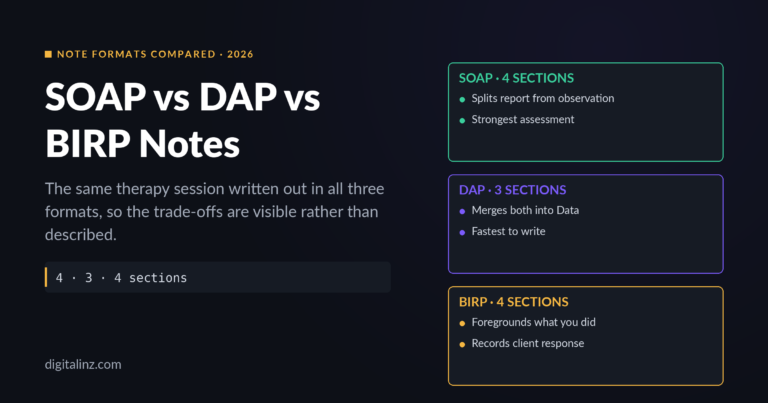
Do these mistakes apply to DAP and BIRP notes too?
Seven of the nine do. The symptom/sign confusion is specific to SOAP, since DAP merges
those sections. Everything about reasoning, specificity, copy-forward, risk and timeliness
applies to any note format.
Will an insurance auditor really read my notes?
Sometimes, and usually without warning. Audits tend to sample a handful of charts across
a date range, which is exactly why consistency matters more than any single excellent note.
This article is general professional information for licensed clinicians and students, not legal, clinical or compliance advice. Documentation requirements vary by state, licensing board, payer and setting. Any example notes are composites written for illustration and do not describe real clients.