SOAP vs DAP vs BIRP Notes: Which Format Should You Use?
Every comparison of these three formats describes them one after another and leaves you
to imagine the difference. That’s not much help, because the formats sound almost
identical in the abstract and only diverge once you put real clinical content into them.
So this guide compares SOAP vs DAP vs BIRP notes by writing out the same
therapy session three times, in full. Read the three versions and the trade-offs become
obvious in a way no description manages.
|
Free · no email required Printable progress note templates Blank templates for all three formats, in one file. Two free packs — blank and guided SOAP, DAP and BIRP progress notes, plus intake, treatment plan and discharge summary templates. |
The short answer
Use SOAP if your records are read by people outside your discipline, or
if defensibility matters most. Separating what the client said from what you observed is the
distinction that holds up best under review.
Use DAP if you are writing high volume and that separation isn’t
worth the time. It is the same content with one fewer decision to make per note.
Use BIRP if you need to demonstrate what you did and how the client
responded — case management, substance use treatment, or any setting where
justifying the intervention is the point.
If your agency mandates a format, that decision is already made. Most do.
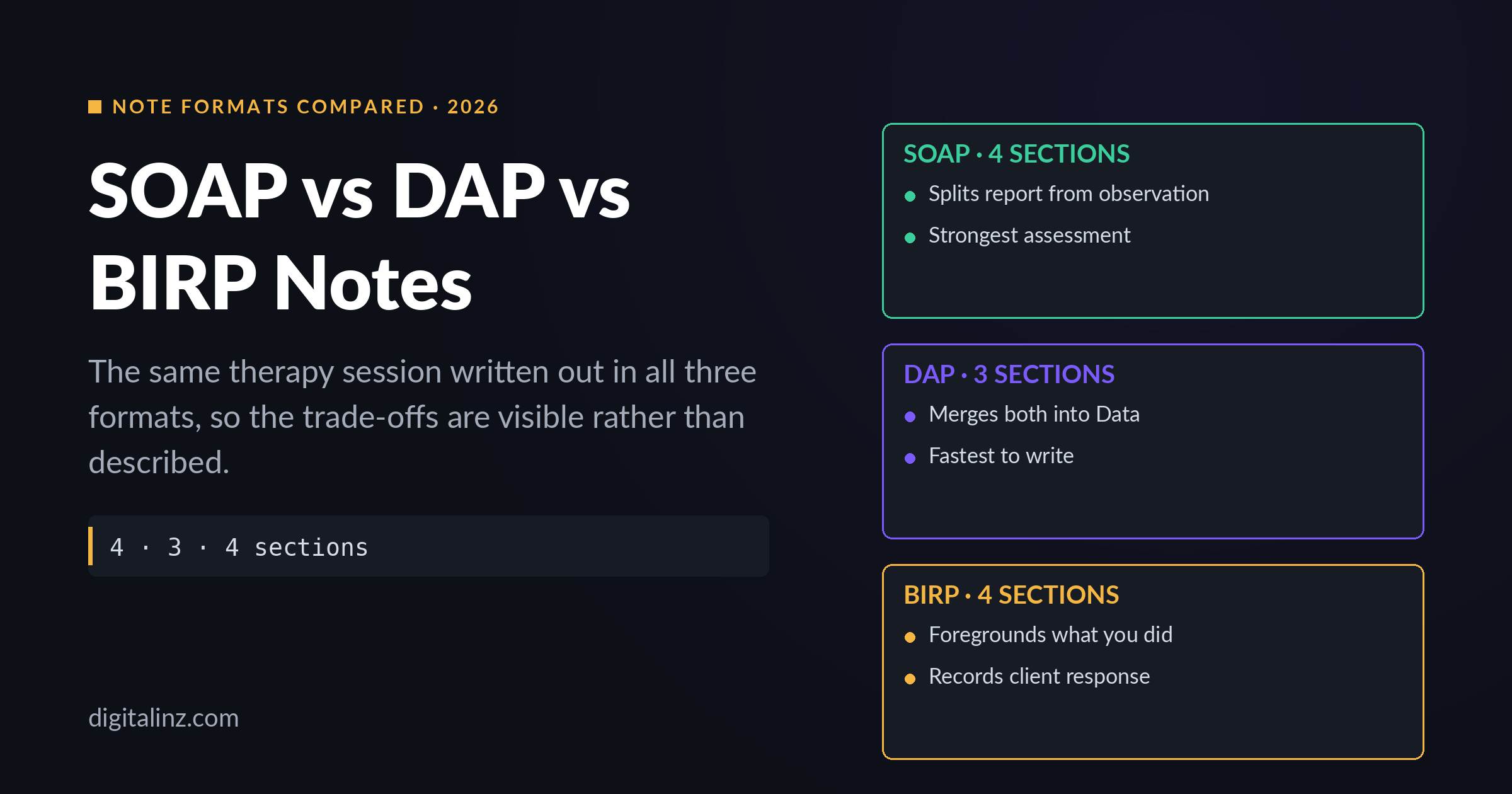
| SOAP | DAP | BIRP | |
|---|---|---|---|
| Sections | 4 | 3 | 4 |
| Splits client report from your observation? | Yes | No | Partly |
| Foregrounds what you did? | No | No | Yes |
| Records client response to intervention? | Indirectly | Indirectly | Explicitly |
| Typical writing time | 6–10 min | 5–8 min | 8–12 min |
| Common settings | Integrated care, medical | Community mental health | Case management, SUD |
What each format actually is
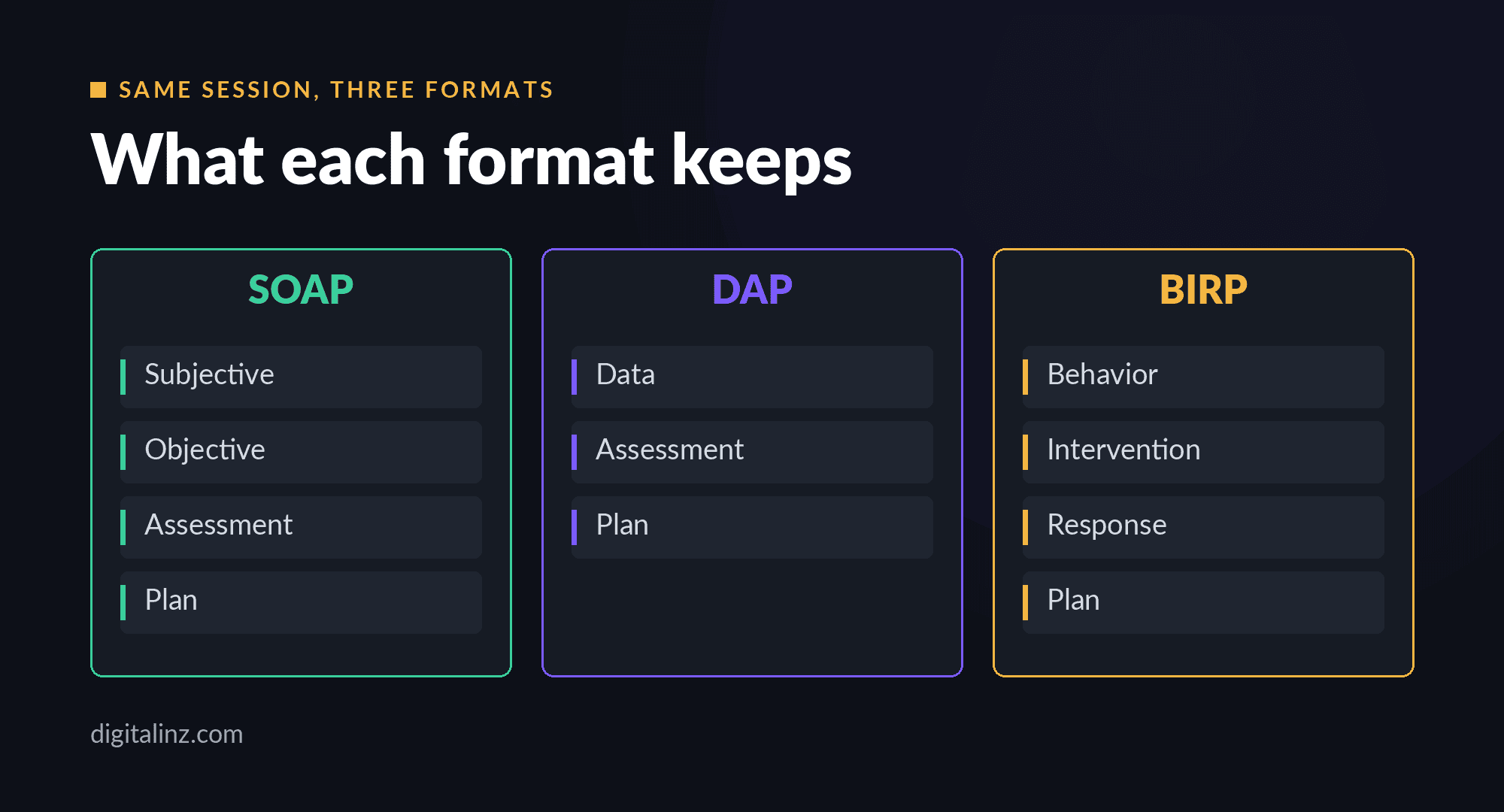
SOAP — Subjective, Objective, Assessment, Plan
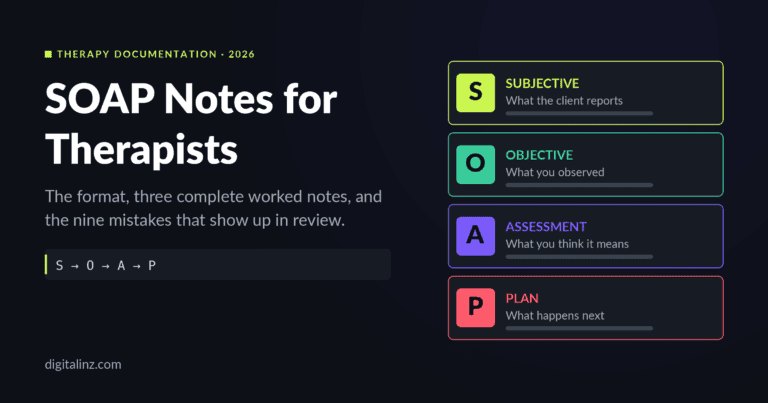
The oldest and most widely used of the three, borrowed from general medicine. Subjective
is the client’s report; Objective is what you observed and measured; Assessment is your
clinical reasoning; Plan is what happens next.
Strength: the subjective/objective split forces a distinction that
matters clinically and is legible to readers from other disciplines. In integrated care, a
physician reading your note already knows how to parse it.
Weakness: the split is also its main cost. Deciding which side of the
line each item falls on is a real judgment made repeatedly, and it is where most
documentation errors occur. Full detail is in our
complete guide to SOAP notes for therapists.
DAP — Data, Assessment, Plan
SOAP with the first two sections merged. Data holds everything observed and reported;
Assessment and Plan are unchanged.
Strength: genuinely faster, and it removes the single most common source
of documentation error by removing the decision that causes it. Popular in community mental
health for exactly this reason.
Weakness: a reader can no longer tell what the client claimed from what
you observed. Where those diverge — which is clinically interesting and sometimes
legally important — DAP loses the contrast unless you write carefully enough to
preserve it in prose.
BIRP — Behavior, Intervention, Response, Plan
Reorganized around the therapeutic action rather than the information. Behavior is the
client’s presentation; Intervention is what you did; Response is how they reacted;
Plan is next steps.
Strength: it is the only one of the three with a dedicated section for
what you did and a dedicated section for what happened as a result. If you have ever had a
payer question whether a session was skilled treatment, BIRP answers that structurally
rather than relying on you to remember to mention it.
Weakness: there is no obvious home for clinical formulation. Your
reasoning ends up distributed across Response and Plan, which makes it easy to write a BIRP
note that describes a session thoroughly and never states what you concluded.
|
The same session, three ways
A composite client, session 4, moderate depression with situational stress. Identical
clinical content each time.
S — Client reported a difficult week, describing two arguments with their partner about finances. Rated mood “a 4 out of 10, most days.” Reported sleeping about five hours nightly. Completed the breathing exercise on three of seven days, saying it “helped in the moment but I keep forgetting.”
O — On time, appropriately groomed. Speech normal rate and volume. Affect mildly constricted, congruent with reported mood. Oriented ×4. PHQ-9: 11. Denied suicidal ideation on direct questioning. Interventions: reviewed homework adherence, introduced habit-stacking cue, psychoeducation on the sleep–irritability relationship.
A — Presentation remains consistent with the moderate depressive symptoms identified at intake, with financial conflict as a current maintaining factor. Homework adherence at three of seven reflects a cueing problem rather than motivation, based on client’s own account, which is why the intervention targeted the cue. Short sleep is likely amplifying irritability and compounding the relational stress. No risk indicators.
P — Continue weekly 50-minute sessions. Homework: breathing exercise attached to an existing daily habit; brief sleep log. Next session: review sleep log, introduce problem-solving structure for the finance conversation. Re-administer PHQ-9 at session 6.
D — Client reported a difficult week with two arguments with their partner about finances, rated mood “a 4 out of 10, most days,” and reported sleeping about five hours nightly. Completed the breathing exercise three of seven days — “helped in the moment but I keep forgetting.” On time, appropriately groomed; speech normal; affect mildly constricted and congruent; oriented ×4. PHQ-9: 11. Denied suicidal ideation on direct questioning. Interventions: reviewed homework adherence, introduced habit-stacking cue, psychoeducation on sleep and irritability.
A — Presentation remains consistent with moderate depressive symptoms, with financial conflict as a current maintaining factor. Adherence reflects a cueing problem rather than motivation. Short sleep is likely amplifying irritability. No risk indicators.
P — Continue weekly 50-minute sessions. Homework: breathing exercise habit-stacked; brief sleep log. Next session: review sleep log, introduce problem-solving structure. Re-administer PHQ-9 at session 6.
B — Client presented on time, appropriately groomed, with mildly constricted affect congruent with a self-rated mood of 4/10. Described two arguments with their partner about finances and reported approximately five hours of sleep nightly. Reported completing the breathing exercise on three of seven days. PHQ-9: 11. Denied suicidal ideation on direct questioning.
I — Reviewed homework adherence and identified the failure point as cueing rather than motivation. Introduced a habit-stacking cue, pairing the breathing exercise with an established twice-daily routine. Delivered psychoeducation on the relationship between sleep restriction and irritability.
R — Client engaged readily with the habit-stacking rationale and independently identified the pairing to use. Responded to the sleep psychoeducation by connecting it to the timing of both arguments, which they had not previously linked. Agreed to the sleep log without hesitation.
P — Continue weekly 50-minute sessions. Homework: habit-stacked breathing exercise; brief sleep log. Next session: review sleep log, introduce problem-solving structure for the finance conversation. Re-administer PHQ-9 at session 6.
What the three versions reveal
DAP is shorter, and the loss is specific. In the SOAP version you can see
that the client reported five hours of sleep while the PHQ-9 was administered and
scored. In DAP those sit in the same paragraph. On a routine note that costs nothing. On a
note that ends up in a disability determination or a custody evaluation, the distinction
between what was claimed and what was measured is exactly what the reader needs.
BIRP is the only version where the intervention is unmissable. Read the
SOAP and DAP versions again: the interventions are there, tucked at the end of a section
about something else. In BIRP they occupy a quarter of the note. If your work is routinely
audited for medical necessity, that structural difference is worth more than the extra
minutes.
BIRP is also the only version that records how the client responded
— that they made the sleep connection themselves, having not linked it before. That is
clinically valuable information, and in SOAP and DAP it survives only if you remember to put
it in the Assessment.
SOAP has the strongest Assessment. Not because the format is superior,
but because a dedicated Assessment section between the data and the plan makes an empty one
conspicuous. In BIRP you can omit your reasoning entirely and the note still looks complete.
That is the format’s real risk.
Four questions to choose
Whichever you land on, blank printable templates for all three are in our free progress note template pack.
- Does your agency or EHR mandate one? Then use it. This is the deciding
factor for most clinicians and there is no benefit to fighting it. - Who reads your notes? Other disciplines and external reviewers favor
SOAP. Internal-only records give you more freedom. - Is medical necessity ever questioned in your setting? If yes, BIRP makes
your case structurally rather than relying on your discipline. - What is your caseload? At thirty-plus sessions a week the time
difference between DAP and BIRP is roughly two hours. That is a real consideration, not a
lazy one.
sensible, but do it at a natural boundary — a new treatment plan period, a new episode
of care — rather than mid-course. A record that changes structure halfway through
without explanation invites the question of why, and the answer should be documented
somewhere. Consistency across a course of treatment matters more than the specific format
chosen.
Frequently asked questions
Is BIRP better than SOAP?
Neither is better in the abstract. BIRP demonstrates skilled intervention more clearly;
SOAP demonstrates clinical reasoning more clearly and travels better between disciplines.
Match the format to who reads your notes and what they need to conclude.
What is the difference between DAP and BIRP notes?
DAP has three sections and merges everything observed and reported into Data. BIRP has
four and splits the session by therapeutic action — what the client presented with,
what you did, how they responded, what is next. DAP is the faster of the two; BIRP is the
more detailed about process.
Can I use different formats for different clients?
Yes, and there are reasonable grounds for it — BIRP for a case-managed client whose
services need justifying, SOAP for one in integrated care. Keep it consistent within each
client’s record.
Which format do insurance companies prefer?
Most don’t specify one. They require documentation that supports medical necessity
and demonstrates skilled care. All three can do that, and all three can fail to — an
empty Assessment or a vague Plan will be flagged regardless of the acronym above it.
Are DAP and BIRP notes also progress notes?
Yes. All three are progress notes and all three sit in the medical record. None of them
are psychotherapy notes in the HIPAA sense, which is a separate category with different
protections — explained in
what are SOAP notes in counseling.
How do I get faster at whichever format I use?
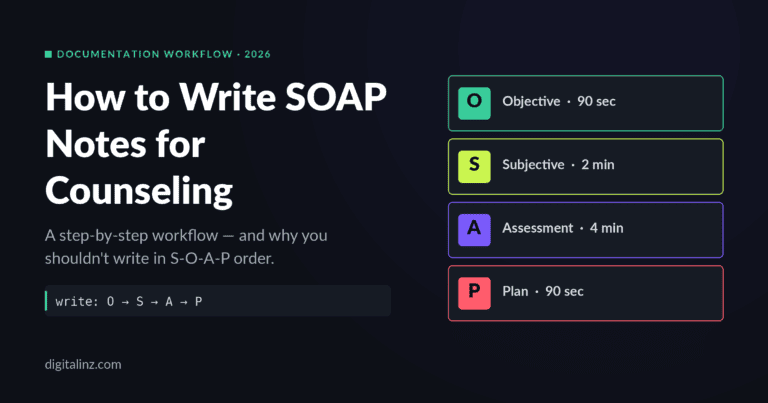
Write in the gap after the session rather than at the end of the day, and write the
sections out of order. Our step-by-step SOAP workflow covers the sequence;
it adapts to DAP and BIRP with minimal changes.
This article is general professional information for licensed clinicians and students, not legal, clinical or compliance advice. Documentation requirements vary by state, licensing board, payer and setting. Any example notes are composites written for illustration and do not describe real clients.