
Is It Okay to Use ChatGPT for Therapy Notes? The Ethics, Not the Tech
“Is it okay?” is doing a lot of work in this question, and it usually hides
four different questions wearing one coat. Most articles answer whichever one they find
easiest and leave the others standing.
| Is it legal? | A HIPAA question about protected health information, business associate agreements and de-identification. Answered in is ChatGPT HIPAA compliant. |
| Is it ethical? | A question about your professional code and your licensing board — consent, disclosure, competence and accountability. This article. |
| Is it clinically sound? | A question about whether the output is accurate and whether using it degrades your own clinical thinking. Covered below, and in the note-quality sections of the SOAP notes guide. |
| How do I actually do it? | A workflow question about prompts, de-identification and review. Answered in can ChatGPT write SOAP notes. |
So: not whether ChatGPT can draft a therapy note — it can — and not
whether HIPAA permits it, which is a separate matter of de-identification. This is about
whether your profession permits it, what you owe the client, and where the accountability
sits when the output is wrong.
|
Free · no email required Printable progress note templates Nothing here needs a tool, a login or an AI model. Two free packs — blank and guided SOAP, DAP and BIRP progress notes, plus intake, treatment plan and discharge summary templates. |
The short answer
Yes, with three obligations. For most licensed clinicians in the US,
using AI to help structure documentation is permitted — provided you tell your clients,
obtain their consent, and remain fully accountable for everything in the record. None of
those three is optional, and the second one surprises people.
What the ethics codes actually say
Professional codes have caught up faster than most clinicians realize. The
ACA Code of Ethics, Section H, which
governs telehealth and technology, addresses AI directly. Two standards matter most here.
On using technology at all:
they are using any form of technology, including applications and AI, at any point in the
counseling process. Counselors obtain consent to use these technologies. Should clients
decline services involving certain technologies, counselors provide alternative options for
them.
And, specifically on documentation:
the use of technology platforms for documentation, including note-taking. Counselors are
responsible for verifying the accuracy of documentation provided by the technology platform.
If clients do not consent to technology platforms for documentation, counselors cannot
terminate services to clients.
Read that last sentence again, because it is the part almost nobody covers. If a client
says no, you don’t get to make it their problem. You write the notes yourself and the
therapeutic relationship continues unchanged.
you are a psychologist you follow the APA Ethical Principles, a social worker the NASW Code
of Ethics, a marriage and family therapist the AAMFT code — and all of them sit
underneath your state licensing board, which can be stricter than any of them. Codes are also
revised periodically. Check the current version of your own before relying on any summary,
including this one.
The obligation people skip: telling the client
Most clinicians who have adopted AI for notes have not mentioned it to a single client.
The reasoning is usually that the client’s information never reaches the tool, so there
is nothing to disclose.
That reasoning answers the HIPAA question, not the ethics question. Those are different
standards. De-identification addresses whether you have disclosed protected information.
Consent addresses whether the client knows how their care is being conducted. You can be
fully compliant on the first and in breach of the second.
The good news is that this is a two-sentence conversation, and it lands far better than
people expect. Clients are broadly aware that AI is now in everything; being told plainly
that you use it, that their information never goes into it, and that they can decline reads
as conscientious rather than alarming. It is a trust-building disclosure, not a
confession.
Sample consent language
“To help me complete clinical documentation, I sometimes use AI software to help structure my notes. When I do, I never enter your name or any information that could identify you — I write a de-identified summary and the software helps organise it. I review and edit everything before it goes in your record, and all clinical judgments remain mine. You can ask me not to use this at any time, and that will not affect your care in any way.”
Adapt to your own practice and jurisdiction, and have it reviewed if your setting has counsel or a compliance function. This is illustrative wording, not a form.
|
What you stay accountable for
All of it. That is not a hedge — it is the actual standard, and it is what makes the
rest workable. The code puts the verification duty on you explicitly, and treats AI as
supplemental to your judgment rather than a substitute for it, particularly around
diagnosis.
Three practical consequences:
- Everything gets read before it is signed. A language model will produce
fluent text containing a detail you never observed. It reads as plausibly as the parts that
are true, which is precisely the danger. - The Assessment stays yours. AI is good at structure and bad at knowing
your client. A generated assessment will be confident, well-written and generic — which
is worse than a short one you wrote, both clinically and under review. - “The AI wrote it” is not a defense. Anywhere. Not to your
board, not to a payer, not in a deposition. Your signature means the same thing it always
did.
The clinical question nobody asks
Beyond permission, there is a question worth sitting with: does drafting notes this way
change your thinking?
Writing the Assessment is not merely recording a conclusion — for many clinicians it
is where the conclusion forms. The ten minutes spent articulating why a client is or
isn’t improving is reflective practice, not administration. Outsourcing the structure
is fine. Outsourcing the reasoning means losing something you probably want to keep.
A reasonable line: let AI handle the parts that are transcription and formatting, and
write the parts that are thinking. In SOAP terms, that means Objective and Plan are fair
game, and the Assessment is yours.
Where the line sits
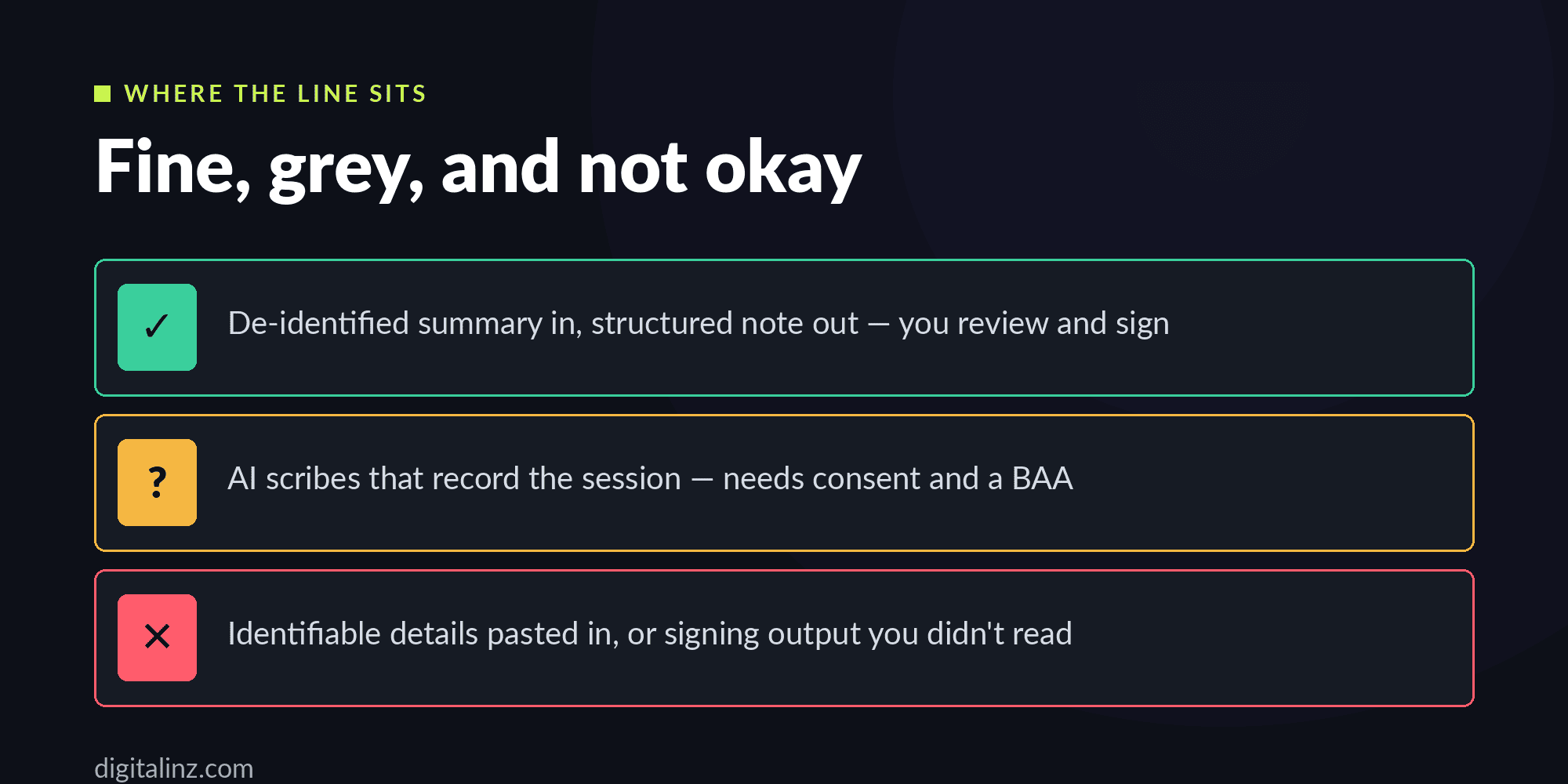
Clearly fine: pasting a de-identified summary you wrote and asking for it
to be structured into SOAP format. Asking for help with wording. Generating a treatment plan
template you then populate. Drafting a referral letter with no identifying detail.
Grey, and depends on consent and your board: AI scribes that transcribe
sessions directly. These are increasingly common and often HIPAA-capable with a business
associate agreement, but they involve recording the session, which triggers its own consent
requirements. Do not adopt one without explicit client consent and a check of your state
rules.
Not okay: pasting identifiable client information into a consumer
chatbot. Signing output you have not read. Letting a model produce a diagnosis or a risk
assessment. Using AI for documentation after a client has declined it.
Frequently asked questions
Do I have to tell my clients I use AI for notes?
Under the ACA code, yes — counselors inform clients when they use any form of
technology including AI, and obtain consent. Other professions’ codes and state boards
vary, but disclosure is the direction of travel everywhere, and it is difficult to construct
an argument for concealing it.
What if a client says no?
You write the notes yourself. The ACA code is explicit that you cannot terminate services
over it, and it would be poor practice regardless.
Does this apply if I never enter any client information?
The consent standard is about informing clients how their care is conducted, not only
about data disclosure. Even fully de-identified, you are using a tool in the course of their
treatment. Disclose it.
Can my licensing board discipline me for using AI?
Boards act on failures of consent, confidentiality, competence and accuracy — not on
tool choice as such. The realistic risk is not “you used AI” but “you
disclosed protected information” or “you signed a note containing something that
never happened.”
Is an AI scribe different from ChatGPT?
Legally, often yes — purpose-built clinical scribes will typically sign a business
associate agreement, which consumer ChatGPT will not. Ethically the consent obligations are
the same, and recording a session adds further requirements. A BAA answers the HIPAA
question and none of the ethics ones.
Where do I start if I want to do this properly?
Check your own code and state board first, add consent language to your intake paperwork,
and use a de-identified workflow from day one —
can ChatGPT write SOAP notes has the prompt and the rules.
This article is general professional information for licensed clinicians and students, not legal, clinical or compliance advice. Documentation requirements vary by state, licensing board, payer and setting. Any example notes are composites written for illustration and do not describe real clients.