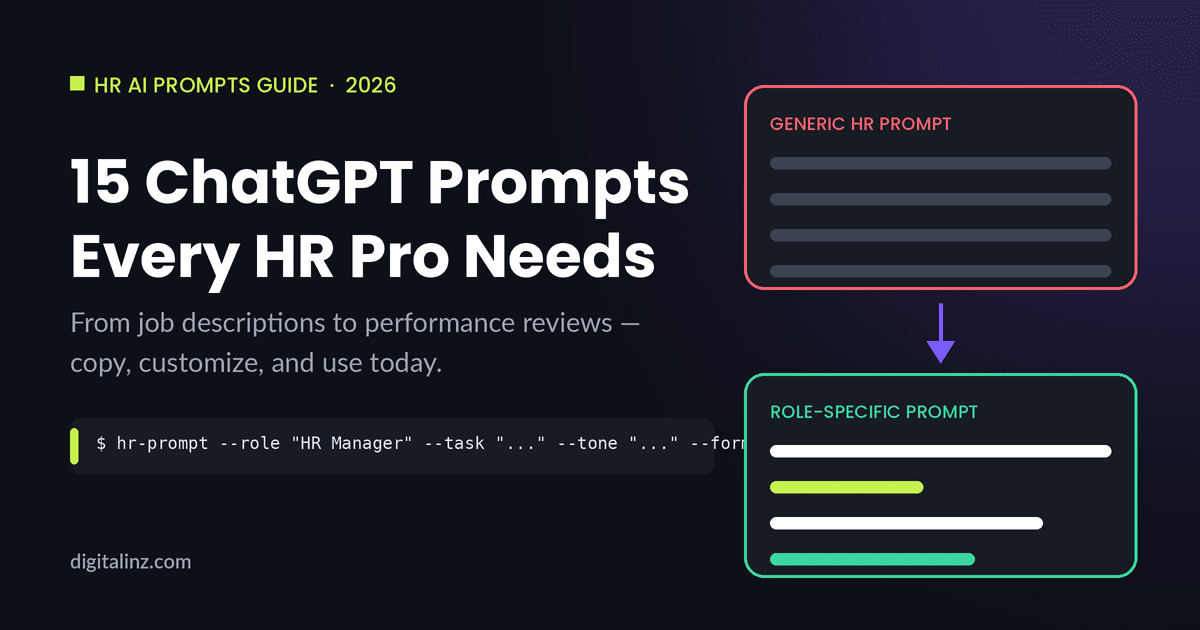
The Best ChatGPT Prompts for HR Professionals (15 Free Templates, 2026)
If you work in HR, you’ve probably already typed something like “write a job description for…” into ChatGPT. But most HR teams are only using a tiny fraction of what’s possible. The best ChatGPT prompts for HR professionals go far beyond job ads — they cover onboarding, performance reviews, policy drafts, and the difficult conversations nobody looks forward to writing. Here are 15 you can copy, customize, and use today, plus one master prompt that works for almost everything else.
Why HR Teams Are Turning to ChatGPT
HR is one of the most writing-heavy roles in any company — job descriptions, offer letters, policy memos, review drafts, announcement emails — and most of it follows predictable structures. That makes it a near-perfect fit for ChatGPT, especially for small or solo HR teams without a dedicated comms or legal function. Used well, ChatGPT can:
- Turn a rough outline into a polished job description in minutes
- Draft a first-pass performance review you then personalize
- Rewrite a dense policy into plain-language employee communication
- Help you find the right tone for a sensitive announcement before you send it
One important guardrail: avoid pasting real, identifiable employee data — names, salaries, performance details — into any AI tool unless your company has reviewed its data and privacy practices. Every prompt below works just as well with placeholder details that you swap back in afterward.
15 ChatGPT Prompts Every HR Professional Should Have
These are grouped by the five areas where HR teams write the most. Copy any prompt, fill in the brackets with your own details, and adjust the tone to match your company.
Recruiting & Job Descriptions
- The Role Snapshot Prompt — “Act as a recruiter. Turn this rough list of duties into a structured job description for a [job title] at a [company size] [industry] company: [paste bullet list]. Include Overview, Responsibilities, Requirements, and Benefits sections.”
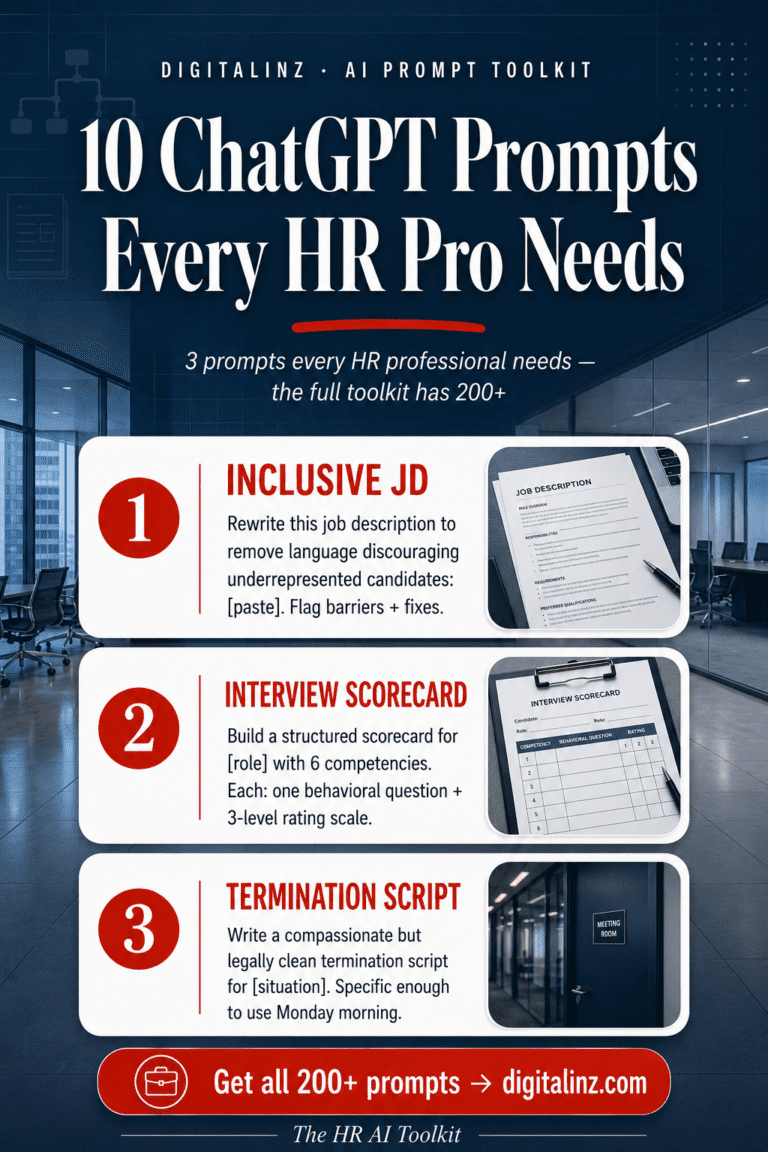
- The Inclusive Language Audit Prompt — “Review this job description for biased or exclusionary language and suggest more inclusive alternatives, without changing the meaning: [paste job description].”
- The Interview Question Set Prompt — “Act as a hiring manager for a [job title] role. Write 8 interview questions that assess [skill 1], [skill 2], and [skill 3], with one follow-up probe for each.”
Onboarding & Employee Communications
- The 30-60-90 Day Plan Prompt — “Create a 30-60-90 day onboarding plan for a new [job title] joining the [department] team. Include goals, check-in points, and resources to review at each stage.”
- The Welcome Email Prompt — “Write a warm, concise welcome email for a new hire starting as [job title] on [date], including their first-day schedule: [paste schedule].”
- The FAQ Builder Prompt — “Based on this list of common new-hire questions: [paste questions], write a short onboarding FAQ page in a friendly, plain-language tone.”
Performance Reviews & Feedback
- The Review Draft Prompt — “Act as an HR manager. Write a [quarterly/annual] performance review draft for a [job title] based on these notes: [paste notes]. Structure: Strengths / Areas for Growth / Goals for Next Period. Keep it under 300 words.”
- The Feedback Reframe Prompt — “Rewrite this feedback to be specific, constructive, and free of vague phrases like ‘good job’ or ‘needs improvement’: [paste feedback].”
- The Self-Review Helper Prompt — “Create a self-review template with 5 prompts that help an employee reflect on accomplishments, challenges, and goals for a [job title] role.”
Policies & Documentation
- The Plain-Language Policy Prompt — “Rewrite this HR policy in plain, friendly language an employee with no HR background could understand, while keeping all the key rules intact: [paste policy text].”
- The Policy Comparison Prompt — “Compare these two policy drafts and summarize the practical differences for employees in a short bullet list: [paste both drafts].”
- The SOP Outline Prompt — “Create a step-by-step SOP outline for [HR process, e.g. ‘processing a leave request’], written for someone doing this task for the first time.”
Employee Relations & Difficult Conversations
- The Difficult Conversation Prep Prompt — “Act as an HR coach. I need to have a conversation with an employee about [situation]. Give me a short script with an opening line, 2-3 key points, and how to handle likely pushback.”
- The Exit Interview Question Prompt — “Write 8 open-ended exit interview questions that help identify patterns in why employees leave [department/role], without sounding accusatory.”
- The Announcement Tone-Check Prompt — “Review this internal announcement for tone — flag anything that could come across as cold, vague, or alarming, and suggest a warmer alternative: [paste announcement].”
Copy-Paste: The HR Context-Stack Prompt
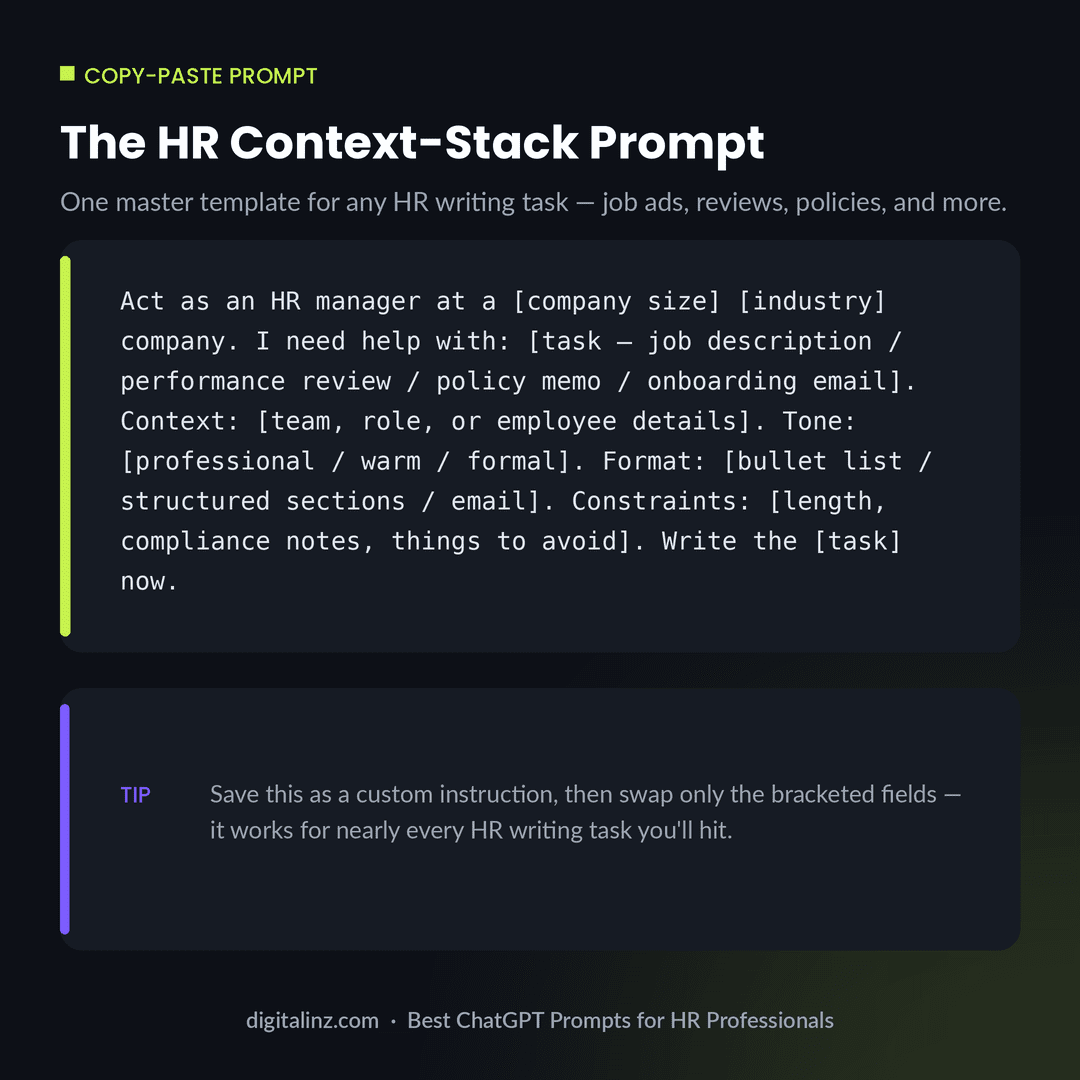
If you only save one of these, save this one. It’s a master template that covers nearly every HR writing task — just swap the bracketed fields:
Act as an HR manager at a [company size] [industry] company. I need
help with: [task — job description / performance review / policy
memo / onboarding email]. Context: [team, role, or employee
details]. Tone: [professional / warm / formal]. Format: [bullet
list / structured sections / email]. Constraints: [length,
compliance notes, things to avoid]. Write the [task] now.
Save it as a custom instruction or a saved prompt so it’s one paste away every time you need it.
Generic vs. HR-Specific: See the Difference
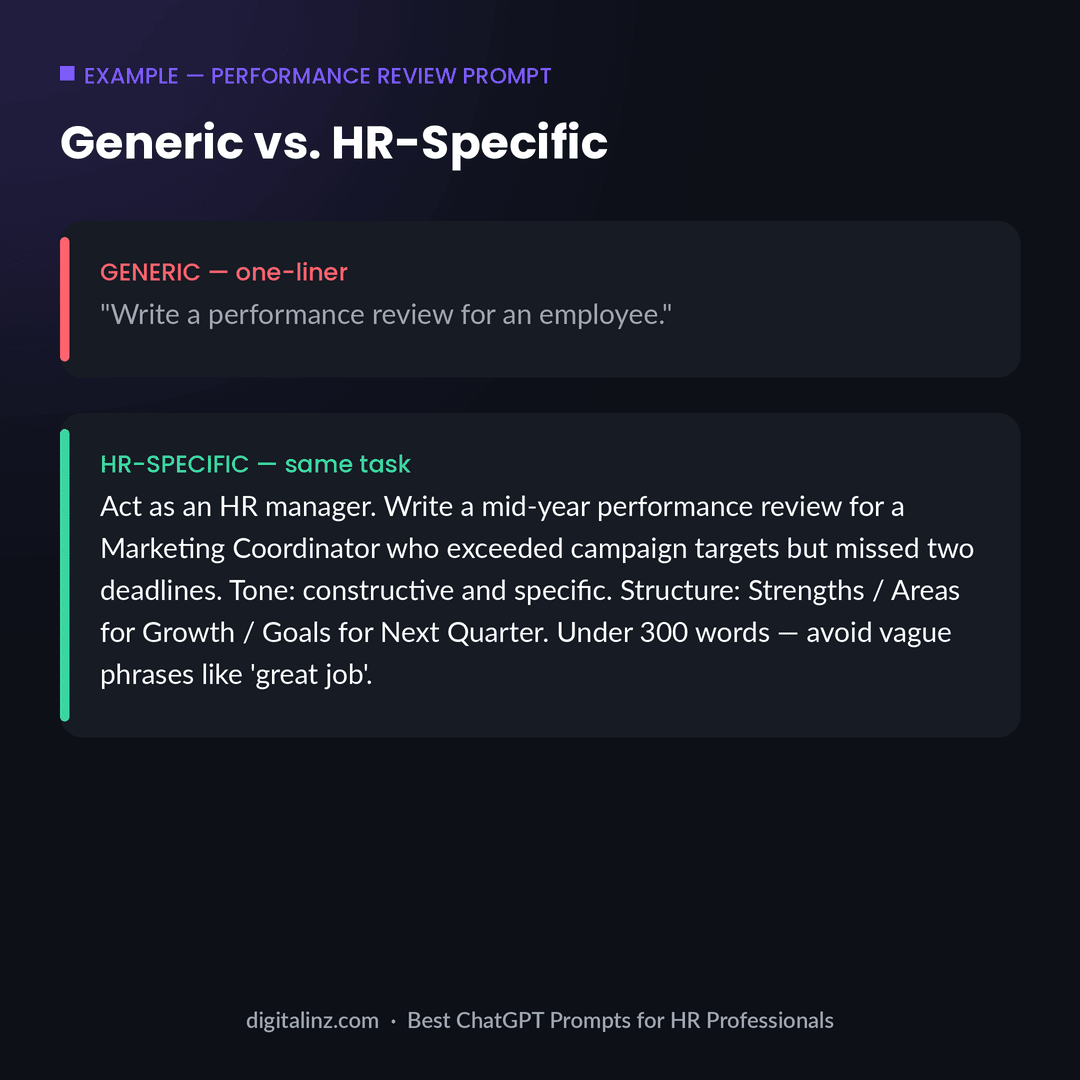
The gap between “write a performance review” and a prompt that includes the employee’s role, what they did well, where they fell short, and how the review should be structured is the entire reason ChatGPT prompts for HR professionals work better when they’re built around real context. If you’ve picked up a prompt pack that promises hundreds of HR prompts, run a sample through our 5-point prompt pack test first — the value is almost always in how much of this context-setup is already done for you.
FAQ
What are the best ChatGPT prompts for HR professionals?
The most useful prompts give ChatGPT a role (HR manager, recruiter, HR coach), real context (job title, department, situation), an output format (email, structured review, bullet list), and constraints (length, tone, things to avoid). The 15 prompts above cover the most common HR writing tasks: recruiting, onboarding, reviews, policies, and employee relations.
Is it safe to use ChatGPT for HR tasks involving employee data?
Use placeholders for names, salaries, and other identifying details whenever possible, and check your company’s AI usage policy before pasting real employee information into any AI tool. Most HR writing tasks work just as well with anonymized details that you swap back in afterward.
Can ChatGPT write a full performance review for me?
ChatGPT can produce a strong first draft, especially when you provide real notes on the employee’s work, but it shouldn’t be the final word. Review every AI-drafted review for accuracy, fairness, and tone before it’s shared, and personalize details that only you would know.
How do I make ChatGPT-written HR communications sound less robotic?
The same fixes that work for any ChatGPT writing apply here: give it a real example to match, set a specific tone like “warm but professional,” and avoid defaulting to “formal” language. See our guide on making ChatGPT not sound like AI for more fixes.
The Shortcut
Typing out 15 prompts — and tweaking them every time — gets old fast. Our HR AI Toolkit includes 200+ ready-to-use prompts covering recruiting, onboarding, reviews, policies, and employee relations, with the role, context, and format already built in. See how it compares to other HR prompt packs in our HR prompt pack comparison, or grab it on Gumroad.