ChatGPT Prompts for Therapists Without PHI (15 Free Templates, 2026)
If you’re a therapist using ChatGPT, the biggest risk usually isn’t the AI — it’s what you paste into it. The best ChatGPT prompts for therapists without PHI are built so you never need to type a client’s name, date of birth, or other identifying details to get useful help with session notes, psychoeducation, treatment planning, and practice admin. Here are 15 you can copy, customize, and use today, plus one master prompt that keeps every clinical writing task de-identified by default.
Why “No PHI” Matters When Using ChatGPT in Your Practice
Protected Health Information (PHI) includes anything that could identify a specific client — names, dates of birth, addresses, and details specific enough to be identifying even without a name. Most consumer AI tools, including the free version of ChatGPT, are not covered entities or business associates under HIPAA, and typing in identifiable client information can create compliance and trust issues even if nothing goes wrong technically. The HHS HIPAA Privacy Rule is the baseline every practice should understand before using any AI tool with client-related work.
The good news: almost every clinical writing task — session notes, treatment plans, handouts, emails — works just as well with placeholders like “adult client” or “presenting concern: work-related anxiety” instead of real names and dates. The 15 prompts below are written that way from the start.
15 ChatGPT Prompts for Therapists (No PHI Required)
These are grouped by the five areas where therapists do the most writing. Copy any prompt, fill in the de-identified brackets, and adjust the tone to match your practice.
Session Documentation (De-Identified)
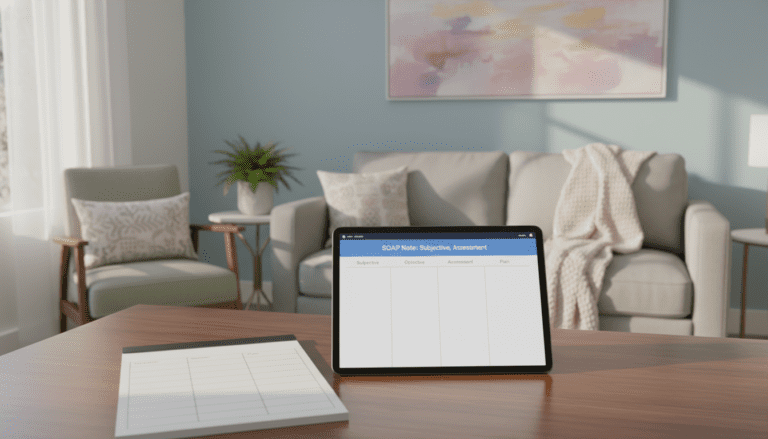
- The De-Identified SOAP Note Prompt — “Act as a licensed therapist. Write a SOAP note using only this de-identified information: adult client, presenting concern [X], session focus [Y], interventions used [Z], plan for next session [A]. Use objective clinical language, under [length].” For more SOAP-specific formatting, see our ChatGPT SOAP note template.
- The Progress Note Summary Prompt — “Summarize this de-identified session into a brief progress note: adult client, main topics discussed [list], affect observed [description], homework assigned [task]. Format as a short paragraph.”
- The Treatment Plan Update Prompt — “Act as a [modality] therapist. Update a treatment plan goal based on this de-identified progress: adult client, original goal [X], progress noted [brief description]. Suggest a revised goal and 2 measurable objectives.”
Treatment Planning & Psychoeducation
- The Psychoeducation Handout Prompt — “Write a one-page psychoeducation handout for clients on [topic, e.g. ‘grounding techniques for anxiety’], written at an 8th-grade reading level, with 3-5 practical steps.”
- The Coping Skills List Prompt — “Create a list of 8 coping strategies for [concern], grouped into ‘in the moment’ and ‘longer-term’ categories, written in plain, supportive language.”
- The Worksheet Builder Prompt — “Design a simple worksheet to help a client practice [skill, e.g. ‘cognitive reframing’], with 3 guided prompts and space for written responses.”
Practice Communications
- The Intake Reminder Email Prompt — “Write a friendly reminder email for a new client’s first appointment, including what to expect and any paperwork to complete beforehand, without referencing any personal details.”
- The Cancellation Policy Reminder Prompt — “Write a polite, professional message reminding clients of our [X]-hour cancellation policy, to be sent as a standard template.”
- The Welcome Packet Outline Prompt — “Create an outline for a new client welcome packet for a [type] therapy practice, covering what to expect, confidentiality, fees, and communication preferences.”
Professional Development & Supervision
- The Case Consultation Prep Prompt — “Act as a clinical supervisor. Help me prepare discussion points for a peer consultation about a de-identified case: adult client, presenting concern [X], current challenge in treatment [Y]. Suggest 3 questions to bring to the group.”
- The CEU Notes Summary Prompt — “Summarize this continuing education topic into 5 key takeaways I can apply in practice: [paste article text or topic].”
- The Self-Reflection Prompt — “Generate 5 reflective questions for a therapist to consider after a challenging session, focused on countertransference and self-care, without referencing any client details.”
Marketing & Practice Admin
- The Practice Bio Prompt — “Write a warm, professional therapist bio for my website, covering my approach to [modality/specialties], who I work with, and what clients can expect, in a [tone] tone.”
- The Newsletter Topic Prompt — “Suggest 5 newsletter topics for therapy clients on the theme of [topic], each with a one-sentence angle.”
- The FAQ Page Prompt — “Write 6 FAQ entries for a therapy practice website covering: what to expect in a first session, how billing works, cancellation policy, and how to get started.”
Copy-Paste: The De-Identified Session Prompt
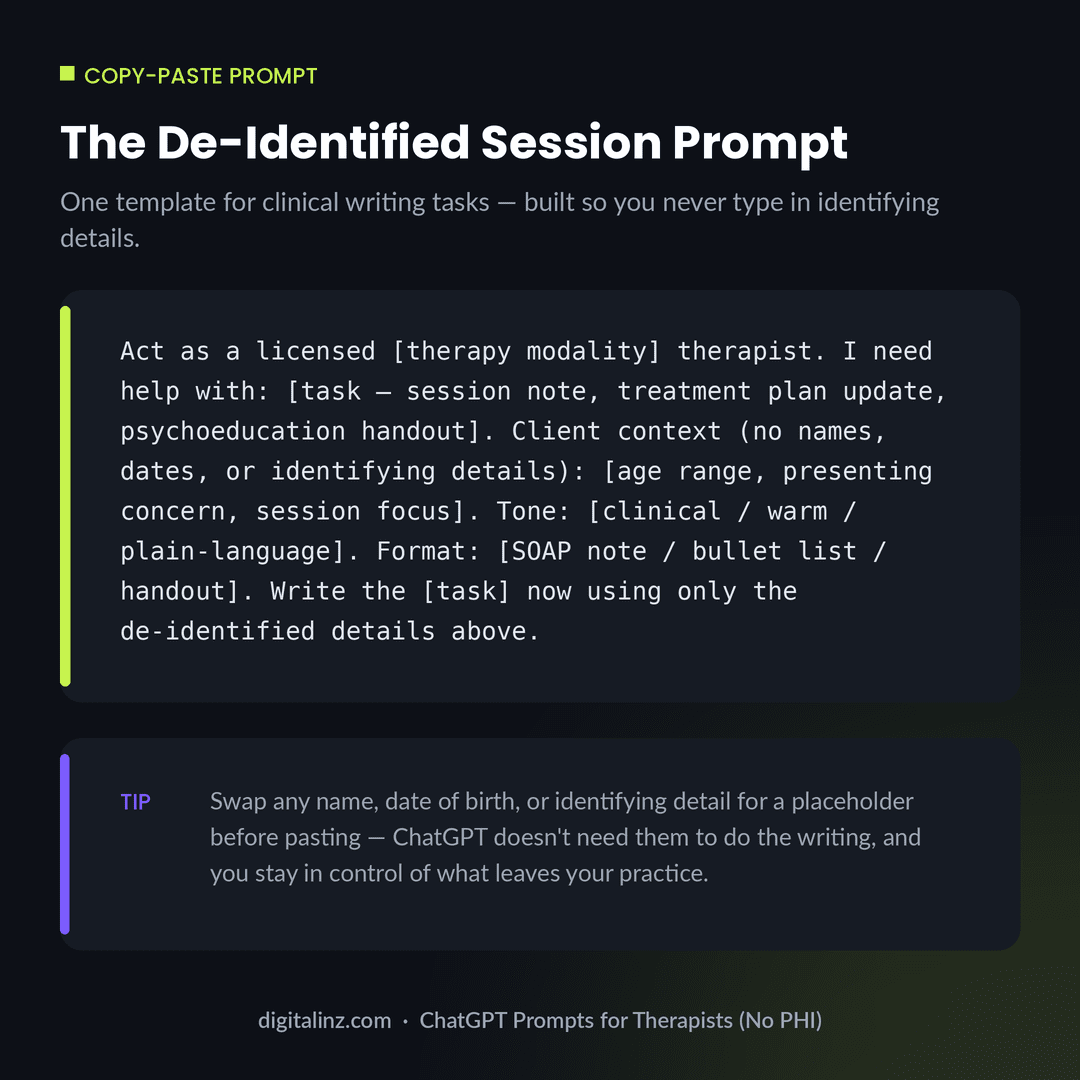
If you only save one of these, save this one. It’s a master template for any clinical writing task — just swap the de-identified fields:
Act as a licensed [therapy modality] therapist. I need help with:
[task — session note, treatment plan update, psychoeducation
handout]. Client context (no names, dates, or identifying
details): [age range, presenting concern, session focus]. Tone:
[clinical / warm / plain-language]. Format: [SOAP note / bullet
list / handout]. Write the [task] now using only the de-identified
details above.
Save it as a custom instruction so the “no PHI” structure is built into every prompt by default — not something you have to remember each time.
Identifiable vs. De-Identified: See the Difference
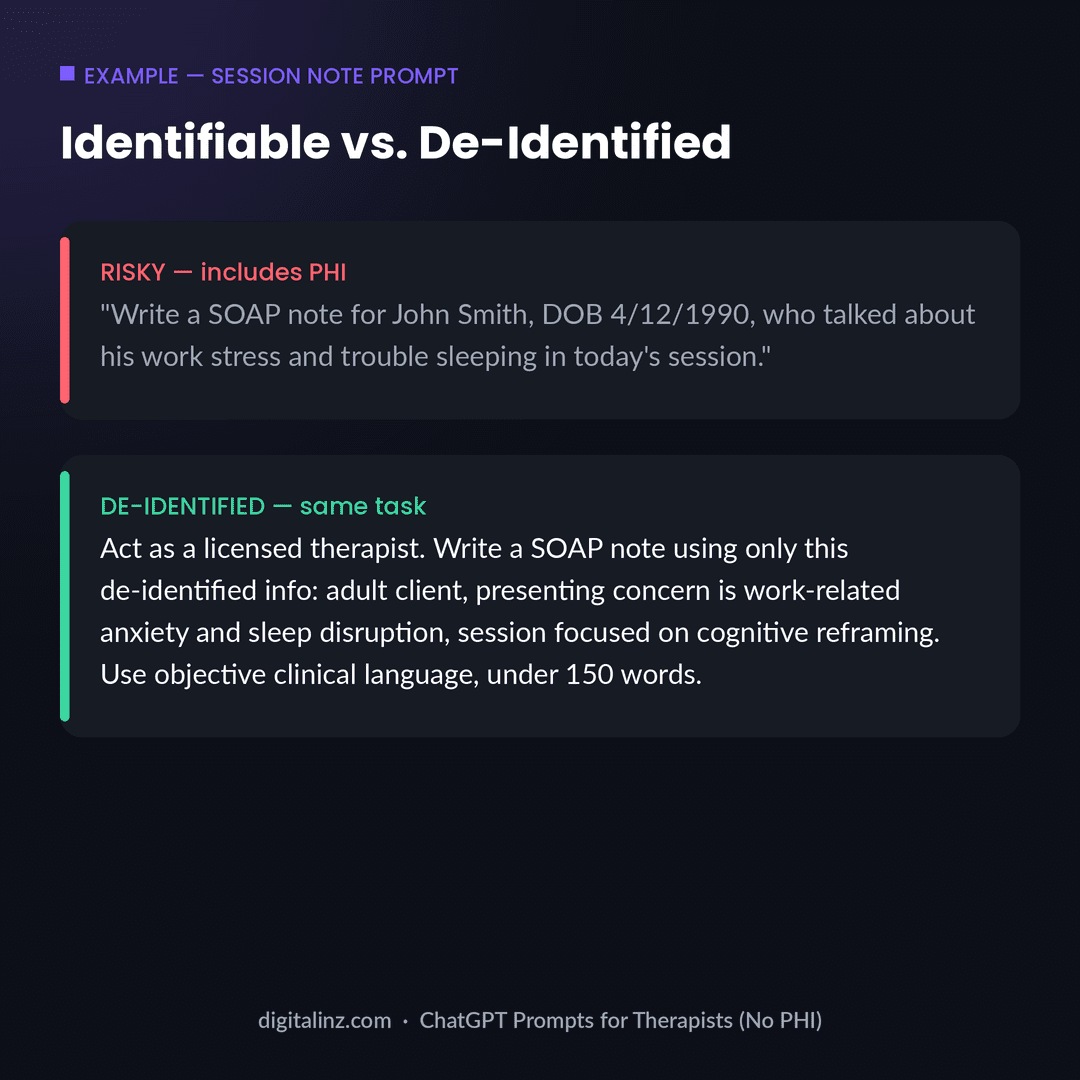
The two prompts above produce nearly identical clinical writing — the only real difference is whether a client’s name and date of birth ever left your practice. That’s the core idea behind every ChatGPT prompt for therapists without PHI: describe the clinical picture, not the person. If you’re looking for a wider set of prompts beyond documentation — for case notes, client communication, and more — see our broader guide on ChatGPT prompts for therapists.
FAQ
What are the best ChatGPT prompts for therapists that protect client privacy?
The best prompts describe the clinical picture — age range, presenting concern, session focus, interventions — without including names, dates of birth, addresses, or other identifying details. The 15 prompts above are written this way for documentation, psychoeducation, communications, supervision, and practice admin.
Is it safe or HIPAA-compliant to use ChatGPT for therapy notes?
Most consumer versions of ChatGPT are not configured as HIPAA business associates, so the safest approach is to never enter identifiable client information at all. Reviewing the HIPAA Privacy Rule and using de-identified prompts like the ones above keeps you on the safer side regardless of which tool you use.
Can ChatGPT actually write a usable SOAP note?
Yes, when given a clear, de-identified description of the session — presenting concern, interventions used, and plan — ChatGPT can produce a solid first draft in the SOAP format. You should always review it for clinical accuracy and add any details only you would know before it goes in a record.
How do I keep client information out of my ChatGPT prompts?
Replace names with “the client,” replace ages with ranges, and describe situations by concern and context rather than specific identifying events. The De-Identified Session Prompt above is structured to make this the default rather than something you have to remember each time.
To see the de-identification rule applied end to end on a real note, read can ChatGPT write SOAP notes. For the underlying format, including worked examples of each section, see SOAP notes for therapists.
The Shortcut
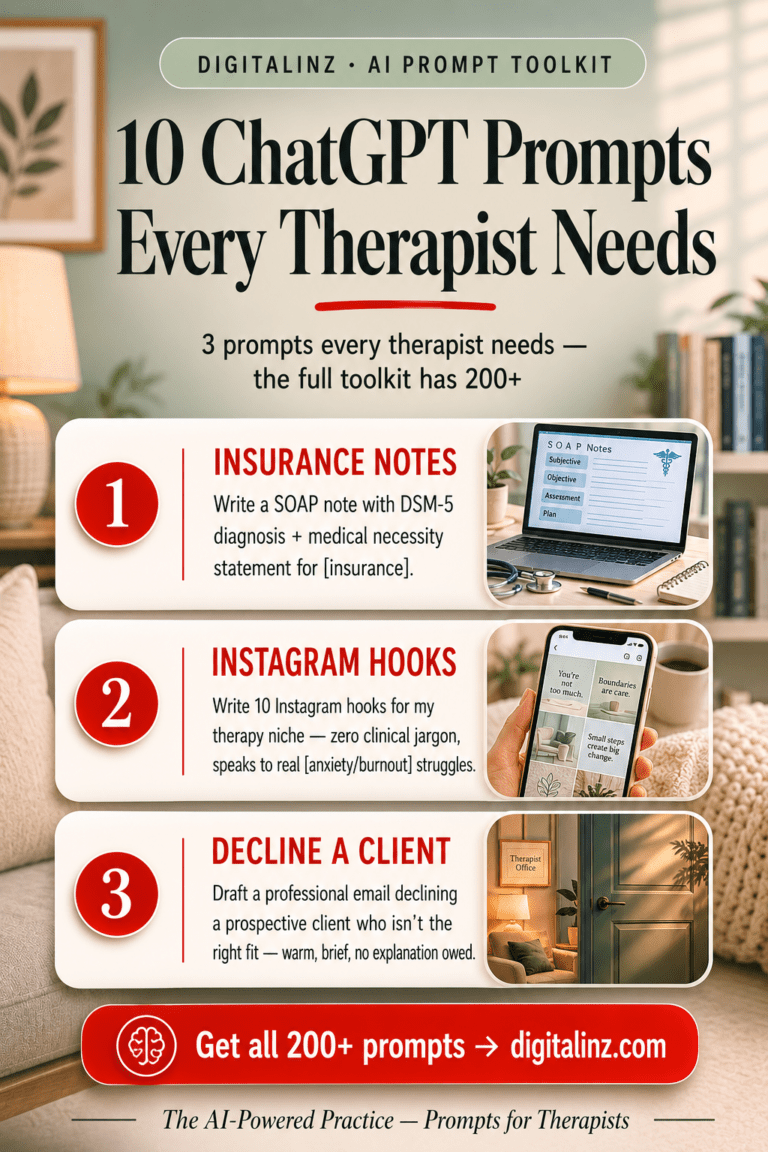
Building de-identified prompts from scratch for every clinical writing task adds up fast. Our AI-Powered Practice Toolkit includes 200+ ready-to-use prompts for session documentation, psychoeducation, treatment planning, and practice communications — all written with privacy in mind from the start. If you’ve seen other “prompt pack” claims, run them through our 5-point prompt pack test first, or see how ours compares in our therapist prompt pack comparison. Also available on Gumroad.