
Free Progress Note Templates for Private Practice (SOAP, DAP & BIRP)
Blank templates are useful. Templates that tell you what to write in each section are
more useful. This pack has both, it’s free, and there’s no email wall in front
of it.
What’s in the packs
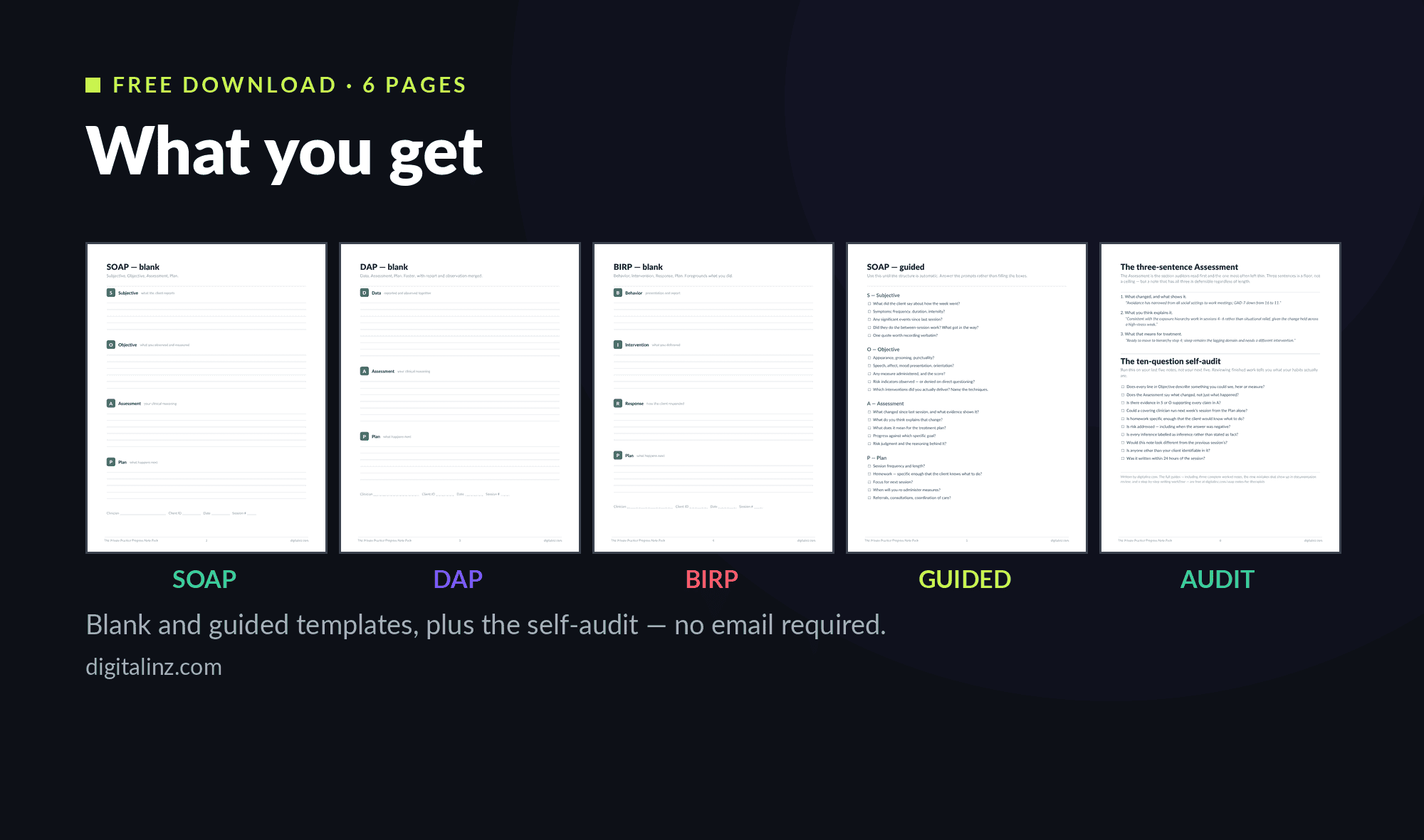
- Blank SOAP, DAP and BIRP templates — one page each, with ruled
writing space sized for handwriting and a footer line for clinician, client ID, date and
session number. - A guided SOAP template — the same four sections, but each one
is a short list of questions to answer. Use it until the structure is automatic. - The three-sentence Assessment — a formula for the section that
takes longest and gets left thinnest. - A ten-question self-audit — run it over notes you have already
written, which is the only version of this exercise that tells you anything true about your
habits.
Six pages, US Letter, designed to print on a home printer without anything falling off
the edge.
If you would rather see completed notes before you start filling one in, ten worked SOAP note examples are written out in full.
Which template should you use?
If your agency or EHR mandates a format, that decision is made. Otherwise, the short
version:
- SOAP if your notes are read by people outside your discipline, or if
defensibility matters most. Separating what the client said from what you observed is the
distinction that holds up best under review. - DAP if you are writing high volume and that separation isn’t
worth the extra decision per note. - BIRP if you need to demonstrate what you did and how the client
responded — case management, substance use treatment, or anywhere medical necessity
gets questioned.
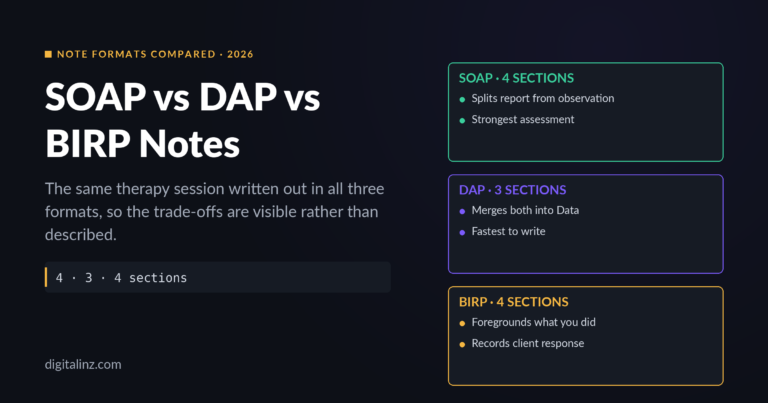
The long version, with the same session written out in all three formats so you can see
what each one gains and loses, is in SOAP vs DAP vs BIRP notes.
How to use the guided template
The guided page is a set of questions rather than a form. Answer them in prose —
you are writing a clinical record, not filling in a survey. Two things make it work
better:
Don’t answer them in order. Start with the Objective questions.
They’re concrete, require no interpretation, and getting them down reloads the session
into working memory before you have to make any judgment calls. The
step-by-step workflow covers the full sequence.
Have the treatment plan open. Almost every case of staring at a blank
Assessment section comes down to the same thing — you are trying to describe progress
without a reference point in front of you.
S — Subjective. Client reported a “flat” two weeks with reduced interest in running and time with family. Reported waking around 4am most days. Described appetite as “I eat because I know I should.” Completed two of seven activity-schedule entries and said the mornings were “the hardest part to get through.”
O — Objective. Arrived ten minutes late, second consecutive late arrival. Grooming decreased from intake. Speech slowed, decreased volume. Affect restricted. Oriented ×4. PHQ-9: 17. Denied suicidal ideation on direct questioning. Interventions delivered: reviewed activity schedule, problem-solved the morning barrier, introduced behavioral activation pairing with an existing morning routine.
A — Assessment. Anhedonia and morning inertia remain the primary maintaining factors, and adherence at two of seven reflects the severity of morning symptoms rather than disengagement — client completed entries reliably on the two days they had an external commitment. That pattern supports pairing activation with existing structure rather than increasing the homework volume. PHQ-9 unchanged from intake; observable presentation slightly worse. No risk indicators beyond low mood.
P — Plan. Continue weekly 50-minute sessions. Homework: two activity entries daily, each attached to an existing fixed commitment. Next session: review adherence pattern, assess whether structure or motivation is the constraint. Re-administer PHQ-9 at session 6. If no change by session 6, discuss PCP referral for medication consultation.
record and needs to be stored to the same standard as anything in your EHR — locked,
and retained for whatever period your state requires. If you use these as a drafting step
before typing into an EHR, shred the paper copy afterwards rather than leaving it in a bag
or a car.
|
Want the next ones? Both packs are above, free. Leave your email and I’ll tell you when new templates and guides go up — nothing else, and you can unsubscribe in one click. |
If your notes are the thing eating your evenings
Templates fix structure. They don’t fix volume, and they don’t fix the two
habits that cause the most trouble in documentation review — a thin Assessment and
copy-forward. Those are worth reading about separately: the
complete guide to SOAP notes for therapists covers the format with three
worked examples, and common SOAP note mistakes covers what a reviewer
concludes when each one shows up.
Frequently asked questions
Are these templates HIPAA compliant?
A template can’t be compliant or non-compliant on its own — compliance
depends on how completed records are stored, transmitted and disclosed. A completed note is
a clinical record and needs to be handled as one.
Can I use these in my agency or group practice?
Check first. Many agencies mandate a specific format and their own forms, usually built
into the EHR. These are aimed at private practice, where you generally choose.
Can I edit them or add my logo?
The PDF is flat, so it isn’t editable. Use it as-is for personal clinical use.
It’s free for that — just don’t redistribute or resell it.
Do you have intake or treatment plan templates?
Yes — intake, treatment plan and discharge summary templates are in the second pack above, blank and guided, along with a page on how the four documents connect.
Why is this free?
Because a template pack is a poor thing to sell and a good thing to be known for. The
paid product is a prompt library for clinicians using AI in their documentation and practice
admin, which is a different problem.
This article is general professional information for licensed clinicians and students, not legal, clinical or compliance advice. Documentation requirements vary by state, licensing board, payer and setting. Any example notes are composites written for illustration and do not describe real clients.