SOAP Notes for Therapists: Format, Examples and Common Mistakes
Most therapists learned the SOAP format in about forty minutes of a graduate class, then
spent the years afterwards quietly inventing their own version of it. That works until an
audit, a subpoena, or a payer request arrives — and the notes that felt thorough at
7pm on a Thursday turn out not to demonstrate what you actually did.
This guide covers SOAP notes for therapists as the format is really used
in mental health: what belongs in each section, three complete worked notes you can model,
and the nine mistakes that show up most often when documentation gets reviewed.
|
Free · no email required Printable progress note templates Want the format as something you can print and write on? Two free packs — blank and guided SOAP, DAP and BIRP progress notes, plus intake, treatment plan and discharge summary templates. |
What a SOAP note is, and why the order matters
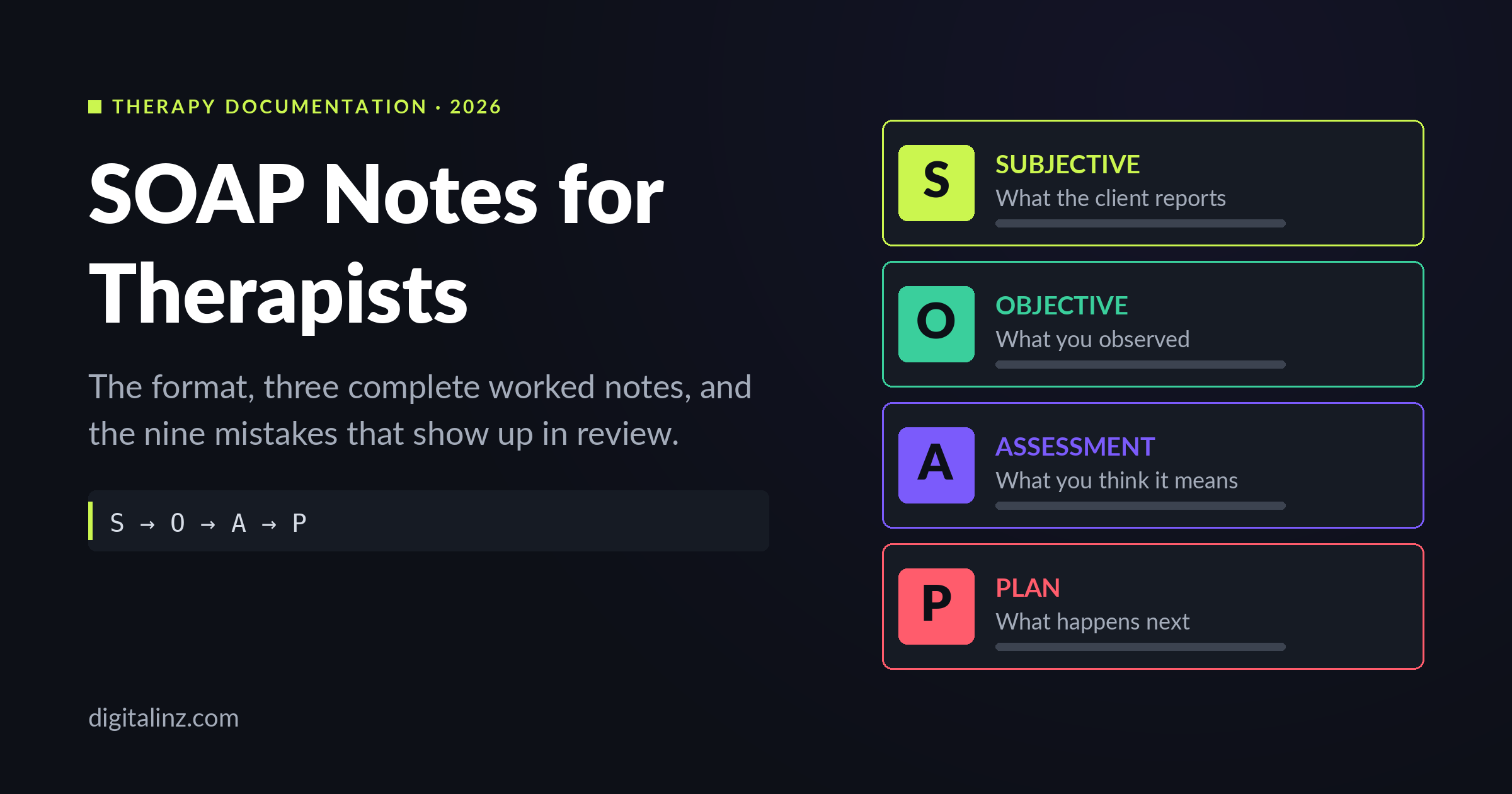
SOAP — Subjective, Objective, Assessment, Plan — was developed by Dr. Larry
Weed around fifty years ago as part of the problem-oriented medical record. It spread across
healthcare because it does two jobs at once: it structures the record, and it structures the
clinician’s reasoning. As
the
StatPearls reference on SOAP notes puts it, the format works as a cognitive framework for
clinical reasoning, not merely a filing system.
The sequence is the point. What the client tells you informs what you observe; together
those produce your clinical judgment; your judgment produces the plan. A note where the Plan
doesn’t follow from the Assessment is a note where something has gone wrong in the
thinking, not just the writing.
One caveat before the detail: the original format was built around vital signs, lab values
and physical examination. Yours has to work for a fifty-minute conversation where the
“objective” data is what you observed rather than what you measured. That
translation is where most SOAP problems in mental health begin.
The four sections, translated for mental health
S — Subjective
What the client reports: their account, their experience, their words.
Include the presenting concern for this session, symptom report with frequency, duration
and intensity, relevant events since the last session, engagement with between-session work,
and direct quotes where the exact language carries clinical weight.
A useful discipline: if you could not have known it without the client telling you, it
belongs in Subjective.
Use quotes sparingly and on purpose. One or two per note that do real work. “I’ve
stopped answering my sister’s calls” earns its place. Transcribing the hour does
not.
O — Objective
What you observed and what you measured.
Include appearance and grooming, behavior, speech, affect, orientation, psychomotor
activity, attention, insight and judgment, any observed risk indicators, scores from
administered measures such as the PHQ-9, GAD-7 or PCL-5, attendance and punctuality, and
— critically — the interventions you actually delivered.
That last item is where a lot of notes go quiet, and it is precisely the part that
demonstrates skilled care rather than supportive conversation.
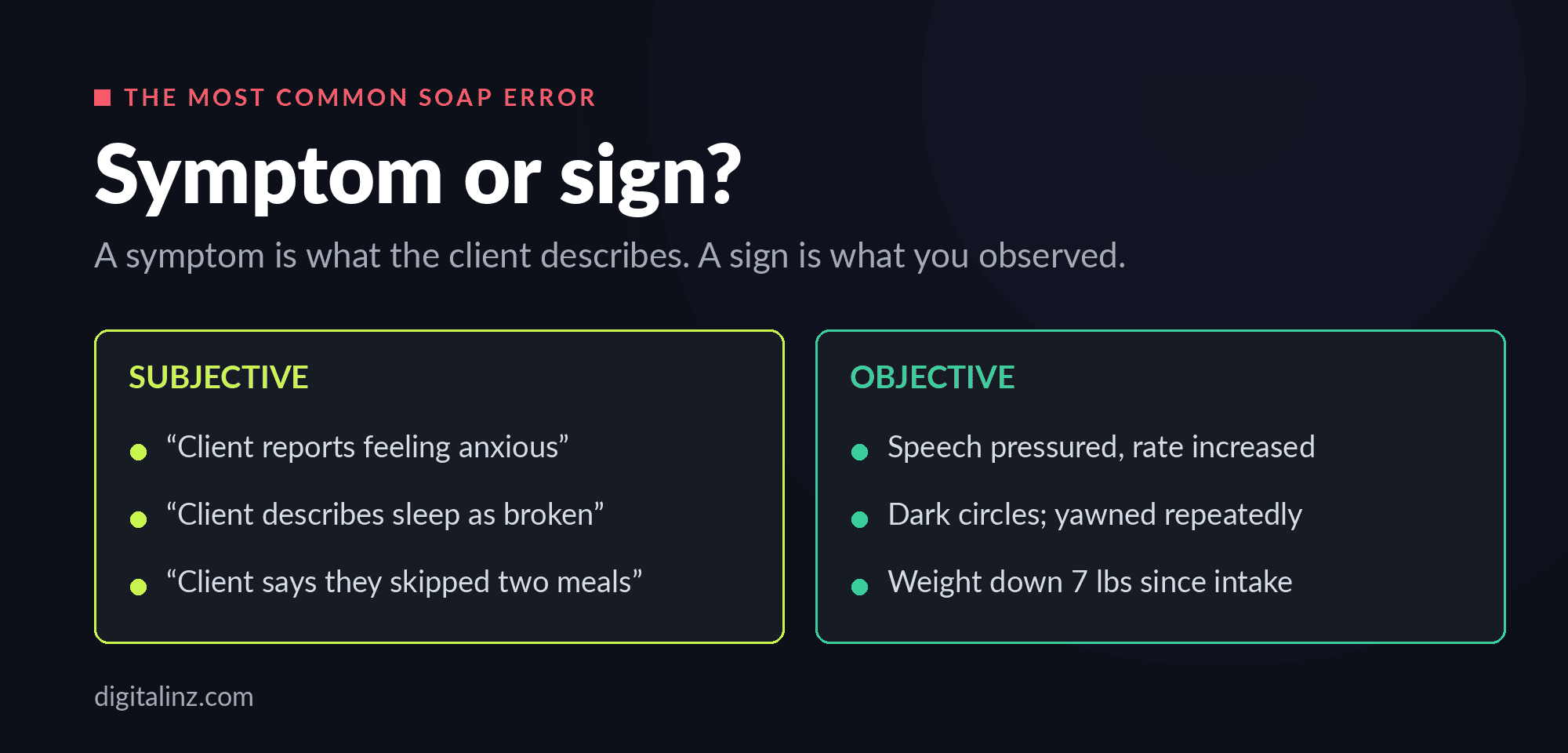
the Objective section. A symptom is the client’s subjective description; a sign is
something you observed. “Client reports feeling anxious” is Subjective.
“Client’s speech was pressured and their leg moved continuously throughout”
is Objective. When a line is ambiguous, ask whether a competent observer in the room could
have seen or heard it, and whether two clinicians would describe it the same way.
A — Assessment
Your clinical thinking: the synthesis of everything above.
Include your interpretation of the session, progress against treatment plan goals, response
to intervention, diagnostic impression and any change to it, risk assessment with your
reasoning, working hypotheses, and the basis for continued care.
This is the section that separates a defensible note from a log, and it is the one most
often left thin. “Client is improving” is not an assessment. “Client’s
reported avoidance has narrowed from all social settings to work meetings specifically,
consistent with the exposure hierarchy in sessions 4–6; GAD-7 down from 16 to 11”
is.
P — Plan
What happens next, specifically enough to be actionable.
Include the focus of the next session, between-session tasks with detail, frequency and
expected duration of treatment, referrals and consultations, coordination of care, risk
management steps, and any change to the treatment plan.
The standard to hold yourself to: could a covering clinician pick up this case from
the Plan alone?
|
If you are newer to the format and want the plain-English version first, start with what are SOAP notes in counseling, which also covers why a SOAP note is a progress note rather than a psychotherapy note.
Three notes are enough to show the pattern. If you want a wider set, ten complete SOAP note examples covers intake, plateau, crisis, grief and termination as well as the presentations below.
Three complete SOAP notes
These are composites written for illustration, not real clients. Model the structure and
the level of specificity — not the content.
S — Subjective. Client reported a “much better” week overall, describing two work meetings attended without leaving early — the first since March. Reported continued difficulty with sleep onset (estimated 45–60 minutes, four nights this week) and described Sunday evenings as “the worst part of the week.” Completed thought records on five of seven days. Stated: “I noticed I was catastrophizing and I actually caught it that time.” Denied panic attacks this week; previously reported two to three weekly.
O — Objective. Arrived on time, appropriately groomed. Speech normal in rate and volume, a change from the pressured presentation in sessions 1–4. Affect congruent and brighter than prior sessions. Oriented ×4. Psychomotor activity within normal limits; the continuous leg movement noted in earlier sessions was absent. GAD-7 administered: 9 (intake 16, session 4 13). Denied suicidal and homicidal ideation on direct questioning. Interventions delivered: reviewed thought records, in-session cognitive restructuring targeting Sunday anticipatory anxiety, introduced stimulus control for sleep onset.
A — Assessment. Client is responding to CBT for generalized anxiety. GAD-7 movement of 16 → 13 → 9 across seven sessions is corroborated by behavioral change — meeting attendance — rather than self-report alone, which supports genuine symptom reduction rather than social desirability. Client is now applying cognitive restructuring independently between sessions, which was Goal 1 of the treatment plan. Sleep onset is the least improved domain and appears maintained by anticipatory worry rather than sleep hygiene, hence the shift to stimulus control this session. The concentration of anticipatory anxiety on Sunday evenings suggests a work-specific rather than generalized trigger, which is worth testing directly. No risk indicators present. Continued weekly treatment is medically necessary to consolidate gains and address the remaining sleep domain.
P — Plan. Continue weekly 50-minute individual CBT. Homework: stimulus control protocol nightly; thought record on Sunday evenings specifically. Next session: review sleep data and begin behavioral experiment at step 4 of the work-meeting hierarchy. Re-administer GAD-7 at session 10. If sleep onset has not improved by session 10, discuss referral to PCP for medication consultation. Anticipate approximately six further sessions to planned termination.
S — Subjective. Client described the past two weeks as “flat,” reporting anhedonia across previously valued activities including running and time with their nephew. Reported waking at approximately 4am most days and being unable to return to sleep. Described appetite as “I eat because I know I should.” When asked directly about thoughts of death, client stated: “Sometimes I think it would be easier if I just didn’t wake up. But I wouldn’t do anything.” Denied intent, plan, and access to means. Reported no history of attempts. Identified their sister and their dog as reasons for living. Reported that the loss of their job six weeks ago was the point at which things “tipped.”
O — Objective. Arrived ten minutes late, the second consecutive late arrival. Grooming notably decreased compared with intake. Speech slowed with decreased volume. Affect restricted; mood depressed by both report and observation. Psychomotor retardation present. Oriented ×4. Attention adequate but effortful, requiring question repetition twice. PHQ-9 administered: 19 (intake 17), with item 9 endorsed at 1 (“several days”). Columbia protocol screen completed: positive for passive ideation; negative for active ideation, plan, intent, and preparatory behavior. Interventions delivered: behavioral activation psychoeducation, activity scheduling, collaborative safety planning. Crisis line and 988 entered into client’s phone during session.
A — Assessment. Presentation is consistent with major depressive disorder, moderate to severe, single episode, with onset temporally linked to job loss six weeks ago. PHQ-9 has increased modestly and observable presentation has deteriorated across grooming, psychomotor activity, and punctuality, so I am not attributing the change to reporting variance. Passive ideation is present without active ideation, plan, intent, means, or attempt history, and protective factors are specific and client-generated. I assess current risk as low to moderate and manageable in outpatient care with a safety plan in place, on the condition of active monitoring rather than assumption. Anhedonia and behavioral withdrawal are the primary maintaining factors and the appropriate first intervention target. Client’s lateness reads as symptom rather than ambivalence, given engagement within session. Medication evaluation is indicated given severity and the absence of early response.
P — Plan. Increase to twice-weekly sessions for three weeks, then reassess. Homework: activity schedule with two pleasant-activity entries daily; sleep and wake log. Copy of safety plan provided to client; client agreed to contact 988 or present to the emergency department if ideation becomes active. Re-administer PHQ-9 and risk screen each session while item 9 remains endorsed. Referral to psychiatry for medication evaluation; release signed in session, referral to be sent this week. Coordinate with PCP under the signed release. If PHQ-9 has not decreased by session 8, or if risk escalates, reassess level of care.
S — Subjective. Both partners attended. Partner A reported the week as “the first one without a blow-up in a while” and identified the time-out agreement as helpful. Partner B agreed that conflict frequency had decreased but reported feeling that “nothing actually gets resolved, we just stop talking about it.” Both reported using the time-out protocol twice during the week. Partner A reported ongoing work-related stress. Partner B reported difficulty sleeping on nights following conflict.
O — Objective. Both partners arrived on time. Interaction pattern observed: Partner B initiated topics; Partner A responded briefly and became increasingly still as discussion of the unresolved argument continued, consistent with the pursue–withdraw pattern identified in session 2. Voices remained at conversational volume throughout, in contrast to sessions 1 and 2, and no escalation occurred in session. Partner B teared up while describing feeling unheard; Partner A offered tissues unprompted. Interventions delivered: reviewed time-out protocol adherence, structured speaker–listener exercise on the unresolved topic, psychoeducation on the pursue–withdraw cycle.
A — Assessment. The couple is meeting the first treatment goal, reduction in conflict escalation, evidenced by both partner report and direct in-session observation. Partner B’s concern about non-resolution is clinically accurate rather than a complaint to be reframed: the time-out protocol was designed to interrupt escalation, not to produce resolution, and the couple has reached the point where the second half of that skill set is required. Partner A’s withdrawal appears to function as affect regulation rather than disengagement, evidenced by the spontaneous repair attempt in session. An attachment framing is likely to be more productive than a communication-skills framing from this point. Progress is consistent with the treatment plan; no change in session frequency indicated.
P — Plan. Continue weekly 60-minute couples sessions. Homework: one structured 20-minute speaker–listener conversation on a low-stakes topic, completed by both partners. Next session: introduce the re-entry protocol for returning to a topic after a time-out. Provide pursue–withdraw psychoeducation handout. Reassess treatment goals at session 8.
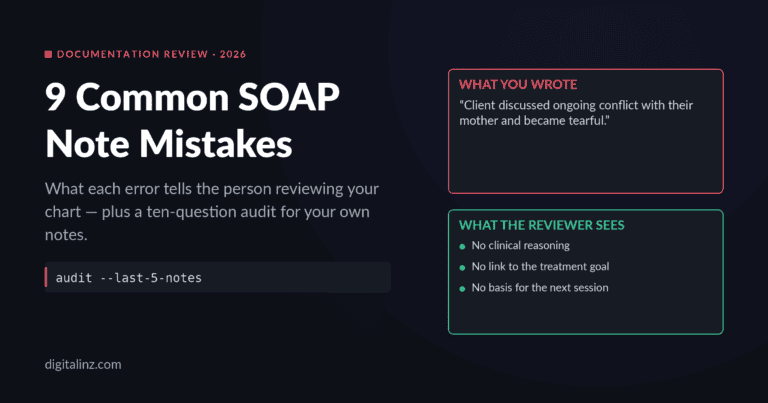
Nine SOAP note mistakes that show up in review
Each of these is covered in more depth — including what the person reviewing your chart concludes when they see it, plus a ten-question self-audit — in our guide to common SOAP note mistakes.
1. Putting symptoms in the Objective section
Instead of: “Client is anxious and worried about work.”
Write: “Client’s speech was rapid; client shifted position repeatedly and broke eye contact when work was raised.”
This is the most common error in the format, and StatPearls names it directly: a symptom is what the client describes, a sign is what you observe. “Client reports feeling anxious” is Subjective. What you saw goes in Objective. Two tests for any line — could a competent observer in the room have seen or heard it, and would two clinicians describe it the same way?
2. An Assessment that only restates the session
Instead of: “Client discussed conflict with their partner and reported feeling frustrated.”
Write: “The conflict pattern client described mirrors the one identified with their mother in session 2, supporting the working hypothesis that this is a schema-level rather than situational issue; this reframes the treatment target.”
Assessment is the section auditors read first and the section most often left thin. Anyone can record what happened. The Assessment is where you explain what it means, and it is the only place your clinical reasoning is visible.
3. “Continue treatment” as a Plan
Instead of: “Continue weekly sessions. Homework as discussed.”
Write: “Continue weekly 50-minute individual sessions. Homework: daily thought record targeting morning rumination. Next session: exposure hierarchy step 3. Re-administer PHQ-9 at session 8.”
A useful standard: could a covering clinician pick up this case from your Plan alone? “Homework as discussed” fails that test, and it is one of the first things a payer flags when assessing whether care was skilled.
4. Copy-forward
Instead of: “Last week’s note with the date changed and one sentence edited.”
Write: “A fresh Objective and Assessment each session, even when the content is similar.”
Copy-forward is fast and it is the single most damaging habit in documentation. It produces records where a client’s deterioration is invisible because every note says the same thing, and it is immediately obvious to anyone reviewing the chart. If two consecutive notes are identical, at least one of them is wrong.
5. Transcribing the session
Instead of: “A 900-word narrative of everything the client said, in order.”
Write: “The clinically relevant content, with one or two quotes that carry weight.”
Longer is not safer. An over-long note buries the information a reader needs, and in a subpoena it hands over far more of the client’s private material than was required. Include what is clinically necessary and defensible.
6. Documenting third parties by name
Instead of: “Client’s sister Maria has bipolar disorder and stopped her lithium in June.”
Write: “Client reported that a family member’s psychiatric instability is a current stressor.”
In individual work, the record belongs to your client. Detailed clinical information about people who are not your client sits awkwardly in their chart and may be disclosed with it. In couples and family work this is sharper still — know how your jurisdiction and your practice handle records where two people are both clients, because release requests get complicated fast.
7. Speculation written as fact
Instead of: “Client is in denial about their drinking.”
Write: “Client’s reported consumption (estimated 4–5 units nightly) is inconsistent with their description of it as “not really a problem.” Ambivalence is likely; motivational interviewing indicated.”
Inference belongs in the Assessment and should be labelled as inference. State what you observed, then state what you think it means and why. A conclusion asserted without its reasoning is the hardest kind of note to defend later.
8. Silence on risk
Instead of: “No mention of risk, because the client didn’t raise it.”
Write: “Denied suicidal and homicidal ideation on direct questioning.”
Document the negative. A note that says nothing about risk is indistinguishable from a note where risk was never assessed. If you asked and the answer was no, that is a clinical finding and it belongs in the record — particularly for any client with a depressive presentation.
9. Writing notes days later
Instead of: “Six notes written on Sunday for the week just gone.”
Write: “Notes completed within 24 hours, ideally in the ten minutes after the session.”
And if you are weighing SOAP against the alternatives, SOAP vs DAP vs BIRP notes writes the same session out in all three formats.
Memory for session detail degrades quickly and predictably. Beyond accuracy, many payers and state boards set timeliness expectations, and a batch of notes all created on the same timestamp is visible in any modern EHR audit log.
How long a SOAP note should take
The rest of this section is the summary; the full routine — what to do before the session, what to capture during it, and why you should not write in S-O-A-P order — is in our step-by-step guide to writing SOAP notes for counseling.
Six to ten minutes is a realistic target for a routine session once the format is habitual.
If yours reliably take twenty-five, the bottleneck is almost always the Assessment —
clinicians tend to rebuild their reasoning from scratch each time rather than writing from the
treatment plan they already have.
Two things help more than anything else. Write immediately after the session, while the
detail is still available at no cognitive cost. And keep the treatment plan goals visible while
you write the Assessment, so progress is described against something rather than in the
abstract. If notes are the thing eating your evenings, we go deeper on this in
how to write therapy notes
faster.
If you would rather work on paper, our free progress note templates include blank and guided SOAP pages built around exactly the structure above.
Where AI fits, and where it doesn’t
AI drafts SOAP notes well, on one condition: it never receives identifiable client
information. The workflow that works is to write a short de-identified summary of the session
yourself — no name, no date of birth, no location, no employer, no anything from the
eighteen HIPAA identifiers — and have the model structure that into SOAP format. You
then review, correct and sign it. The clinical judgment stays yours, because it has to.
What AI is genuinely good at is the Objective and Plan sections, where the work is
structural. What it is bad at is the Assessment, which requires knowing the case. A model will
produce a confident, fluent, entirely generic assessment if you let it, and that is worse than
a short one you wrote yourself.
Two related pieces if you’re going down this route:
can ChatGPT write SOAP
notes covers the five rules and includes a copy-paste prompt, and
is ChatGPT HIPAA compliant
answers the compliance question properly. Whether you are permitted to at all is a separate question from whether it is compliant — is it okay to use ChatGPT for therapy notes covers consent and what your ethics code requires. For other note formats, see our
SOAP, DAP and BIRP
templates.
Frequently asked questions
What is the difference between a SOAP note and a DAP note?
DAP collapses Subjective and Objective into a single Data section, giving you Data,
Assessment, Plan. It is faster to write and popular in community mental health. SOAP’s
advantage is that separating what the client said from what you observed forces a distinction
that matters clinically and holds up better under review. Many clinicians use DAP for routine
sessions and SOAP where the record needs to be more defensible.
How long should a SOAP note be?
Long enough to justify the clinical decisions, short enough that a reader finds what they
need. For a routine outpatient session that is usually 150–300 words. Length is not
protection — a long note that omits your reasoning is weaker than a short one that
includes it.
Do insurance companies require SOAP notes specifically?
Generally no. Most payers require that documentation supports medical necessity and
demonstrates skilled care; they rarely mandate a particular acronym. SOAP is popular because it
happens to produce those elements reliably. Requirements vary by payer, state and licensing
board, so check yours rather than relying on a general guide.
Should I write SOAP notes during the session or after?
After, in almost all cases. Writing during the session costs you the observational data that
fills the Objective section, and clients notice. The exception is jotting a measure score or a
direct quote you want verbatim.
What do I do about a mistake in a signed note?
Never delete or overwrite. Add an addendum that states the correction, the reason, and the
date. Every EHR keeps an audit trail, so an altered note looks far worse than an openly
corrected one. Your board or agency will have a specific procedure — follow it.
This article is general professional
information for licensed clinicians, not legal, clinical or compliance advice. Documentation
requirements vary by state, licensing board, payer and setting. The example notes are
composites written for illustration and do not describe real clients.